Titanic Survivor Interviews: What It Was Like to Flee the Sinking Luxury Liner
Millvinia Dean, the last surviving passenger of the RMS Titanic, died in 2009. She’d lived a full life of 97 years, but that meant that she’d been only two months old when the famously luxurious and innovative ship hit the iceberg that sent it to the bottom of the Atlantic in the middle of its maiden voyage. Despite being humanity’s last direct link to the Titanic, she would have retained no memory of the ship or its sinking. That’s very much not the case with the survivors interviewed in the 1970 British Pathé documentary footage above. One of them, Edith Russell, remembers the Titanic as having been “so very formal.” The “coziness” of other ocean liners, the “get-together feeling — it didn’t exist.”
A celebrity stylist and Paris correspondent for Women’s Wear Daily, Russell was traveling first-class: one stateroom for her, and another for her luggage. Not so Gurshon Cohen, who’d been “sleeping six in a bunk” down below. Unlike many of the Titanic’s third-class passengers, prohibited as they were from entering the upper decks, Cohen managed to find a place on a lifeboat (after jumping ship first).
Whatever the differences in their situations, Russell and Cohen had congruent memories of the disaster, especially as regards the popular notion that the ship’s band continued performing until the bitter end. As Russell puts it, “when people say that music played as the ship went down, that is a ghastly, horrible lie.”
Eva Hart, interviewed in 1993, does recall hearing music — specifically, a rendition of “Near My God to Thee” — right up until her escape. The vivid images she retained from the lifeboat also included the ship’s breaking in half, an event widely denied until it was proven decades thereafter. You can hear more stories of how the Titanic really went down, as it were, from the 1956 and 1970 BBC interviews with Kate Gilnagh Manning, Maude Louise Slocombe, and Frank Prentice (the latter two of whom were working on the ship) just above. They all remember the incongruously “slight bump” of the impact, the “dead calm” of the sea, the perilous sight of lifeboats dangling 70 feet above the water — and the feeling of impossibility that the “unsinkable” Titanic could really have met its end.
Related content:
Watch the Titanic Sink in Real Time in a New 2‑Hour, 40 Minute Animation
The Titanic: Rare Footage of the Ship Before Disaster Strikes
How the Titanic Sank: James Cameron’s New CGI Animation
Real Interviews with People Who Lived in the 1800s
Watch 85,000 Historic Newsreel Films from British Pathé Free Online (1910–2008)
Based in Seoul, Colin Marshall writes and broadcasts on cities, language, and culture. His projects include the Substack newsletter Books on Cities, the book The Stateless City: a Walk through 21st-Century Los Angeles and the video series The City in Cinema. Follow him on Twitter at @colinmarshall, on Facebook, or on Instagram.
Read More...Why You Should Read The Handmaid’s Tale: A Timely Animated Introduction
Prophecies are really about now. In science fiction it’s always about now. What else could it be about? There is no future. There are many possibilities, but we do not know which one we are going to have.
There is no need to explain why Margaret Atwood’s The Handmaid’s Tale has gone from reading like a warning of the near-future to an allegory of the present after the U.S. Supreme Court’s ruling in Dobbs v. Jackson Women’s Health Organization. Atwood’s story revolves around the fictional Republic of Gilead, which takes over the U.S. after a fertility crisis decimates the population. Overnight, the fundamentalist Christian theocracy divides women into two broad classes – Handmaids: chattel who perform the labor of forced birth through forced conception; and the infertile who prop up the patriarchal ruling class as wives, overseers, or slave labor in the polluted “colonies.”
It’s a bleak tale, a story far less about heroism than the TV series based on the book would have viewers–who haven’t read it–believe. (The 5th season, slated for this July, seems to have been delayed until September without explanation.) Why should we read The Handmaid’s Tale? Because it is not only a work of dystopian futurism, but also a narrativized account of what has already happened to women around the world throughout history to the present. The novel is a prism through which to view the ways women have been oppressed through reproductive slavery without the sci-fi scenario of a precipitous loss of human fertility.
As Atwood has explained, “when I wrote The Handmaid’s Tale, nothing went into it that had not happened in real life somewhere at some time.” Some of the worst offenses were not well-known. “Female genital mutilation was taking place,” says Atwood, “but if I had put it in 1985 [when the novel was written] probably people wouldn’t have known what I was talking about. They do now.” But we can still choose to overlook the information. “Ignoring isn’t the same as ignorance,” Atwood says in the novel, “you have to work at it.” The quote opens the 2018 TED-Ed lesson by Naomi Mercer above on Atwood’s book, walking us through its sources in history.
The Handmaid’s Tale, the lesson points out, is an example of “Speculative Fiction,” a form of writing concerned with “possible futures.” This theme unites both utopian and dystopian novels. Atwood’s books trade in the latter, but any reader of the genre will tell you how quickly a more perfect fictional union becomes a nightmare. The Canadian writer has offered this literary inevitability as an explanation for the multiple crises of American democracy:
The real reason people expect so much of America in modern times is that it set out to be a utopia. That didn’t last very long. Nathaniel Hawthorne nailed it when he said the first thing they did when they got to America was build a scaffold and a prison.
What Atwood doesn’t mention, as many critics have pointed out, are the slave pens and auction houses, or the fact that Gilead closely resembles the slave-holding American South in its theocratic patriarchal Christian hierarchy and ultimate control of women’s bodies. And yet, the novel completely sidesteps race by having the Republic of Gilead ship all of the country’s Black people to the Midwest (presumably for forced labor). They are never heard from again by the reader.
This tactic has seemed irresponsible to many critics, as has the show’s sidestepping through colorblind casting, and the wearing of red cloaks and white bonnets in imitation of the book and show as a means of protest. “When we rely too heavily on ‘The Handmaid’s Tale,’ which ignores the presence of race and racism,” says activist Alicia Sanchez Gill, “it really dehumanizes and dismisses our collective experiences of reproductive trauma.” Atwood’s “possible future” pillages slavery’s past and conveniently gets rid of its descendants.
The trauma Gill references includes rape and forced birth, as well as the forced sterilizations of the eugenics movement, carried out with the imprimatur of the Supreme Court (and continuing in recent cases). Kelli Midgley, who founded Handmaids Army DC, offers one explanation for using The Handmaid’s Tale as a protest symbol. Though she agrees to leave the costumes at home if asked by organizers, she says “we are trying to reach a broader audience for people who need this message. We don’t need to tell Black women that their rights are endangered. They always have been.”
Maybe a new message after Dobbs v. Jackson Women’s Health Organization is that an assault on anyone’s rights threatens everyone. Or as Atwood wrote in a Canadian Globe and Mail op-ed in 2018, “depriving women of contraceptive information, reproductive rights, a living wage, and prenatal and maternal care – as some states in the US want to do – is practically a death sentence, and is a contravention of basic human rights. But Gilead, being totalitarian, does not respect universal human rights.”
Related Content:
Pretty Much Pop #10 Examines Margaret Atwood’s Nightmare Vision: The Handmaid’s Tale
Hear Margaret Atwood’s Story “Stone Mattress,” Read by Author A. M. Homes
Josh Jones is a writer and musician based in Durham, NC. Follow him at @jdmagness
Read More...The Young Punk Rockers The Linda Lindas Play a Tiny Desk Concert Gig (at the Public Library)
The last we checked in with teenage girl power-punk band The Linda Lindas, they were tearing up the Los Angeles Public Library (Cypress Park branch) with their lockdown-hit “Racist, Sexist Boy.” After eleven-year-old drummer Mila de Garza recounted the xenophobic encounter that led to the song, the band unleashed some true noisy angst befitting a group twice their age. It was the song of rage we needed at the time, the clip went viral, and they soon got a record deal. Along the way, they’ve appeared in Amy Poehler’s documentary, contributed to a track by Best Coast, opened for Bikini Kill, played Jimmy Kimmel Live, and received accolades from Thurston Moore and Tom Morello of Rage Against the Machine.
Just over a year later, and The Linda Lindas are back in the library as part of NPR’s Tiny Desk concert series. Usually Tiny Desk gigs features an artist playing in the very cramped offices of the radio station, but as things are still not 100% safe, The Linda Lindas opted for the place they know well, this time playing at the Los Angeles Central Library branch.
This band is no one-off. The de Garza sisters, along with their cousin Eloise Wong and friend Bela Salazar, formed in 2018 and have been playing ever since. Compare the step up in confidence and band interplay on this newer version of “Racist, Sexist Boy,” with which they close the set.
Before that The Linda Lindas perform songs from their new album Growing Up, including the poppy Spanish ballad “Cuántas Veces”, the pop-punk “Talking to Myself,” and the title track. The band’s lyrics are honest, absent pretension, and while many of the concerns are universal, the album is definitely born out of COVID-era anxiety. If you’re wondering how these years are affecting those coming of age at this time, the album is essential.
And, hey kids, there’s still available (not on the live playlist but as a single on bandcamp) “Nino,” a harmony-filled ode to their pet cat.
By the way, there aren’t many other rock bands playing in libraries, but we did find one while searching the intertubes: it’s The Clash’s Mick Jones playing a solo electric set of his hits. It’s just one more reminder to support your local library—you never know who might turn up.
Related Content:
How the Riot Grrrl Movement Created a Revolution in Rock & Punk
Fear of a Female Planet: Kim Gordon (Sonic Youth) on Why Russia and the US Need a Pussy Riot
Ted Mills is a freelance writer on the arts who currently hosts the Notes from the Shed podcast and is the producer of KCRW’s Curious Coast. You can also follow him on Twitter at @tedmills, and/or watch his films here.
Read More...How to Get into a Creative “Flow State”: A Short Masterclass
Is “flow state” the new mindfulness? The phrase has gained a lot of currency lately. You may have heard it spoken of in rarified terms that sound like you have to be a full-time artist, professional athlete, or Albert Einstein to access it. On the other hand, we have award-winning journalist, human performance expert, and Flow Research Collective founder Steven Kotler explaining in a video that we featured recently how to achieve a flow state on command. So, does flow require a little or a lot of us? It requires, first and foremost, a shift in consciousness.
In the field of positive psychology, flow is most associated with theorist Mihaly Csikszentmihalyi, whose Creativity: Flow the Psychology of Discovery and Invention provided key contemporary insights into the idea. For Csikszentmihalyi, directing our activity toward material notions of security sets us up for disappointment. Flow states are best understood as actualized creativity we can manifest in almost any conditions: we can be “happy, or miserable, regardless of what is actually happening ‘outside,’ just by changing the contents of consciousness,” he said.
For Taoists, flow means according with the nature of things as they are, which takes a lot of keeping still and letting be. Goethe used the phrase “effortless effort” to describe creative flow. Kotler’s definition is a bit more operational: Flow, he says in his Mindvalley talk above, is an “optimalized state of consciousness where we feel our best and we perform our best.” One thing all notions of flow seem to share is a belief in the importance of what Kotler calls “non-time,” or what the Taoist calls “the doing of non-doing,” a pleasurable resting state without distraction. (Kotler takes his “non-time” between 4 and 7:30 in the morning.)
Kotler himself arrived at the flow state “through an unusual door” — which he illustrates in his talk with an MRI of a skull in profile and list titled “The Cost of Doing Business.” For an ambitious freelance journalist, that meant “2 fractured kneecaps, 2 shattered arms, 1 snapped wrist, 2 mangled ankles,” and the list goes on (including 5 concussions): a description of injuries incurred while following extreme athletes around the world. What he saw, he says, were people who had everything going against them — little education, little natural ability, and histories of “destroyed homes.”
The athletes he followed were traumatized people who would not necessarily be candidates for world-changing innovation. Yet here they were, “extending the limits of kinesthetic possibility” — doing the previously impossible by achieving flow states. Kotler’s descriptions of flow are often very Yang, we might say, focusing on “peak performance” and favoring sports examples. But his claims for flow also sound like deeply healing medicine. He talks about “triggering” flow states to “overcome PTSD, addiction, and heartbreak.” Like Csikszentmihalyi, he saw firsthand how flow states can heal trauma.
We can achieve this “altered state of consciousness” by surfing or skydiving. We can also achieve it while solving equations, translating foreign languages, or knitting scarves. As Csikszentmihalyi points out, it is not the content of an experience — or the expense in airline tickets and broken bones — that matters so much as our state of absorption in activities we love and practice regularly, which take us away from thoughts about our ever-present problems and open up the space for possibility.
Related Content:
How to Enter a ‘Flow State’ on Command: Peak Performance Mind Hack Explained in 7 Minutes
Josh Jones is a writer and musician based in Durham, NC. Follow him at @jdmagness
Read More...What Makes Vermeer’s The Milkmaid a Masterpiece?: A Video Introduction
Johannes (or Jan) Vermeer’s tranquil domestic scenes draw larger crowds than nearly any other European painter; he, like Rembrandt, is synonymous with the phrase “Dutch Master.” But for much of its existence, his work lay in near-obscurity. After his death, some of his most-renowned paintings passed through the hands of patrons and collectors for next to nothing. In 1881, for example, Girl with a Pearl Earring sold for two guilders, thirty cents, or about $26.
While other Vermeer masterpieces languished, one painting never lost its value. The Milkmaid – “probably purchased from the artist by his Delft patron Pieter van Ruijven,” who owned twenty-one of the artist’s works, notes the Met — was described at its 1696 auction as “exceptionally good.” It fetched the second highest price of Vermeer’s works (next to View of Delft). In 1719, “The famous milkmaid, by Vermeer of Delft” (described as “artful”) began its journey through a series of significant Amsterdam collections.
The Milkmaid eventually landed in the hands of “one of the great woman collectors of Dutch art, Lucretia Johanna van Winter,” who married into the wealthy Six family of art collectors. Finally, in 1908, the Rijksmuseum purchased the painting from her sons with help from the Dutch government. The Milkmaid, that is to say, has remained part of the cultural heritage of the Netherlands from its beginnings. In the Great Art Explained video above, you can learn what makes this early work, painted between 1657–58, so special.
The Baroque art that preceded Vermeer’s generation “came from conflict,” namely the religious wars of the Reformation and Counter-Reformation. “The art being produced in Catholic countries had become a powerful tool of propaganda, characterized by a heightened sense of drama, movement and theatricality that had never been seen before.” We see the dramatic transition in Dutch art in the movement from Peter Paul Rubens to Vermeer, as “simple domestic interiors of middle-class life” became dominant: “secular works that contain stories of real human relationships.” Those works arose in a Calvinist culture that banned religious imagery and stressed “simplicity in both worship and decorative style.”
The Dutch break with Catholic tradition meant a total reinvention of Dutch art; thus came the realist tradition, produced not for the church but the wealthy merchant class, with Vermeer as one of its early masters because of his near-photographic rendering of natural light and naturalistic composition. Vermeer epitomized the new Dutch art, despite the fact that he was a Catholic convert through marriage. After his marriage, he spent his life “in the same town, the same house, slowly producing paintings in the same room… at a rate of two or three a year.” His output, perhaps 60 paintings — 36 of which survive — pales in comparison to that of his peers. But of all the artists producing domestic scenes, “there were none quite like Vermeer.”
These scenes hardly seem radical to viewers today. They are prized for everything they are not — they are not Rubens: wild, fleshy, passionate, lascivious, exuberant… but that does not mean they are devoid of eroticism. There are obvious signifiers, such as a tile showing Cupid “brandishing his bow.” (Reminding us of a once-hidden Cupid in another famous Vermeer.) There are signs much less obvious to us, such as the foot warmer, employed to “frequently suggest feminine desire in Dutch genre paintings,” the Met writes. And then there is the resemblance of Vermeer’s “milkmaid” — with her downcast eyes, white bonnet, and yellow blouse — to a figure in The Procuress, painted the year previous, a work composed almost entirely of leers and gropes (and said to feature the only self-portrait of the artist himself.)
Vermeer’s Milkmaid “exudes a very earthy appeal,” a quality that comes through not only in its sexual undertones but also in its ideal depiction of Dutch “domestic virtue.” Both are suggested at once by the pitcher and the milk, common symbols of female sexuality. But it is a painting that transcends the genre, which often enough shaped itself for the gaze of male employers in a society that “acknowledged and accepted that maids engaged in love affairs with their masters,” Giordana Goretti writes,” with consent or without it.” The “earthiness” of Vermeer’s middle-class domestic paintings — perhaps most profoundly in The Milkmaid as you’ll learn above — comes from a triumph of painterly technique and perspective, creating scenes so seemingly real that they resist objectification.
Related Content:
A 10 Billion Pixel Scan of Vermeer’s Masterpiece Girl with a Pearl Earring: Explore It Online
A Restored Vermeer Painting Reveals a Portrait of a Cupid Hidden for Over 350 Years
Josh Jones is a writer and musician based in Durham, NC. Follow him at @jdmagness
Read More...Lou Reed Album With Demos of Velvet Underground Classics Getting Released: Hear an Early Version of “I’m Waiting for the Man”
In 1965, Lou Reed was a 23-year-old graduate stalled in a music and art career he wasn’t sure would take off. A few years earlier a doo-wop single recorded with high school friends had been released to no avail. More recently, a parody of dance-craze singles “Do the Ostrich”, created by Reed and performed by a pick-up band of musicians, had also made its way onto wax and then right out of people’s memories. However, John Cale was in that pick-up band, and soon the two were fast friends. It was Cale who helped record Reed’s demo tape of songs that year. And it was Reed who took the tape and mailed it back to himself as a “poor man’s copyright.”
That demo tape has now been unsealed and these never-before heard recordings are heading to LP and CD and streaming. Above you can hear a very early version of “I’m Waiting for the Man,” that would get radically reworked for the Velvet Underground’s debut album.
Over rudimentary guitar plucking, Reed’s demo is slower, has harmonies, and a more decided folk bent. Reed acts out the various parts, including the “Pardon me sir, it’s the furthest from my mind” line in a faux-Brit accent. There’s even a Dylan-esque harmonica solo.
The demo tape contains other future Velvet Underground classics like “Heroin” and “Pale Blue Eyes,” but also songs that would turn up on Berlin (“Men of Good Fortune”) and a favorite cover “Wrap Your Troubles in Dreams” that would pop up in Velvets sets. But there’s also songs that were never released in any format: “Stockpile,” “Buzz Buzz Buzz,” and “Buttercup Song.”
Reed had been influenced by poet Delmore Schwartz, who he’d studied under at Syracuse University. Schwartz had instilled in Reed the idea that the simplest words could have the maximum effect in the right hands. Reed’s style of street documentary and repetition came out of his relationship with Schwartz, whom Reed paid tribute to on the first Velvets album with “European Son.”
The album, all nicely remastered, will be available in the usual formats on August 26, including a bonus ep of earlier demos, including 1963 home recordings and a 1958 rehearsal. For now enjoy this glimpse into the mind of an artist about to find his place in the world, and he doesn’t even know it yet.
Related Content
Teenage Lou Reed Sings Doo-Wop Music (1958–1962)
How Drummer Moe Tucker Defined the Sound of the Velvet Underground
Ted Mills is a freelance writer on the arts who currently hosts the Notes from the Shed podcast and is the producer of KCRW’s Curious Coast. You can also follow him on Twitter at @tedmills, and/or watch his films here.
Read More...The Only Surviving Manuscript of John Milton’s Paradise Lost Gets Published in Book Form for the First Time
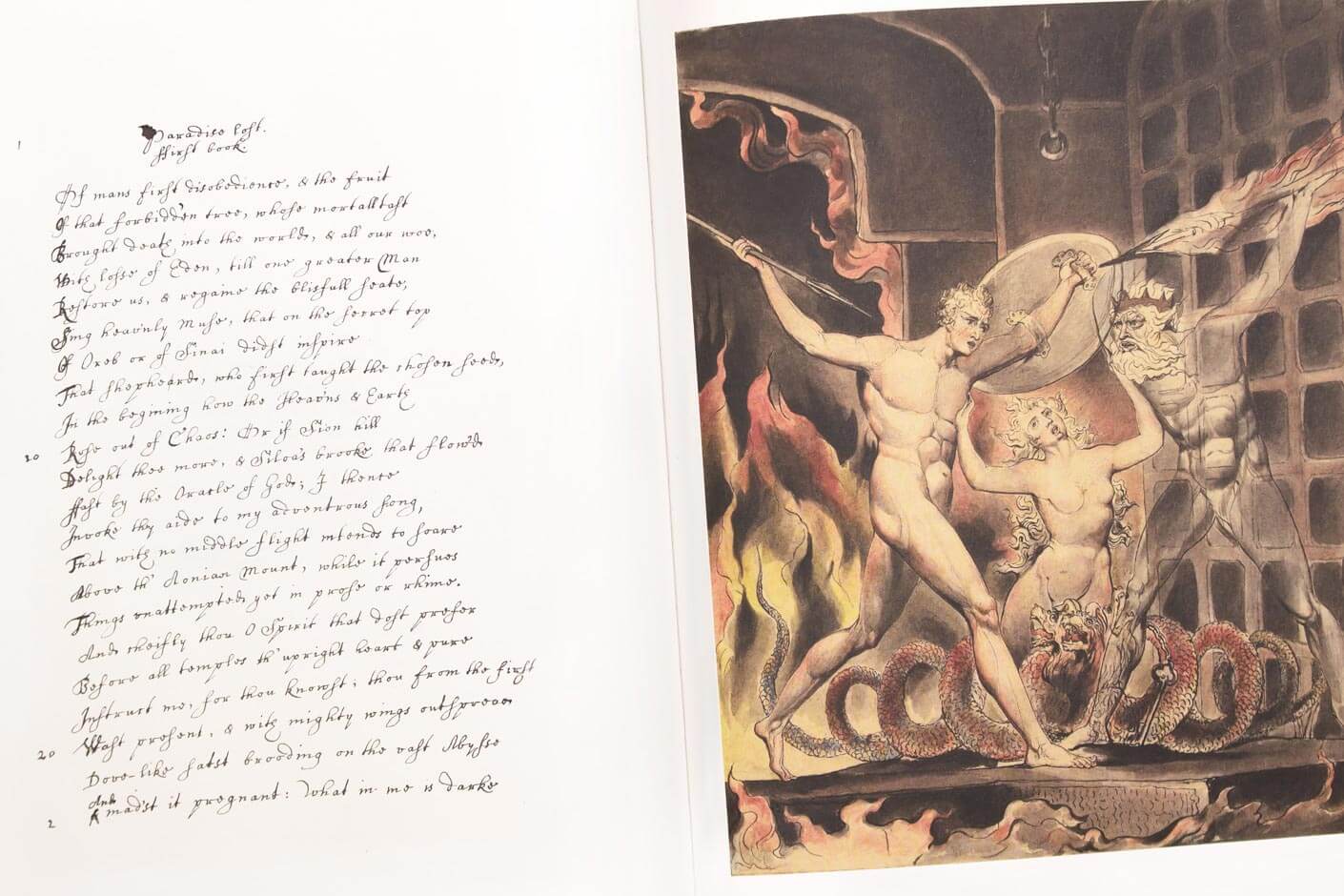
In The Marriage of Heaven and Hell, William Blake adds a note to the text that became a famous adage about John Milton’s Paradise Lost: the 10,000-line, 17th century blank verse epic about the war between heaven and hell and the failed testing of God’s premium product, human beings. Milton “wrote in fetters when he wrote of Angels & God, and at liberty when he wrote Devils & Hell,” Blake declared, “because he was a true Poet and of the Devil’s party without knowing it.” The statement inspired “other Romantic and Gothic writers to view Satan as a hero,” the British Library writes.
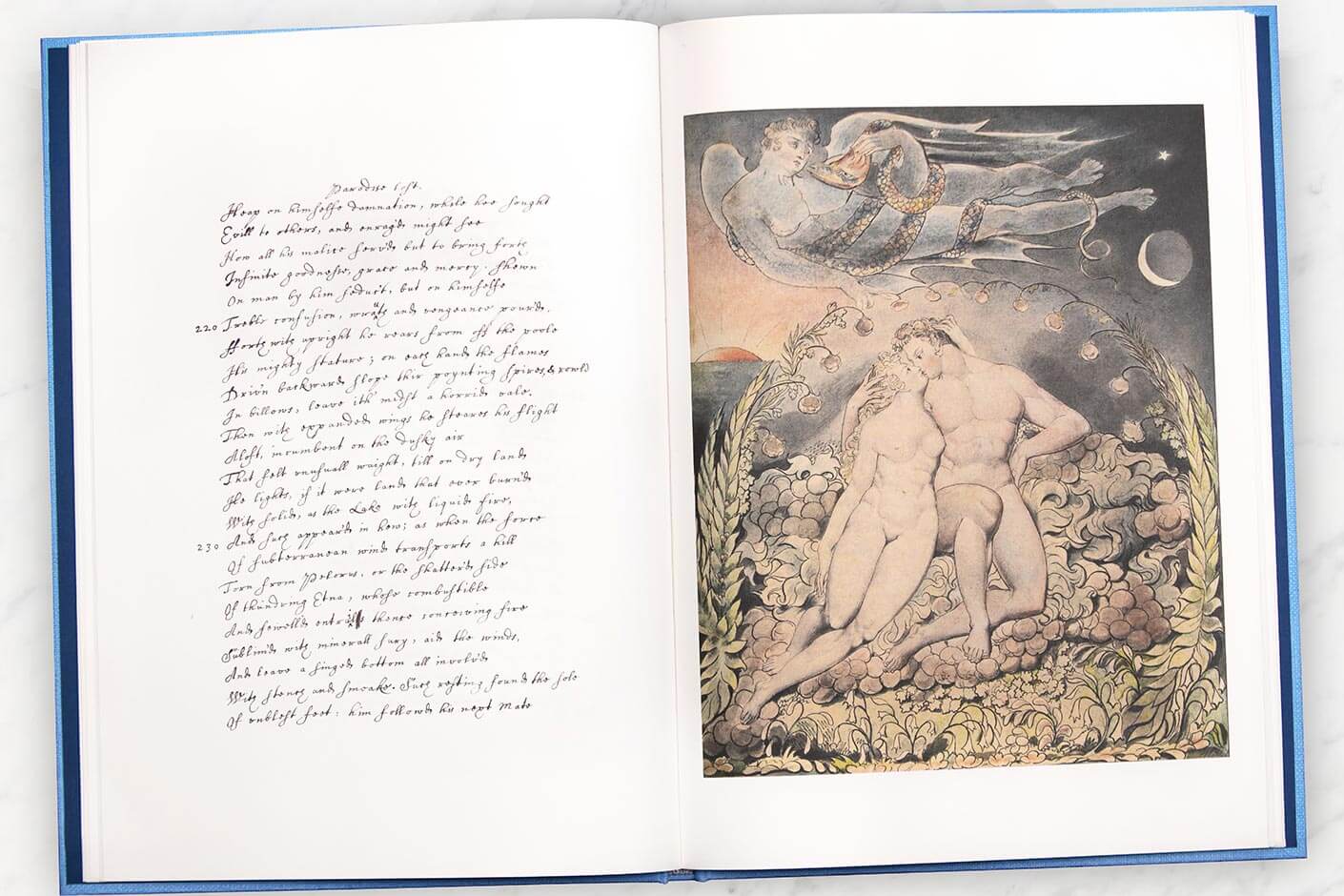
Blake himself illustrated Paradise Lost in three separate commissions over the course of his career as an engraver and printer. His deep admiration for the poem helped it become a “Bible of the Romantic movement,” writes the manuscript publisher SP Books in their introduction to a rare new book publication of the only surviving manuscript of the work.
Only 1,000 numbered, large format copies of this printing are available. (We do hope a subsequent edition will appear, maybe with a transcription and annotations. But it will not be as beautiful as this sky-blue cloth-covered book with Blake’s full-color illustrations.)
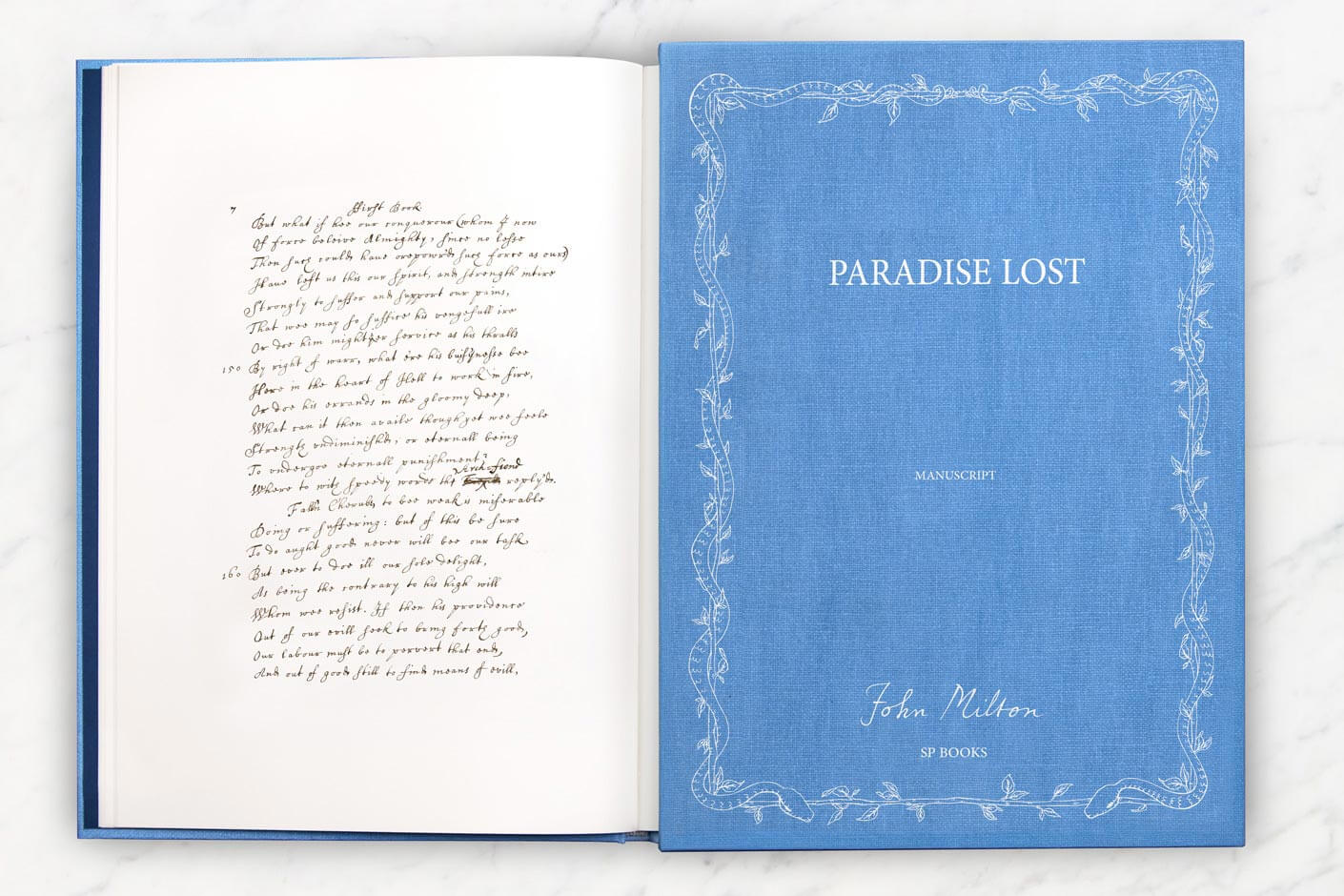
The book preserves the only part of the poem that survives in manuscript: 798 lines from Book One of Paradise Lost. These are not in Milton’s hand — he had been blind since 1652, and the poem was first published in 1667. He conceived the epic in his 50s, his career in government over after the English Civil Wars and the brief period of the Cromwells’ Protectorate ended in the Restoration of Charles II. “Milton composed ‘Paradise Lost’ aloud, in bed or (per witnesses) ‘leaning backwards obliquely in an easy chair,’ ” Lauren Christensen writes at The New York Times, “memorizing the stanzas to be transcribed in another’s hand.”
These first few hundred lines show why Satan seems so noble to Milton’s readers; speeches by and about him portray his doomed campaign as a righteous assault on heavenly tyranny. The Romantics’ use of Paradise Lost reflects their own preoccupations, while also echoing contemporary suspicions of the poem. “The authorities were concerned,” for example, Tom Paulin notes at The London Review of Books, by an image in Book One describing Satan:
as when the sun new ris’n
Looks through the horizontal misty air
Shorn of his beams, or from behind the moon
In dim eclipse disastrous twilight sheds
On half the nations, and with fear of changePerplexes monarchs.
“According to Milton’s early biographer, the Irish republican John Toland, Charles II’s Licenser for the Press regarded these lines as subversive,” Paulin points out, “and wanted to suppress the whole poem.” It’s surprising he was able to publish at all. Milton had vociferously supported the Puritan revolutionaries who overthrew the king’s father, Charles I, and removed his head. Milton later published several pamphlets in defense of regicide. In 1660, when Richard Cromwell’s Protectorate fell apart and Charles II returned, Milton’s works were banned by royal decree and the poet went into hiding until a general pardon.
Later critics have pointed to Milton’s political writings as evidence that he knew exactly whose party he was of. California State University’s Michael Bryson has gone so far as to argue that Milton was a secret atheist. In any case, he was a passionate believer in the overthrow of kings and the establishment of republics (for which he has become a libertarian hero). Paulin sums up the critical case for Paradise Lost as an allegory for the “lost cause” of the revolution:
Milton knew that the poem he was dictating to his amaneuensis would be scrutinized by the recently restored monarch’s Licenser of the Press, so he coded the English people’s formation of a republic as the creation of the “heavens and earth.” The idea passed the censor by, just as it has passed by many readers, but it was nonetheless Milton’s founding intention in composing his epic.
The charge that Milton made Satan a hero is hard to ignore when, reading Book One, we find the poet giving the Chief of Fallen Angels the best lines, as anyone who’s read Paradise Lost will remember. If you haven’t, just see the classic example below.
The mind is its own place, and in itself
Can make a Heav’n of Hell, a Hell of Heav’n.
What matter where, if I be still the same,
And what I should be, all but less than he
Whom Thunder hath made greater? Here at least
We shall be free; th’Almighty hath not built
Here for his envy, will not drive us hence:
Here we may reign secure, and in my choice
To reign is worth ambition though in Hell:
Better to reign in Hell, than serve in Heav’n.
Learn more about this rare manuscript edition at The New York Times’ review and purchase one (if one remains) at SP Books.
Related Content:
The Otherworldly Art of William Blake: An Introduction to the Visionary Poet and Painter
Spenser and Milton (Free Course)
Josh Jones is a writer and musician based in Durham, NC. Follow him at @jdmagness
Read More...What Is the House of the Rising Sun?: An Introduction to the Origins of the Classic Song
Everyone knows the song, a warning from a man or woman returning to the place that will destroy them. Yet they cannot turn back. The tragedy of “House of the Rising Sun” lies in its inevitability. “The narrator seems to have lost his free will,” writes Jim Beviglia, caught, perhaps, in the grip of an unbeatable addiction. As soon as we hear those first few notes, we know the story will end in ruin. But what kind of ruin takes place there? Is the House of the Rising Sun a brothel or a gambling den, or both? Was it a real place in New Orleans? Maybe a pub in England? Or a place in the anonymous songwriter’s imagination?
Eric Burdon and the Animals, who popularized the song worldwide when they recorded and released it in 1964, didn’t know. Even Alan Lomax couldn’t suss out the song’s origin, though he tried, and suspected it may have originated with an English farm worker named Harry Cox who sang a song called “She Was a Rum One” with a similar opening line.
Dave Van Ronk and Bob Dylan played “House of the Rising Sun” in coffeehouses. Burdon himself picked the song up from the English folk scene, and the Animals first covered the slow, sinister tune when they opened for Chuck Berry because they knew they “couldn’t outrock” the guitar great.
“House of the Rising Sun” has been recorded by Lead Belly, Woody Guthrie, Nina Simone, Dolly Parton, and virtually every other artist concerned with American roots music. “It’s so deep in the heart of this culture,” says New Orleans guitarist Reid Netterville, who finds that people from all over the world know the lyrics when he plays the song on street corners. Since the Animals’ recording, it has become “one of the single most performed songs in music history,” notes Polyphonic in the video at the top, “with renditions in every genre you can think of, from metal to reggae to disco.”
Maybe audiences around the world connect with this tale of ruin and despair because its setting is so mysterious and yet so perfectly placed. Burdon himself, who visits New Orleans often, gets invited to all sorts of strange places in the city, he says, purporting to be the titular “House”: “I’d go to women’s prisons, coke dealers’ houses, insane asylums, mens’ prisons, private parties. They just wanted to get me there.” The ambiguity between the real and the symbolic makes the song adaptable to any number of different kinds of voices. “It’s been described as an abstract metaphor but also a reference to real historical places,” notes Polyphonic, and it’s gone from the lament of a “ruined” female narrator to a dissolute male voice with only a change in pronouns.
While there may be a handful of spurious claimants to the title of real House of the Rising Sun, the origin of the song remains unknown. But its allure is not a mystery. The house is “a place of vice, a place of darkness and foreboding” — a place that we both can’t seem to resist and that we’d do best to stay clear of. We’ll always have curiosity about the dark corners of the world; the warning of “House of the Rising Sun” will always be pertinent, and mothers, often tragically to no avail, will always tell their children about it, wherever and whatever that den of sin may be.…
Related Content:
B.B. King Explains in an Animated Video Whether You Need to Endure Hardship to Play the Blues
Josh Jones is a writer and musician based in Durham, NC. Follow him at @jdmagness
Read More...George Harrison Breaks Down Abbey Road Track-By-Track on the Day of Its Release (September 26, 1969)
By the time the Beatles finished The White Album, it seemed they might not ever make another record together. “The group was disintegrating before my eyes,” recording engineer Geoff Emerick remembers. “It was ugly, like watching a divorce between four people. After a while, I had to get out.” Emerick left, but thankfully the band hung in a while longer and managed to patch things up in the studio to make their final record.
When they called Emerick to work on Abbey Road, they promised to get along for what would turn out to be their last album. (Emerick points out that on the cover they’re walking away from Abbey Road studios.) Not only did they manage to avoid personal conflict, but more importantly “the musical telepathy between them was mind-boggling.” As if to seal the moment of accord forever, they ended the album, and the Beatles, with a medley.
Abbey Road shows every member of the band rising to their full songwriting potential, especially George Harrison, who fully came into his own with “Something,” a song everyone knew would be “an instant classic.” Harrison became more confident and talkative in interviews, sitting down on the day of Abbey Road’s release with Australian music writer and John Lennon friend Ritchie York to offer his impressions of each track.
In the enhanced audio interview above, Harrison briefly comments, track-by-track, on what he thinks of each song and the album as a whole. What is perhaps most interesting, given Emerick’s comment about “musical telepathy,” is how the music seems to come from somewhere else, a kind of intuition or channeling that transcends the individual personalities of each Beatle.
Take Ringo’s “Octopus’s Garden,” a song Harrison loves. “On the surface,” he says, “it’s just — it’s like a daft kids’ song. But the lyrics are great, really. For me, y’know, I find very deep meaning in the lyrics, which Ringo probably doesn’t see, but all the things like… ‘We’ll be warm beneath the storm.’… Which is really great, y’know, because it’s like this level is a storm, and it’s always — y’know, if you get sort of deep in your consciousness, it’s very peaceful. So Ringo’s writing his cosmic songs without noticing!”
The genius of Lennon, says Harrison, comes through particularly in his timing, “but when you question him as to what it is, he doesn’t know. He just does it naturally.” As for the album as a whole, Harrison says, “it all gels, it fits together and that, but… it’s a bit like it’s somebody else, y’know?.… It doesn’t feel as though it’s us.… It’s more like just somebody else.”
Harrison doesn’t say much about the recording process, but he does talk about the songwriting and influences on the album. When he wrote “Something,” he says, he imagined “somebody like Ray Charles doing it.” He calls Paul’s “Maxwell’s Silver Hammer,” which Lennon hated, an “instant sort of whistle-along tune” that people will either love or hate.
The conversation eventually moves to Harrison’s feelings about The White Album and other topics. Where he really opens up is near the end when the subject of India comes up. We see him walking away from Abbey Road on his own path. When York asks him about “the Indian scene,” Harrison replies, “I dunno, it’s like it’s karma, my karma.… I’m just pretending to be, y’know, a Beatle. Whereas there’s a greater job to be done.”
Hear the interview in full above and read a transcript here.
Related Content:
Watch George Harrison’s Final Interview and Performance (1997)
Josh Jones is a writer and musician based in Durham, NC. Follow him at @jdmagness
Read More...The Revolutionary Paintings of Jean-Michel Basquiat: A Video Essay
“The idea of the unrecognized genius slaving away in a garret is a deliciously foolish one,” says artist and critic Rene Ricard, as portrayed by Michael Wincott, in Julian Schnabel’s Basquiat. “We must credit the life of Vincent Van Gogh for really sending this myth into orbit.” And “no one wants to be part of a generation that ignores another Van Gogh. In this town, one is at the mercy of the recognition factor.” The town to which he refers is, of course, New York, in which the titular Jean-Michel Basquiat lived the entirety of his short life — and created the body of work that has continued not just to appreciate enormously in value, but to command the attention of all who so much as glimpse it.
As a film Basquiat has much to recommend it, not least David Bowie’s appearance as Andy Warhol. But as one would expect from a biopic about an artist directed by one of his contemporaries, it takes a subjective view of Basquiat’s life and career. “The Revolutionary Paintings of Jean-Michel Basquiat,” the video essay by Youtube Blind Dweller above, adheres more closely to the historical record, telling the story of how his wild imagination spurred him on to become the hottest phenomenon on the New York art scene of the nineteen-eighties. By the middle of that decade, the young Brooklynite who’d once lived on the street after dropping out of school found himself making over a million dollars per year with his art.
At that time Basquiat “had collectors knocking on his door nearly every day demanding art from him, yet simultaneously asking for specific colors or imagery to match their furniture,” which resulted in “him slamming the door in a lot of collectors’ faces.” He refused to produce art to order, consumed as he was with his own interests — the law, sainthood, African culture, black American history, the built environment of New York City — and their incorporation into his work. He also possessed a keen sense of how to maintain a tantalizing distance between himself and his public, for instance by deliberately crossing out text in his paintings on the theory that “when a word is more obscured, the more likely an observer will be drawn to it.”
This would have been evident to Warhol, himself no incompetent when it came to audience management. His association with Basquiat secured both of their places in the zeitgeist of eighties America, but his death in 1987 marked, for his young protégé, the beginning of the end. “He began dissociating himself from his downtown past, attending more parties reserved for the super-rich, and becoming increasingly obsessed with the idea of being accepted by certain crowds,” says Blind Dweller, and his final heroin overdose occurred the very next year. Basquiat is remembered as both beneficiary and victim of the phenomenon to which we refer (now almost always positively) as hype — countless cycles of which have since done nothing to diminish the vitality exuded by his most striking paintings.
Related content:
The Story of Jean-Michel Basquiat’s Rise in the 1980s Art World Gets Told in a New Graphic Novel
The Odd Couple: Jean-Michel Basquiat and Andy Warhol, 1986
When Glenn O’Brien’s TV Party Brought Klaus Nomi, Blondie & Basquiat to Public Access TV (1978–82)
When David Bowie Played Andy Warhol in Julian Schnabel’s Film, Basquiat
Based in Seoul, Colin Marshall writes and broadcasts on cities, language, and culture. His projects include the Substack newsletter Books on Cities, the book The Stateless City: a Walk through 21st-Century Los Angeles and the video series The City in Cinema. Follow him on Twitter at @colinmarshall, on Facebook, or on Instagram.
Read More...Support Us
We're hoping to rely on loyal readers, rather than erratic ads. Please click the Donate button and support Open Culture. You can use Paypal, Venmo, Patreon, even Crypto! We thank you!

About Us

Open Culture scours the web for the best educational media. We find the free courses and audio books you need, the language lessons & educational videos you want, and plenty of enlightenment in between.
Advertise With Us
FREE UPDATES!
GET OUR DAILY EMAIL
Get the best cultural and educational resources on the web curated for you in a daily email. We never spam. Unsubscribe at any time.
FOLLOW ON SOCIAL MEDIA
Open Culture editor Dan Colman scours the web for the best educational media. He finds the free courses and audio books you need, the language lessons & movies you want, and plenty of enlightenment in between.
Advertise With Us


