|
How Medieval Cathedrals Were Built Without Science, or Even Mathematics, The Ingenious Engineering of Silk: How the 2,000-Year-Old Pattern Loom Powered the Silk Road and the Wealth of Ancient China ͏ ͏ ͏
|
| |
|
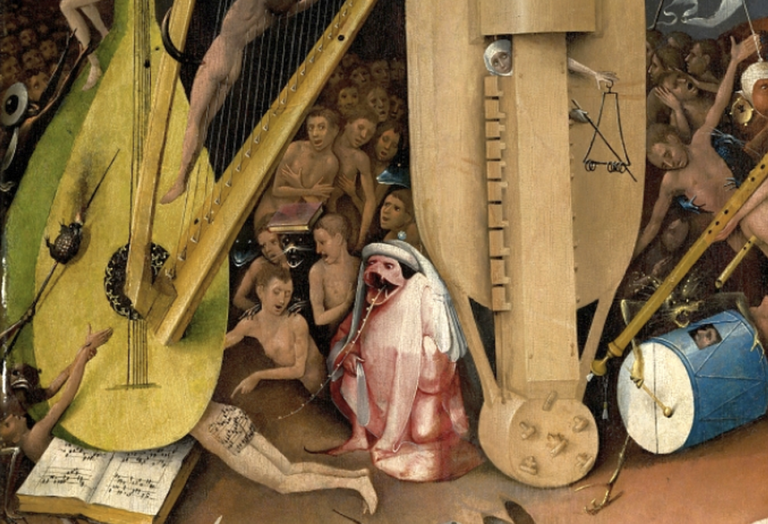
Welcome to The Garden of Earthly Delights.
You’ll find no angelic strings here.
Those are reserved for first-class citizens whose virtuous lives earned them passage to the uppermost heights.
Down below, stringed instruments produce the most hellish sort of cacophony, a fitting accompaniment for the horn whose bell is…
|
|
|
|
| |

|
Science and engineering may be conflated to some degree in the public mind, but anyone who’s spent much time in an academic department belonging to one or the other of those branches of endeavor knows how insistently distinctions can be drawn between them. Bill Hammack, a professor of engineering at the University of Illinois Urbana-Champaign who’s been there since he was a master’s student in 1986, surely has his own thoughts on the subject. The video above from his popular YouTube channel Engineerguy explains how cathedrals were designed in the Middle Ages, using the example of Sainte-Chapelle in Paris. Specifically, it gets into how such a building’s arches and supporting walls could have been engineered without the aid of science at all, or even the use of mathematics.
Compared to today, the scope of knowledge humanity commanded back in medieval times may have been impossibly narrow — to say nothing of the knowledge possessed by any given human, especially outside the literate elite. Yet what was then known proved more than sufficient to build structures that still […]
|
|
|
|
| |

|
The Silk Road’s long period of high activity spanned the second century BC and the fifteenth century AD, but its name wasn’t coined until more than 400 years after that. Scholars have argued it practically ever since, given that the referent wasn’t just one road but a vast and ever-changing network of them, and…
|
|
|
|
| |

|
We seem to be living through yet another major moment for podcasting. Over the past two decades, the medium has gone from niche experiment to mainstream habit, becoming a regular part of how we learn, entertain ourselves, and pass the time. The popularity of podcasts—in an age of ubiquitous screens and perpetual distractions—speaks to…
|
|
|
|
| |

|
In ancient Egypt, writing hieroglyphs was a highly specialized skill, one commanded by only a small fraction of the population. The fact that there were more than 1,000 characters to memorize probably had something to do with that, but the variety of surfaces on which hieroglyphs were written couldn’t have made it any easier. Depending…
|
|
|
|