|
Digest of new articles at openculture.com, your source for the best cultural and educational resources on the web ͏ ͏ ͏ ͏ ͏ ͏ ͏ ͏ ͏ ͏ ͏ ͏ ͏ ͏ ͏ ͏ ͏ ͏ ͏ ͏ ͏ ͏ ͏ ͏ ͏ ͏ ͏ ͏ ͏ ͏ ͏ ͏ ͏ ͏ ͏ ͏ ͏ ͏ ͏ ͏ ͏ ͏ ͏ ͏ ͏ ͏ ͏ ͏ ͏ ͏ ͏ ͏ ͏ ͏ ͏ ͏ ͏ ͏ ͏ ͏ ͏ ͏ ͏ ͏ ͏ ͏ ͏ ͏ ͏ ͏ ͏ ͏ ͏ ͏ ͏ ͏ ͏ ͏ ͏ ͏ ͏ ͏ ͏ ͏ ͏ ͏ ͏
|
|
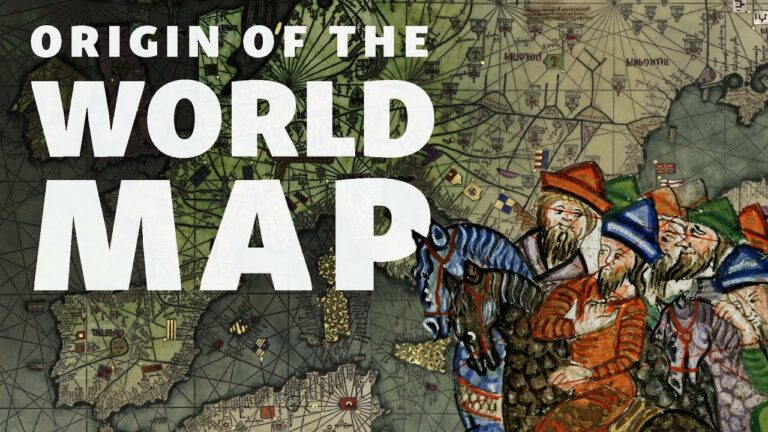
Regular readers of Open Culture know a thing or two about maps if they’ve paid attention to our posts on the history of cartography, the evolution of world maps (and why they are all wrong), and the many digital collections of historical maps from all over the world. What does the seven and a half-minute video above bring to this compendium of online cartographic knowledge? A very quick survey of world map history, for one thing, with stops at many of the major historical intersections from Greek antiquity to the creation of the Catalan Atlas, an astonishing mapmaking achievement from 1375.
The upshot is an answer to the very reasonable question, “how were accurate world maps created before air travel or satellites?” The explanation? A lot of history — meaning, a lot of time. Unlike innovations today, which we expect to solve problems near-immediately, the innovations in mapping technology took many centuries and required the work of thousands of travelers, geographers, cartographers, mathematicians, historians, and other scholars who built upon the work that came before. It started with speculation, […]
|
|
|
|
|
By now, you’re familiar with “Playing for Change,” a multimedia music project that brings together musicians and singers from across the globe–some well known, many others not. Their latest video features Carlos Santana playing “Oye Como Va,” a song he made famous in 1970. He’s joined by Cindy Blackman, Tito Puente, Jr. (whose father wrote the song in 1963), bassist Tal Wilkenfeld, Rubén Rada and musicians from Colombia, Panama, Uruguay, the Congo, Brazil, and beyond. For more Playing for Change videos, see the Relateds below. The one featuring John Paul Jones performing “When The Levee Breaks” is a personal favorite.
Related Content
“When The Levee Breaks” Performed by John Paul Jones & Musicians Around the World
[…]
|
|
|
|
|
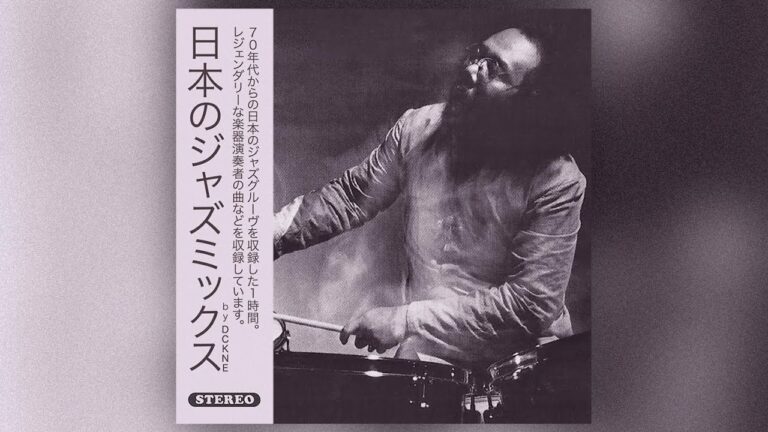
Like American jazz, Japanese jazz started with earlier styles like foxtrot and ragtime. Jazz was an international music, spreading across the Atlantic to London, Paris, and Berlin and across the Pacific to Shanghai, Manilla, and Tokyo. Luxury liners crossed the ocean and their house bands ferried new styles of dance music with them. “There was precious little improvisation,” in early Japanese jazz, “but that wasn’t as big a deal, as you know, in American jazz of the 1910s or ’20s,” historian E. Taylor Atkins tells NPR.
Japan even had its own jazz age. The word first entered the country in a 1929 “popular song attached to a movie called Tokyo March,” says Atkins. “The lyrics refer to jazz, and … that’s sort of where it came into mass consciousness. It was associated with dance halls, it was associated with ‘modern girls’ and ‘modern boys’ — the Japanese version of flappers and dandies — and the urban leisure classes: excess, and dogs and cats sleeping together, and all those sorts of portents of future calamity.”
When calamity came in the form of […]
|
|
|
|
|
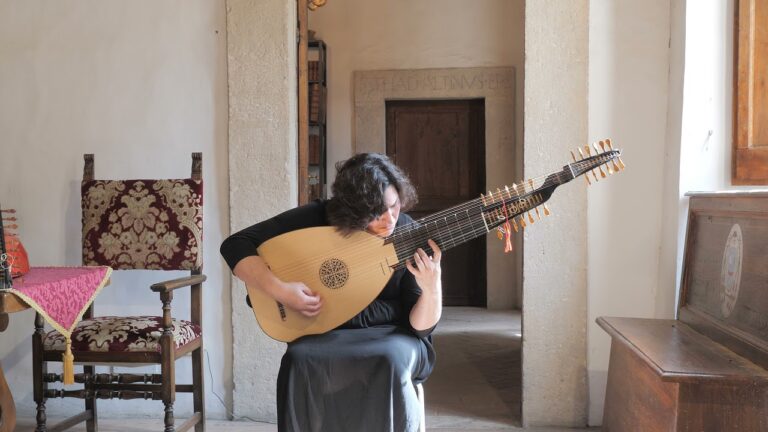
In the two videos here, see Argentine lutenist Evangelina Mascardi play passionate renditions of J.S. Bach compositions on the rich, resonant Baroque lute. In Bach’s time, lutenists were some of the most widely-admired instrumental players, and it’s easy to see why. The Baroque lute is not an easy instrument to play. Much less so were the theorbo and chitarrone, instruments like it but with longer necks for longer bass strings. We see Mascardi concentrate with utmost intensity on every note, a virtuoso on an instrument that Bach himself could not master.
Indeed, there has been significant debate over whether Bach actually composed his four pieces for solo lute for that instrument and not another. For one thing, he seems to have had a “weak grasp” of the instrument, guitarist and lutenist Cameron O’Connor writes in an examination of the evidence.
“The lute may have been an intimidating subject even for Bach.” There are several problems with authenticating existing copies of the music, and “none of the pieces in staff notation is playable on the standard Baroque lute without […]
|
|
|
When first published in 1985, Margaret Atwood’s The Handmaid’s Tale drew acclaim for how it combined and made new the genre conventions of the dystopian, historical, and fantasy novel. But the book has enjoyed its greatest fame in the past decade, thanks in part to a 2017 adaptation on Hulu and a sequel, The Testaments, published two years thereafter. It’s even become prominent in mass culture, frequently referenced in discussions of real-life politics and society in the manner of Nineteen Eighty-Four or Fahrenheit 451.
Like George Orwell and Ray Bradbury’s famous works, The Handmaid’s Tale also seems at risk of becoming less often read than publicly referenced — and therefore, no small amount of the time, publicly misinterpreted. The only way to fortify yourself against such abuse of literature is, of course, actually to read the book. Fortunately, The Handmaid’s Tale is now widely available, unlike certain books in certain places that have been subject to bans. It is against such banning that the latest edition of Atwood’s novel stands, printed and bound using only fireproof materials.
“Across the United States and […]
|
When first published in 1985, Margaret Atwood’s The Handmaid’s Tale drew acclaim for how it combined and made new the genre conventions of the dystopian, historical, and fantasy novel. But the book has enjoyed its greatest fame in the past decade, thanks in part to a 2017 adaptation on Hulu and a sequel, The Testaments, published two years thereafter. It’s even become prominent in mass culture, frequently referenced in discussions of real-life politics and society in the manner of Nineteen Eighty-Four or Fahrenheit 451.
Like George Orwell and Ray Bradbury’s famous works, The Handmaid’s Tale also seems at risk of becoming less often read than publicly referenced — and therefore, no small amount of the time, publicly misinterpreted. The only way to fortify yourself against such abuse of literature is, of course, actually to read the book. Fortunately, The Handmaid’s Tale is now widely available, unlike certain books in certain places that have been subject to bans. It is against such banning that the latest edition of Atwood’s novel stands, printed and bound using only fireproof materials.
“Across the United States and […]
|
|
|
|