|
Digest of new articles at openculture.com, your source for the best cultural and educational resources on the web ͏ ͏ ͏ ͏ ͏ ͏ ͏ ͏ ͏ ͏ ͏ ͏ ͏ ͏ ͏ ͏ ͏ ͏ ͏ ͏ ͏ ͏ ͏ ͏ ͏ ͏ ͏ ͏ ͏ ͏ ͏ ͏ ͏ ͏ ͏ ͏ ͏ ͏ ͏ ͏ ͏ ͏ ͏ ͏ ͏ ͏ ͏ ͏ ͏ ͏ ͏ ͏ ͏ ͏ ͏ ͏ ͏ ͏ ͏ ͏ ͏ ͏ ͏ ͏ ͏ ͏ ͏ ͏ ͏ ͏ ͏ ͏ ͏ ͏ ͏ ͏ ͏ ͏ ͏ ͏ ͏ ͏ ͏ ͏ ͏ ͏ ͏
|
|
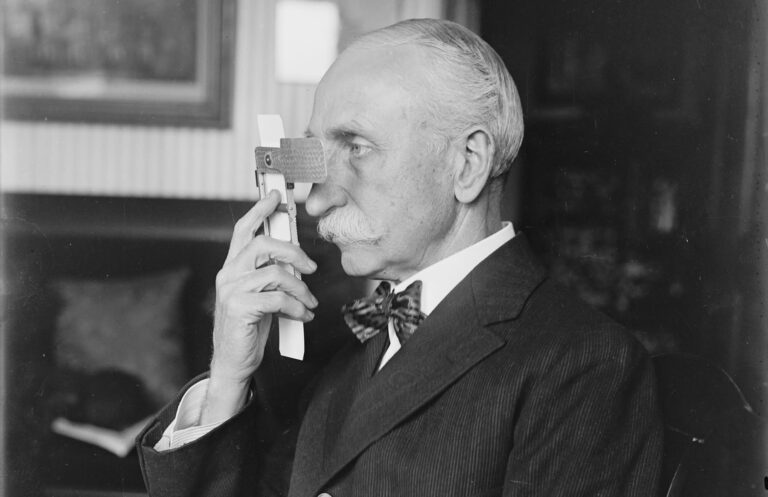
The Sony Librie, the first e-reader to use a modern electronic-paper screen, came out in 2004. Old as that is in tech years, the basic idea of a handheld device that can store large amounts of text stretches at least eight decades farther back in history. Witness the Fiske Reading Machine, an invention first profiled in a 1922 issue of Scientific American. “The instrument, consisting of a tiny lens and a small roller for operating this eyepiece up and down a vertical column of reading-matter, is a means by which ordinary typewritten copy, when photographically reduced to one-hundredth of the space originally occupied, can be read with quite the facility that the impression of conventional printing type is now revealed to the unaided eye,” writes author S. R. Winters.
Making books compatible with the Fiske Reading Machine involved not digitization, of course, but miniaturization. According to the patents filed by inventor Bradley Allen Fiske (eleven in all, between 1920 and 1935), the text of any book could be photo-engraved onto a copper block, reduced […]
|
|
|
|
|
Even by the extreme standards of dystopian fiction, the premise of Ray Bradbury’s Fahrenheit 451 can seem a little absurd. Firemen whose job is to set fires? A society that bans all books? Written less than a decade after the fall of the Third Reich, which announced its evil intentions with book burnings, the novel explicitly evokes the kind of totalitarianism that seeks to destroy culture—and whole peoples—with fire. But not even the Nazis banned all books. Not a few academics and writers survived or thrived in Nazi Germany by hewing to the ideological orthodoxy (or at least not challenging it), which, for all its terrifying irrationalism, kept up some semblance of an intellectual veneer.
The novel also recalls the Soviet variety of state repression. But the Party apparatus also allowed a publishing industry to operate, under its strict constraints. Nonetheless, Soviet censorship is legendary, as is the survival of banned literature through self-publishing and memorization, vividly represented by the famous line in Mikhail Bulgokov’s The Master and Margarita, “Manuscripts don’t burn.”
Bulgakov, […]
|
|
|
|
|
During his final decade, Friedrich Nietzsche’s worsening constitution continued to plague the philosopher. In addition to having suffered from incapacitating indigestion, insomnia, and migraines for much of his life, the 1880s brought about a dramatic deterioration in Nietzsche’s eyesight, with a doctor noting that his “right eye could only perceive mistaken and distorted images.”
Nietzsche himself declared that writing and reading for more than twenty minutes had grown excessively painful. With his intellectual output reaching its peak during this period, the philosopher required a device that would let him write while making minimal demands on his vision.
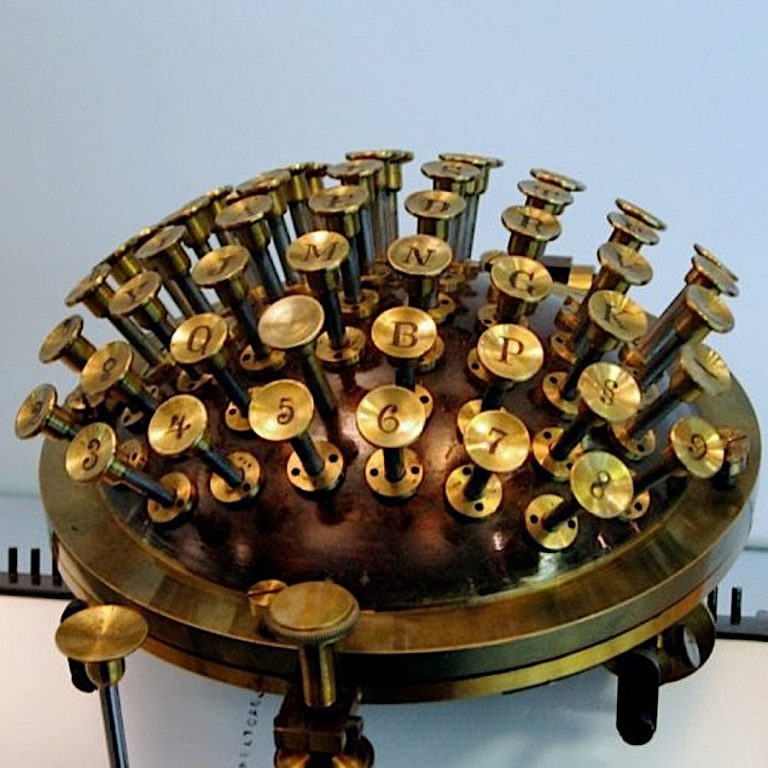
So he sought to buy a typewriter in 1881. Although he was aware of Remington typewriters, the ailing philosopher looked for a model that would be fairly portable, allowing him to travel, when necessary, to more salubrious climates. The Malling-Hansen Writing Ball seemed to fit the bill:
In Dieter Eberwein’s free Nietzches Screibkugel e-book, the vice president of the Malling-Hansen Society explains that the writing ball was the closest thing to a 19th century laptop. The […]
|
|
|
|
|
Drink our coffee. Or else. That’s the message of these curiously sadistic TV commercials produced by Jim Henson between 1957 and 1961.
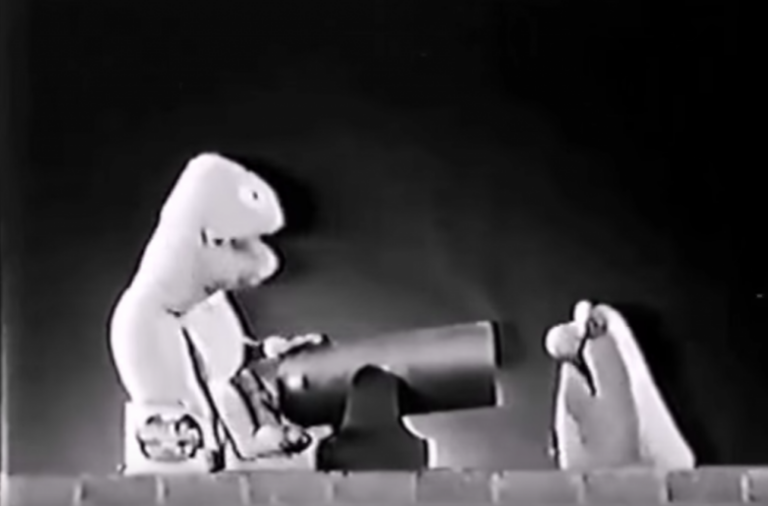
Henson made 179 ten-second spots for Wilkins Coffee, a regional company with distribution in the Baltimore-Washington D.C. market, according to the Muppets Wiki: “The local stations only had ten seconds for station identification, so the Muppet commercials had to be lightning-fast–essentially, eight seconds for the commercial pitch and a two-second shot of the product.”
Within those eight seconds, a coffee enthusiast named Wilkins (who bears a resemblance to Kermit the frog) manages to shoot, stab, bludgeon or otherwise do grave bodily harm to a coffee holdout named Wontkins. Henson provided the voices of both characters.
Up until that time, TV advertisers typically made a direct sales pitch. “We took a different approach,” said Henson in Christopher Finch’s Of Muppets and Men: The Making of the Muppet Show. “We tried to sell things by making people laugh.”
The campaign for Wilkins Coffee was a hit. “In terms of popularity of commercials in the Washington area,” said Henson in a 1982 interview […]
|
|
|
No cultural tour of Glasgow could be complete without a visit to the Britannia Panopticon, the world’s oldest surviving music hall. “Converted from warehouse to music hall in 1857 and licensed in 1859, the Britannia Music Hall entertained Glasgow’s working classes for nearly 80 years,” says its about page. “By the time it closed in 1938 it had also accommodated cinema, carnival, freak show, wax works, zoo, art gallery and hall of mirrors,” and it had also changed its name to reflect the fact that every conceivable form of entertainment could be seen there. Thanks to an ongoing conservation effort, the building still stands today, and its details have gradually been returned to the look and feel of its glory days.
In 2016, the Britannia Panopticon marked 120 years of showing film in that building. Part of the celebration involved uploading, to its very own Youtube channel, this 40-minute compilation of real footage from 1896, the year its cinematic programming began. (Ambient sound has been added to enhance the sensation of time travel.)
In it you’ll catch glimpses of […]
|
No cultural tour of Glasgow could be complete without a visit to the Britannia Panopticon, the world’s oldest surviving music hall. “Converted from warehouse to music hall in 1857 and licensed in 1859, the Britannia Music Hall entertained Glasgow’s working classes for nearly 80 years,” says its about page. “By the time it closed in 1938 it had also accommodated cinema, carnival, freak show, wax works, zoo, art gallery and hall of mirrors,” and it had also changed its name to reflect the fact that every conceivable form of entertainment could be seen there. Thanks to an ongoing conservation effort, the building still stands today, and its details have gradually been returned to the look and feel of its glory days.
In 2016, the Britannia Panopticon marked 120 years of showing film in that building. Part of the celebration involved uploading, to its very own Youtube channel, this 40-minute compilation of real footage from 1896, the year its cinematic programming began. (Ambient sound has been added to enhance the sensation of time travel.)
In it you’ll catch glimpses of […]
|
|
|
|