|
Digest of new articles at openculture.com, your source for the best cultural and educational resources on the web ͏ ͏ ͏ ͏ ͏ ͏ ͏ ͏ ͏ ͏ ͏ ͏ ͏ ͏ ͏ ͏ ͏ ͏ ͏ ͏ ͏ ͏ ͏ ͏ ͏ ͏ ͏ ͏ ͏ ͏ ͏ ͏ ͏ ͏ ͏ ͏ ͏ ͏ ͏ ͏ ͏ ͏ ͏ ͏ ͏ ͏ ͏ ͏ ͏ ͏ ͏ ͏ ͏ ͏ ͏ ͏ ͏ ͏ ͏ ͏ ͏ ͏ ͏ ͏ ͏ ͏ ͏ ͏ ͏ ͏ ͏ ͏ ͏ ͏ ͏ ͏ ͏ ͏ ͏ ͏ ͏ ͏ ͏ ͏ ͏ ͏ ͏
|
|
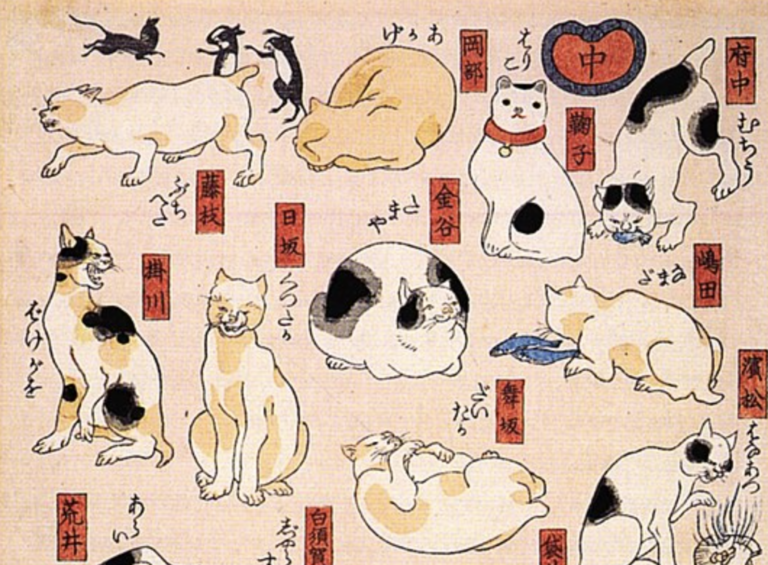
Few countries love cats as much as Japan does, and none expresses that love so clearly in its various forms of art. Though not eternal, the Japanese inclination toward all things feline does extend deeper into history than some of us might assume. “In the sixth century, Buddhist monks travelled from China to Japan,” writes Philip Kennedy at Illustration Chronicles. On these journeys, they brought scriptures, drawings, and relics – items that they hoped would help them introduce the teachings of Buddhism to the large island nation.” They also brought cats, in part as carriers of good luck and in part for their ability to “guard the sacred texts from the hungry mice that had stowed on board their ships.”

Buddhism made a lasting mark on Japanese culture, but those cats practically overtook it. “Today, cats can be found nearly everywhere in Japan,” Kennedy writes. “From special cafés and shrines to entire cat islands. Indeed the owners of one Japanese train station were so […]
|
|
|
|
|
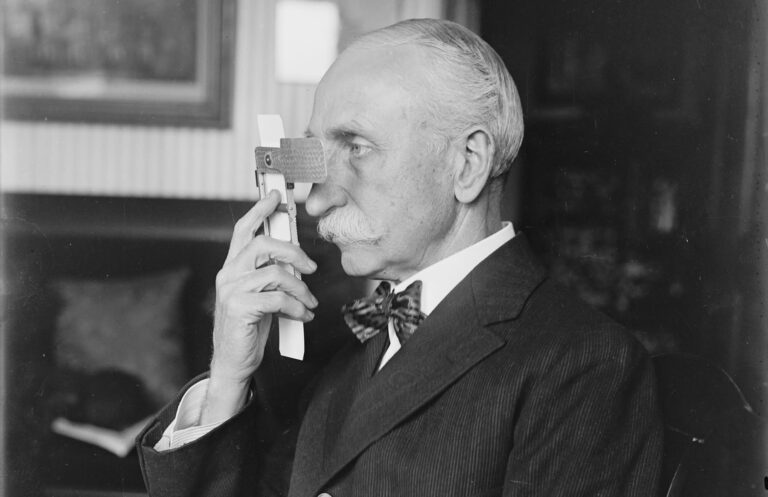
The Sony Librie, the first e-reader to use a modern electronic-paper screen, came out in 2004. Old as that is in tech years, the basic idea of a handheld device that can store large amounts of text stretches at least eight decades farther back in history. Witness the Fiske Reading Machine, an invention first profiled in a 1922 issue of Scientific American. “The instrument, consisting of a tiny lens and a small roller for operating this eyepiece up and down a vertical column of reading-matter, is a means by which ordinary typewritten copy, when photographically reduced to one-hundredth of the space originally occupied, can be read with quite the facility that the impression of conventional printing type is now revealed to the unaided eye,” writes author S. R. Winters.
Making books compatible with the Fiske Reading Machine involved not digitization, of course, but miniaturization. According to the patents filed by inventor Bradley Allen Fiske (eleven in all, between 1920 and 1935), the text of any book could be photo-engraved onto a copper block, reduced […]
|
|
|
|
|
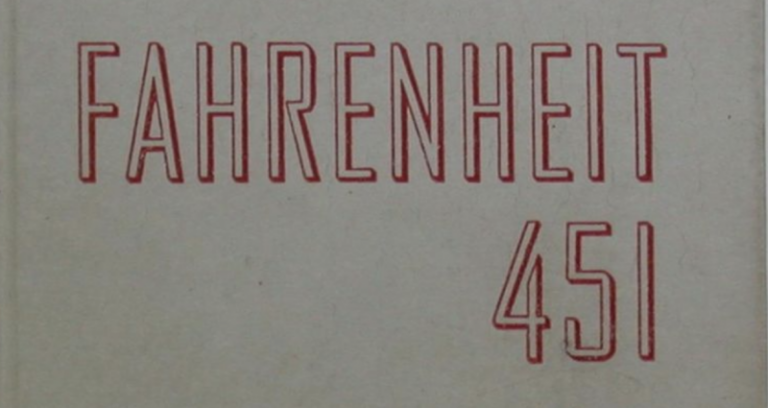
Even by the extreme standards of dystopian fiction, the premise of Ray Bradbury’s Fahrenheit 451 can seem a little absurd. Firemen whose job is to set fires? A society that bans all books? Written less than a decade after the fall of the Third Reich, which announced its evil intentions with book burnings, the novel explicitly evokes the kind of totalitarianism that seeks to destroy culture—and whole peoples—with fire. But not even the Nazis banned all books. Not a few academics and writers survived or thrived in Nazi Germany by hewing to the ideological orthodoxy (or at least not challenging it), which, for all its terrifying irrationalism, kept up some semblance of an intellectual veneer.
The novel also recalls the Soviet variety of state repression. But the Party apparatus also allowed a publishing industry to operate, under its strict constraints. Nonetheless, Soviet censorship is legendary, as is the survival of banned literature through self-publishing and memorization, vividly represented by the famous line in Mikhail Bulgokov’s The Master and Margarita, “Manuscripts don’t burn.”
Bulgakov, […]
|
|
|
|
|
During his final decade, Friedrich Nietzsche’s worsening constitution continued to plague the philosopher. In addition to having suffered from incapacitating indigestion, insomnia, and migraines for much of his life, the 1880s brought about a dramatic deterioration in Nietzsche’s eyesight, with a doctor noting that his “right eye could only perceive mistaken and distorted images.”
Nietzsche himself declared that writing and reading for more than twenty minutes had grown excessively painful. With his intellectual output reaching its peak during this period, the philosopher required a device that would let him write while making minimal demands on his vision.
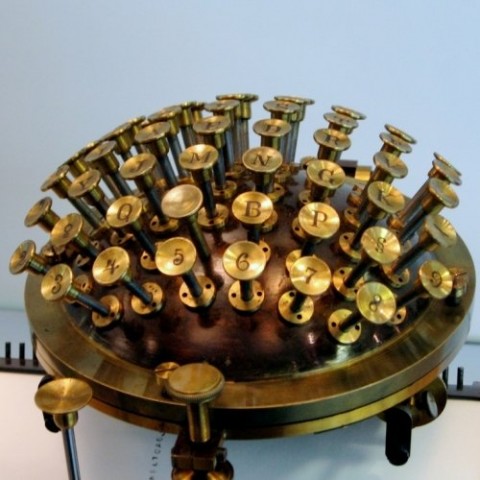
So he sought to buy a typewriter in 1881. Although he was aware of Remington typewriters, the ailing philosopher looked for a model that would be fairly portable, allowing him to travel, when necessary, to more salubrious climates. The Malling-Hansen Writing Ball seemed to fit the bill:
In Dieter Eberwein’s free Nietzches Screibkugel e-book, the vice president of the Malling-Hansen Society explains that the writing ball was the closest thing to a 19th century laptop. The […]
|
|
|
|