|
Digest of new articles at openculture.com, your source for the best cultural and educational resources on the web ͏ ͏ ͏ ͏ ͏ ͏ ͏ ͏ ͏ ͏ ͏ ͏ ͏ ͏ ͏ ͏ ͏ ͏ ͏ ͏ ͏ ͏ ͏ ͏ ͏ ͏ ͏ ͏ ͏ ͏ ͏ ͏ ͏ ͏ ͏ ͏ ͏ ͏ ͏ ͏ ͏ ͏ ͏ ͏ ͏ ͏ ͏ ͏ ͏ ͏ ͏ ͏ ͏ ͏ ͏ ͏ ͏ ͏ ͏ ͏ ͏ ͏ ͏ ͏ ͏ ͏ ͏ ͏ ͏ ͏ ͏ ͏ ͏ ͏ ͏ ͏ ͏ ͏ ͏ ͏ ͏ ͏ ͏ ͏ ͏ ͏ ͏
|
|
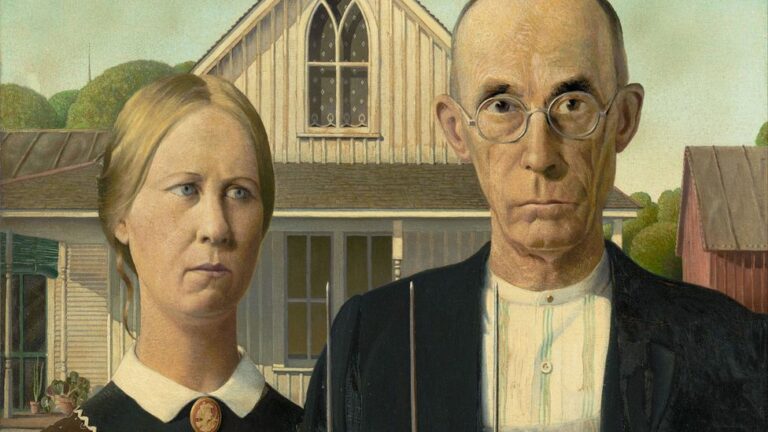
“We should fear Grant Wood. Every artist and every school of artists should be afraid of him, for his devastating satire.” Gertrude Stein wrote those words after seeing American Gothic, the 1930 painting that would become one of the most iconic images created in the United States. Yet Wood himself “said he painted American Gothic to extol rural American values, real people in their well-ordered world: an image of reassurance during the onset of the Great Depression.” That’s how Art History School host Paul Priestley puts it in the video above, which asks of the painting, “Is it a satire, or a positive statement of American rural life?”
It could be neither; then again, it could be both. That very ambiguity goes some way to explaining American Gothic‘s success — as well as its persistence in the culture through frequent and unceasing parody. Yet in its day, the painting also angered some of its viewers: “An Iowan farmer’s wife who’d seen the picture in the papers in 1930 telephoned Wood to express her anger,” says Priestly.
“She claimed […]
|
|
|
|
|
Back in September, we mentioned that Yale historian Timothy Snyder had started teaching a course, The Making of Modern Ukraine, and putting the lectures online. With the fall semester now over, you can watch 23 lectures on YouTube. All of the lectures appear above, or on this playlist. Key questions explored by the course include:
What brought about the Ukrainian nation? Ukraine must have existed as a society and polity on 23 February 2022, else Ukrainians would not have collectively resisted Russian invasion the next day. Why has the existence of Ukraine occasioned such controversy? In what ways are Polish, Russian, and Jewish self-understanding dependent upon experiences in Ukraine? Just how and when did a modern Ukrainian nation emerge? Just how for that matter does any modern nation emerge? And why some nations and not others? What is the balance between structure and agency in history? Can nations be chosen, and does it matter? Can the choices of individuals influence the rise of much larger social organizations? If so, how? Ukraine was the country most […]
|
|
|
|
|
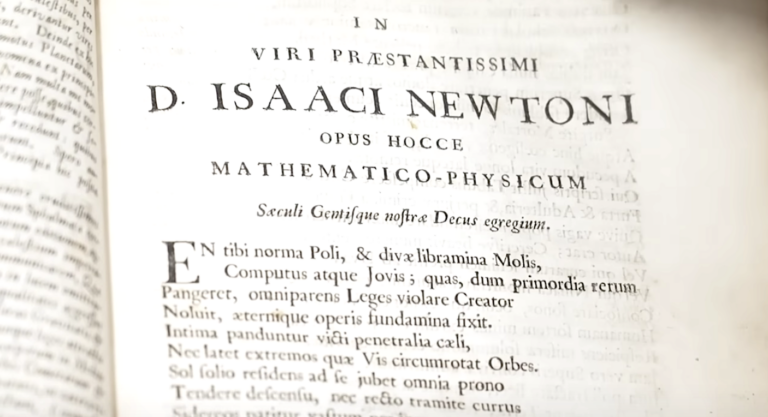
The exalted status of Isaac Newton’s Philosophiæ Naturalis Principia Mathematica is reflected by the fact that everybody knows it as, simply, the Principia. Very few of us, by contrast, speak of the Historia when we mean to refer to John Ray and Francis Willughby’s De Historia Piscium, which came out in 1686, the year before the Principia. Both books were published by the Royal Society, and as it happens, the formidable cost of Willughby and Ray’s lavish work of ichthyology nearly kept Newton’s groundbreaking treatise on motion and gravitation from the printing press.
According to the Royal Society’s web site, “Ray and Willughby’s Historia did not prove to be the publishing sensation that the Fellows had hoped and the book nearly bankrupted the Society. This meant that the Society was unable to meet its promise to support the publication of Isaac Newton’s masterpiece.”
Fortunately, “it was saved from obscurity by Edmund Halley, then Clerk at the Royal Society” — and now better known for his eponymous […]
|
|
|
|
|
Christmas cards aren’t just an anachronism.
They’re almost an endangered species, the victim of the Internet, postal rate increases, and the jettisoning of any time consuming tradition whose execution has been found to bring the opposite of joy.
Above, Victoria and Albert Museum curators Alice Power and Sarah Beattie take us on a backwards trip to a time when the exchange of Christmas cards was a source of true social merriment.
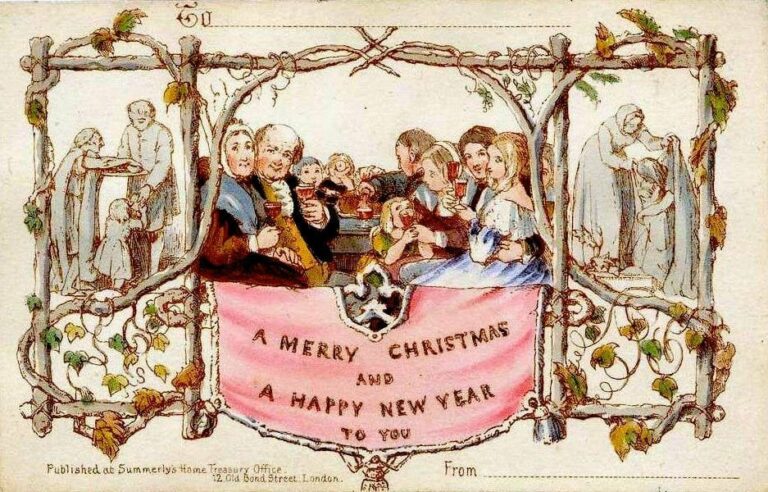
Christmas cards must hold a special place in both the V&A’s collections and heart, given that the museum’s founder, Henry Cole, inadvertently invented them in 1843.
As a well respected man about town, he received a great many more holiday letters than he had time or inclination to respond to, but neither did he wish to appear rude.
So he enlisted his friend, painter J.C. Horsley, to create a festive illustration with a built-in holiday greeting, leaving just enough space to personalize with a recipient’s name and perhaps, a handwritten line or two.
He then had enough postcard-sized reproductions […]
|
|
|
|