|
Digest of new articles at openculture.com, your source for the best cultural and educational resources on the web ͏ ͏ ͏ ͏ ͏ ͏ ͏ ͏ ͏ ͏ ͏ ͏ ͏ ͏ ͏ ͏ ͏ ͏ ͏ ͏ ͏ ͏ ͏ ͏ ͏ ͏ ͏ ͏ ͏ ͏ ͏ ͏ ͏ ͏ ͏ ͏ ͏ ͏ ͏ ͏ ͏ ͏ ͏ ͏ ͏ ͏ ͏ ͏ ͏ ͏ ͏ ͏ ͏ ͏ ͏ ͏ ͏ ͏ ͏ ͏ ͏ ͏ ͏ ͏ ͏ ͏ ͏ ͏ ͏ ͏ ͏ ͏ ͏ ͏ ͏ ͏ ͏ ͏ ͏ ͏ ͏ ͏ ͏ ͏ ͏ ͏ ͏
|
|
Image via The Bulletin of the Atomic Scientists
Last year, the fates handed the New York Times‘ Maria Cramer an enviably striking lede: “Humanity is 100 seconds away from total annihilation. Again.” That we all know immediately what she was writing about speaks to the power of graphic design. Specifically, it speaks to the power of graphic design as practiced by Martyl Langsdorf, who happened to be married to ex-Manhattan Project physicist Alexander Langsdorf. This connection got her the gig of creating a cover for the June 1947 issue of the Bulletin of the Atomic Scientists. She came up with a simple image: the upper-left corner of a clock, its hands at seven minutes to midnight.
Asked later why she set the clock to that time in particular, Langsdorf explained that “it looked good to my eye.” That quote appears in a post at the Bulletin addressing frequently asked questions about what’s now known as the Doomsday Clock, “a design that warns the public about how close we are […]
|
|
|
|
|
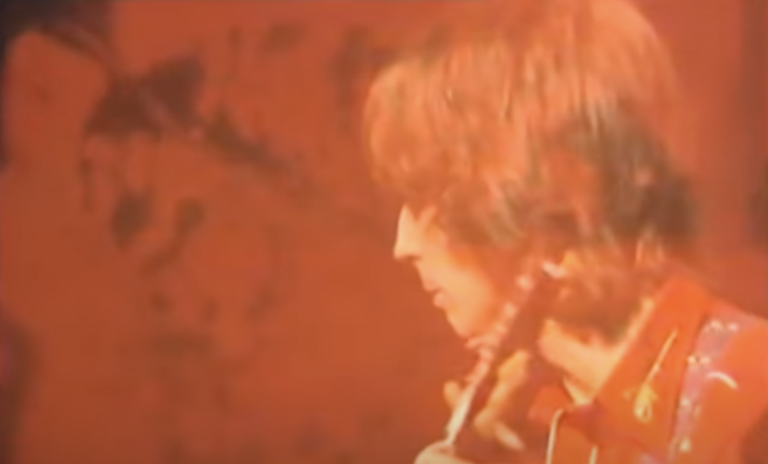
The original rock supergroup, Cream, lasted two years, changed the course of rock music, barely held together because of rancor between members and said goodbye in 1968. Their farewell concert at the Royal Albert Hall in London was one for the ages. Maybe not their best performance, but one of their most energetic. And inside the cavernous Hall, the three men laid down a wall of undeniable sound.
Too bad that it wasn’t properly documented, despite a series of cameras there that evening. A Youtube denizen called Mike Lefton has tried to rectify the history by assembling a cut of the 70-minute concert that plays in real time. It’s the kind of fan project for which YouTube is designed—something not professional enough for official release, but vitally important for the fans.
Go on to the BezosBorg site (you know, it rhymes with Glamazon), and you can find a concert film offered on Blu-Ray. What’s wrong with that, you might ask? Cream fans will tell you. Instead of letting the band play, the official Farewell Concert leaves off several songs, and includes a […]
|
|
|
|
|
Last week we featured the recent discovery of Ernest Shackleton’s ship Endurance, which has spent more than a century at the bottom of the Weddell Sea off Antarctica. It sank there in 1915, after having been entrapped and slowly crushed by pack ice for the most of a year. That marked the end of what had started as the 1914–1917 Imperial Trans-Antarctic Expedition, but it certainly wasn’t the end of the story. When it had become clear that there was no hope for Endurance, writes Rain Noe at Core77, “Shackleton and five of the crew then sailed 800 miles in a lifeboat to Stromness, an inhabited island and whaling station in the South Atlantic, where they were able to organize a rescue party. Shackleton located and rescued his crew four months later.”
Today we can watch the Endurance‘s demise on film, as shot by expedition photographer Frank Hurley. “How is it possible that the film footage survived this ordeal?” Noe writes. “After the crew abandoned ship, food was the main thing to be carried away by the men, and Hurley had […]
|
|
|
|
|
There was a period in the late 20th-century when having hair long enough to sit on was considered something of an accomplishment.
Judging by the long hair pins unearthed from Austria’s Hallstatt burial site, extreme length was an early Iron Age hair goal, too, possibly because a coronet of thick braids made it easier to balance a basket on your head or keep your veil securely fastened.
Morgan Donner, whose YouTube channel documents her attempts to recreate historical garments and hairstyles, committed to trying various Hallstatt looks after reading archeologogist Karina Grömer‘s 2005 article Experimente zur Haar- und Schleiertracht in der Hallstattzeit (Experiments on hairstyles and veils in the Hallstatt period.)
Gromer, the vice-head of the Vienna Natural History Museum‘s Department of Prehistory, published precise diagrams showing the position of the hair ornaments in relation to the occupants of various graves.
For example, the skeleton in grave 45, below, was discovered with “10 bronze needles to the left of and below the skull, (and) parts of a bronze spiral roll in […]
|
|
|
|
|
Violinist Kerenza Peacock writes: “I befriended some young violinists in Ukraine via Instagram and discovered some were in basement shelters but had their violins. So I asked colleagues across the world to accompany them in harmony. And I got sent videos from 94 violinists in 29 countries in 48 hours!! An astonishing collaboration forming an international violin choir of support for Ukraine. Illia Bondarenko had to film this between explosions, because he could not hear himself play.
We play an old Ukrainian folk song called Verbovaya Doschechka. Nine other young violinists sheltering in Ukraine join in unison, and are accompanied in harmony by players from London Symphony Orchestra, Tokyo Symphony, Oslo Philharmonic, the Hollywood Studios, and top violinists from all over the world including Ireland, the Netherlands, New Zealand, Belgium, Georgia, Poland, South Korea, South Africa, Moldova, Denmark, India, and the entire violin section of the Munich Chamber Orchestra!”
Learn more about the collaboration here, and donate to support Ukrainians in distress here.
|
|
|
|