|
Digest of new articles at openculture.com, your source for the best cultural and educational resources on the web ͏ ͏ ͏ ͏ ͏ ͏ ͏ ͏ ͏ ͏ ͏ ͏ ͏ ͏ ͏ ͏ ͏ ͏ ͏ ͏ ͏ ͏ ͏ ͏ ͏ ͏ ͏ ͏ ͏ ͏ ͏ ͏ ͏ ͏ ͏ ͏ ͏ ͏ ͏ ͏ ͏ ͏ ͏ ͏ ͏ ͏ ͏ ͏ ͏ ͏ ͏ ͏ ͏ ͏ ͏ ͏ ͏ ͏ ͏ ͏ ͏ ͏ ͏ ͏ ͏ ͏ ͏ ͏ ͏ ͏ ͏ ͏ ͏ ͏ ͏ ͏ ͏ ͏ ͏ ͏ ͏ ͏ ͏ ͏ ͏ ͏ ͏
By most measures, Japan boasts the highest life expectancy in the world. But that ranking, of course, doesn’t mean that every Japanese person sees old age. Though the country’s rate of violent crime is low enough to be the envy of most of the world, its suicide rate isn’t, and it says even more that the Japanese language has a word that refers specifically to death by overwork. I first encountered it nearly thirty years ago in a Dilbert comic strip. “In Japan, employees occasionally work themselves to death. It’s called karōshi,” says Dilbert’s pointy-haired boss. “I don’t want that to happen to anybody in my department. The trick is to take a break as soon as you see a bright light and hear dead relatives beckon.”
httpv://youtu.be/9Y-YJEtxHeo
You can see the phenomenon of karōshi examined more seriously in the short Nowness video at the top of the post. In it, a series of Japanese salarymen (a Japanese English term now well-known around the world) speak to the exhausting and unceasing rigors of their everyday work schedules — and, in some […]
|
By most measures, Japan boasts the highest life expectancy in the world. But that ranking, of course, doesn’t mean that every Japanese person sees old age. Though the country’s rate of violent crime is low enough to be the envy of most of the world, its suicide rate isn’t, and it says even more that the Japanese language has a word that refers specifically to death by overwork. I first encountered it nearly thirty years ago in a Dilbert comic strip. “In Japan, employees occasionally work themselves to death. It’s called karōshi,” says Dilbert’s pointy-haired boss. “I don’t want that to happen to anybody in my department. The trick is to take a break as soon as you see a bright light and hear dead relatives beckon.”
You can see the phenomenon of karōshi examined more seriously in the short Nowness video at the top of the post. In it, a series of Japanese salarymen (a Japanese English term now well-known around the world) speak to the exhausting and unceasing rigors of their everyday work schedules — and, in some […]
|
|
|
|
|
Granted a wish to travel back in time, many a Bach lover would leap to Thuringia, in a pre-unified Germany, circa the early 1700s, or to Arnstadt, Mühlhausen, the courts of Weimar and Köthen, or Leipzig. There, Bach composed his concertos, suites, fugues, preludes, canons, chorales, organ works, solo pieces, as well as unique works like the Goldberg Variations and The Well-Tempered Clavier. He wrote principally for churches and sovereigns who had his music performed in what we now call its original settings.
Of course, we can’t hear Bach’s Baroque masterworks the way his contemporaries did, though we can try. But imagine standing in St. Paul’s Church, hearing the composer play his organ works himself in the early 1720s. (Built in 1231, the church survived WWII, only to be demolished for redevelopment under the East German regime in 1968.) Imagine hearing Bach’s chamber works played in the ornate chambers of the 18th century. It’s a nice dream, but I think we’re fortunate to live in his distant future, and to have experienced his music through three-hundred years of interpretations, new arrangements and instrumentation, […]
|
|
|
|
|
Niccolò Machiavelli lived in a time before the internet, before radio and television, before drones and weapons of mass destruction. Thus one naturally questions the relevance of his political theories to the twenty-first century. Yet in discussions about the dynamics of power, no name has endured as long as Machiavelli’s. His reputation as a theorist rests mostly on his 1532 treatise Il Principe, or The Prince, in which he pioneered a way of analyzing power as it was actually wielded, not as people would have liked it to be. How, he asked, does a ruler — a prince — attain his position in a state, and even more importantly, how does he maintain it?
You can hear Machiavelli’s answers to these questions explained, and see them illustrated, in the 43-minute video above. It breaks The Prince down into seven parts summarizing as many of the book’s main points, including “Do not be neutral,” “Destroy, do not would,” and “Be feared.”
These commandments would seem to align with Machiavelli’s popular image as an apologist, even an advocate, for brutal and repressive forms of rule. But his […]
|
|
|
|
|
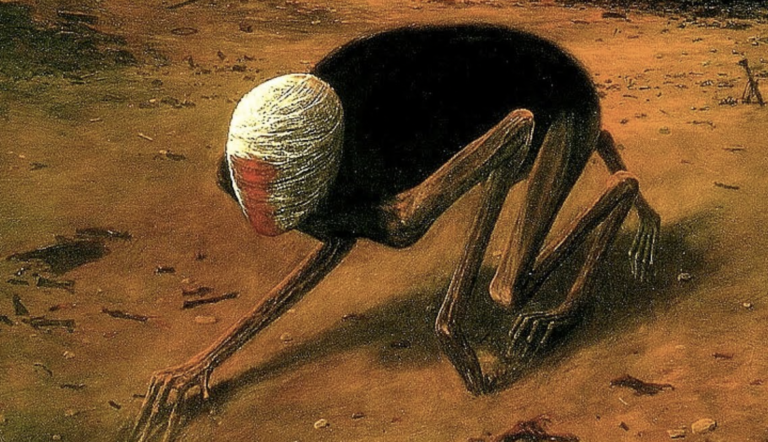
“In the medieval tradition, Beksinski seems to believe art to be a forewarning about the fragility of the flesh — whatever pleasures we know are doomed to perish — thus, his paintings manage to evoke at once the process of decay and the ongoing struggle for life. They hold within them a secret poetry, stained with blood and rust.” — Guillermo del Toro
The life and death of Polish painter, photographer, and sculptor Zdzisław Beksiński has been sensationalized, made into a cursed tragedy in the telling of events late in his life that, taken together, all seem horrifying enough: the death of the artist’s wife from cancer in 1998, the suicide of his son, Tomasz, one year later, and, finally, his own stabbing death in 2005 at the hands of his caretaker’s teenage son. If we add to this account Beksiński’s childhood in Nazi-occupied, then Soviet-occupied Poland, we have ample reason to speculate about the meaning of his nightmarish visions.
But the “Nightmare Artist,” as he’s called in the video above, wants us to stay […]
|
|
|
|
|
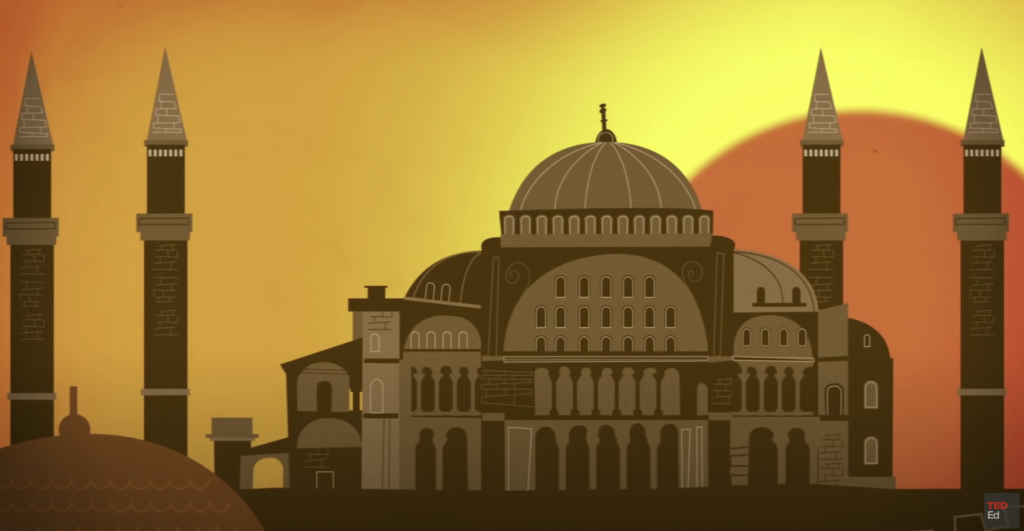
If you only know one fact about the Roman Empire, it’s that it declined and fell. If you know another, it’s that the Roman Empire gave way to the Europe we know today — in the fullness of time, at least. A good deal of history lies between our twenty-first century and the fall of Rome, which in any case wouldn’t have seemed like such a decisive break when it happened. “Most history books will tell you that the Roman Empire fell in the fifth century CE,” says the narrator of the animated TED-Ed lesson above. “This would’ve come as a great surprise to the millions of people who lived in the Roman Empire up through the Middle Ages.”
This medieval Roman Empire, better known as the Byzantine Empire, began in the year 330. “That’s when Constantine, the first Christian emperor, moved the capital of the Roman Empire to a new city called Constantinople, which he founded on the site of the ancient Greek city Byzantium.” Not only did Constantinople survive the barbarian invasions of the Empire’s western provinces, it […]
|
|
|
|