|
Digest of new articles at openculture.com, your source for the best cultural and educational resources on the web ͏ ͏ ͏ ͏ ͏ ͏ ͏ ͏ ͏ ͏ ͏ ͏ ͏ ͏ ͏ ͏ ͏ ͏ ͏ ͏ ͏ ͏ ͏ ͏ ͏ ͏ ͏ ͏ ͏ ͏ ͏ ͏ ͏ ͏ ͏ ͏ ͏ ͏ ͏ ͏ ͏ ͏ ͏ ͏ ͏ ͏ ͏ ͏ ͏ ͏ ͏ ͏ ͏ ͏ ͏ ͏ ͏ ͏ ͏ ͏ ͏ ͏ ͏ ͏ ͏ ͏ ͏ ͏ ͏ ͏ ͏ ͏ ͏ ͏ ͏ ͏ ͏ ͏ ͏ ͏ ͏ ͏ ͏ ͏ ͏ ͏ ͏
More than four decades after its release, The Buggles’ “Video Killed the Radio Star” is usually credited with more pop-cultural importance than musical influence. Perhaps that befits the song whose video was the first-ever aired on MTV. But if you listen closely to the song itself in The Buggles’ recording (as opposed to the concurrently produced version by Bruce Woolley and the Camera Club, which also has its champions), you’ll hear an unexpected degree of both compositional and instrumental complexity. You’ll also have a sense of a fairly wide variety of inspirations, one that Buggles co-founder Trevor Horn has since described as including not just other music but literature as well.
“I’d read J. G. Ballard and had this vision of the future where record companies would have computers in the basement and manufacture artists,” said Horn in a 2018 Guardian interview. “I’d heard Kraftwerk‘s The Man-Machine and video was coming. You could feel things changing.” The Buggles, Horn and collaborator Geoff Downes employed all the technology they could marshal. And by his reckoning, “Video Killed […]
|
More than four decades after its release, The Buggles’ “Video Killed the Radio Star” is usually credited with more pop-cultural importance than musical influence. Perhaps that befits the song whose video was the first-ever aired on MTV. But if you listen closely to the song itself in The Buggles’ recording (as opposed to the concurrently produced version by Bruce Woolley and the Camera Club, which also has its champions), you’ll hear an unexpected degree of both compositional and instrumental complexity. You’ll also have a sense of a fairly wide variety of inspirations, one that Buggles co-founder Trevor Horn has since described as including not just other music but literature as well.
“I’d read J. G. Ballard and had this vision of the future where record companies would have computers in the basement and manufacture artists,” said Horn in a 2018 Guardian interview. “I’d heard Kraftwerk‘s The Man-Machine and video was coming. You could feel things changing.” The Buggles, Horn and collaborator Geoff Downes employed all the technology they could marshal. And by his reckoning, “Video Killed […]
|
|
|
|
|
If you listen to the hype surrounding quantum computing, you might think the near future shown in Alex Garland’s sci-fi series Devs is upon us — that we have computers complex enough to recreate time and space and reconstruct the human mind. Far from it. At this still-early stage, quantum computers promise much more than they can deliver, but the technology is “poised,” writes IBM “to transform the way you work in research.” The company does have — as do most other other big makers of what are now called “classical computers” — a “roadmap” for implementing quantum computing and a lot of cool new technology (such as the quantum runtime environment Quiskit) built around the qubit, the quantum computer version of the classical bit.
The computer bit, as we know, is a binary entity: either 1 or 0 and nothing in-between. The qubit, on the other hand, mimics quantum phenomena by remaining in a state of superposition of all possible states between 1 and 0 until users interact with it, like a spinning coin that only lands on […]
|
|
|
|
|
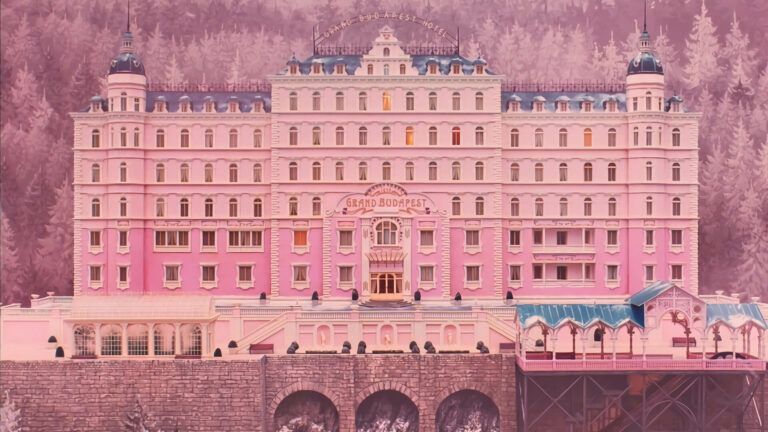
Wes Anderson’s The Grand Budapest Hotel features many notable players: Willem Dafoe, Tilda Swinton, F. Murray Abraham, and presiding above all, Ralph Fiennes as celebrated concierge Monsieur Gustave H. But it is Gustave’s domain, the titular alpine health resort, that figures most prominently in the film, transcending place, time, and political regime. Such an establishment could only exist within Anderson’s cinematic imagination, which dictates the manner in which he introduces it to his viewers. “It’s obviously a model,” says architect Michael Wyetzner in the video above. “It’s fake” — an adjective that, when applied to a Wes Anderson production, can only be a compliment.
Wyetzner surely means it that way, given how much interest he shows through the video in the details of the Grand Budapest Hotel as constructed and revealed, one set at a time, by Anderson and his collaborators. Envisioned as a kind of “French chateau growing out of the mountain,” the building incorporates a mansard roof, a “rusticated base” with the look of an ancient aqueduct, and Art Nouveau canopies of the kind still seen at the entrances of […]
|
|
|
|
|
My Name is called Disturbance…. — “Street Fighting Man”
More than two decades before German band the Scorpions blew their allegedly CIA-penned “Wind of Change” over the end of the Cold War; before the “hard rock Woodstock” in Moscow; before Bruce Springsteen rocked East Berlin and rang the “Chimes of Freedom,” another band took the stage behind the Iron Curtain: one not particularly well-known at the time for making geopolitical statements.
In 1967, the Rolling Stones recorded and released Between the Buttons and major hits “Ruby Tuesday” and “Let’s Spend the Night Together.” They tried to compete with the Beatles with stabs at psychedelia on Their Satanic Majesties Request. They didn’t record what is sometimes considered their most political song, “Street Fighting Man,” for another two years, and that song — with its options of street fighting or singing for a rock and roll band — has never been mistaken for a peace anthem.
It wasn’t peace the band courted in their original plan to play Moscow. “They started toying with the idea of performing in Moscow and becoming the most controversial rock […]
|
|
|
|
|
Though it may not be for everyone, the job of President of the United States of America does have its perks. Take, for example, the ability to screen any film you like at the White House: here on Open Culture, we’ve previously featured lists of movies watched by Richard Nixon, Jimmy Carter, and Ronald Reagan. But for Carter in particular, music seems to have been even more important than cinema. So explains John Chuldenko, stepson of that former president’s son Jack, in the episode of The 1600 Sessions above. In it, he tells of his rediscovery of an institution created under Nixon, greatly expanded under Carter, and packed away under Reagan: the White House Record Library.
“The Library, begun by First Lady Pat Nixon, was curated by a volunteer commission of noted music journalists, scholars, and other experts,” says the White House Historical Association. When it came time to update it at the end of the nineteen-seventies, writes Washingtonian’s Rob Brunner, “the selection process would be headed by John Hammond, a hugely influential figure who had signed Bob Dylan, […]
|
|
|
|