|
Digest of new articles at openculture.com, your source for the best cultural and educational resources on the web ͏ ͏ ͏ ͏ ͏ ͏ ͏ ͏ ͏ ͏ ͏ ͏ ͏ ͏ ͏ ͏ ͏ ͏ ͏ ͏ ͏ ͏ ͏ ͏ ͏ ͏ ͏ ͏ ͏ ͏ ͏ ͏ ͏ ͏ ͏ ͏ ͏ ͏ ͏ ͏ ͏ ͏ ͏ ͏ ͏ ͏ ͏ ͏ ͏ ͏ ͏ ͏ ͏ ͏ ͏ ͏ ͏ ͏ ͏ ͏ ͏ ͏ ͏ ͏ ͏ ͏ ͏ ͏ ͏ ͏ ͏ ͏ ͏ ͏ ͏ ͏ ͏ ͏ ͏ ͏ ͏ ͏ ͏ ͏ ͏ ͏ ͏
|
|
The art of bonsai originated in China. As subsequently refined in Japan, its techniques produce miniature trees that give aesthetic pleasure to people all around Asia and the wider world beyond. This appreciation is reflected in the couple-on-the-street interview footage incorporated into “The Biology Behind Bonsai Trees,” the video above from Youtuber Jonny Lim, better known as The Backpacking Biologist. Not only does Lim gather positive views on bonsai around Los Angeles, he also finds in that same city a bonsai nursery run by Bob Pressler, who has spent more than half a century mastering the art.
Even Pressler admits that he doesn’t fully understand the biology of bonsai. Lim’s search for scientific answers sends him to “something called the apical meristem.” That’s the part of the tree made of “stem cells found at the tips of the shoots and roots.” Stem cells, as you may remember from their long moment in the news a few years ago, have the potential to turn into any kind of cell.
The cells of bonsai are the same size as those of regular trees, […]
|
|
|
|
|
Image by Wikimedia Commons
This Spotify playlist (play below) contains music by Prince and the Grateful Dead, Weezer and Billie Holliday, Kanye West and Johannes Brahms, Hans Zimmer and David Bowie, Wolfgang Amadeus Mozart and Radiohead. Perhaps you’d expect such a range from a 712-track playlist that runs nearly 66 hours. Yet what you’ll hear if you listen to it isn’t just the collection of a modern-day “eclectic” music-lover, but a neuroscientist-curated arrangement of pieces that all cause us to experience the same sensation: frisson.
As usual, it takes a French word to evoke a condition or experience that other terms simply don’t encompass. Quoting one definition that calls frisson “a sudden feeling or sensation of excitement, emotion or thrill,” Big Think’s Sam Gilbert also cites a recent study suggesting that “one can experience frisson when staring at a brilliant sunset or a beautiful painting; when realizing a deep insight or truth; when reading a particularly resonant line of poetry; or when watching the climax of a film.”
Gilbert notes […]
|
|
|
|
|
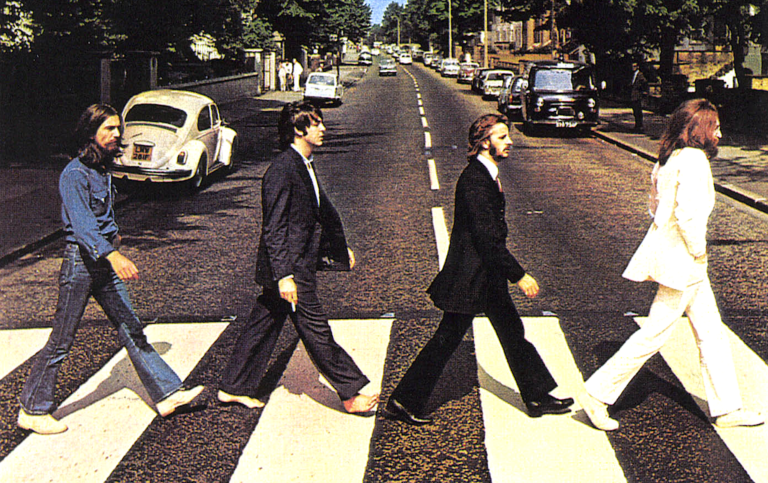
By the time the Beatles finished The White Album, it seemed they might not ever make another record together. “The group was disintegrating before my eyes,” recording engineer Geoff Emerick remembers. “It was ugly, like watching a divorce between four people. After a while, I had to get out.” Emerick left, but thankfully the band hung in a while longer and managed to patch things up in the studio to make their final record.
When they called Emerick to work on Abbey Road, they promised to get along for what would turn out to be their last album. (Emerick points out that on the cover they’re walking away from Abbey Road studios.) Not only did they manage to avoid personal conflict, but more importantly “the musical telepathy between them was mind-boggling.” As if to seal the moment of accord forever, they ended the album, and the Beatles, with a medley.
Abbey Road shows every member of the band rising to their full songwriting potential, especially George Harrison, who fully came into his own with “Something,” a song everyone knew would be […]
|
|
|
|
|
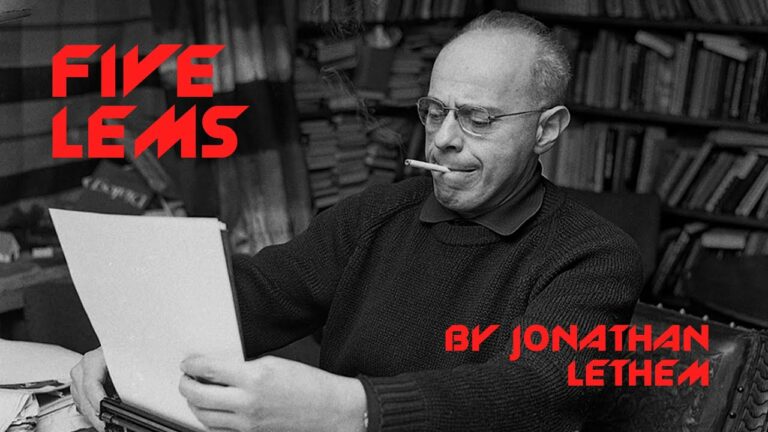
Who was Stanislaw Lem? The Polish science fiction writer, novelist, essayist, and polymath may best be known for his 1961 novel Solaris (adapted for the screen by Andrei Tarkosvky in 1972 and again by Steven Soderbergh in 2014). Lem’s science fiction appealed broadly outside of SF fandom, attracting the likes of John Updike, who called his stories “marvelous” and Lem a poet of “scientific terminology” for readers “whose hearts beat faster when the Scientific American arrives each month.”
Updike’s characterization is but one version of Lem. There are several more, writes Jonathan Lethem in an essay for the London Review of Books, penned for Lem’s 100th anniversary – at least five different Lems with five different literary personalities. Only the first is a “hard science fiction writer,” the genre originating not with Mary Shelley’s Frankenstein, but “in H.G. Wells’ technological prognostications.”
Represented best in the pages of Astounding Stories and other sci-fi pulps, hard sci-fi “advertises consumer goods like personal robots and flying cars. It valorizes space travel that culminates in successful, if difficult, contact with the […]
|
|
|
|
|
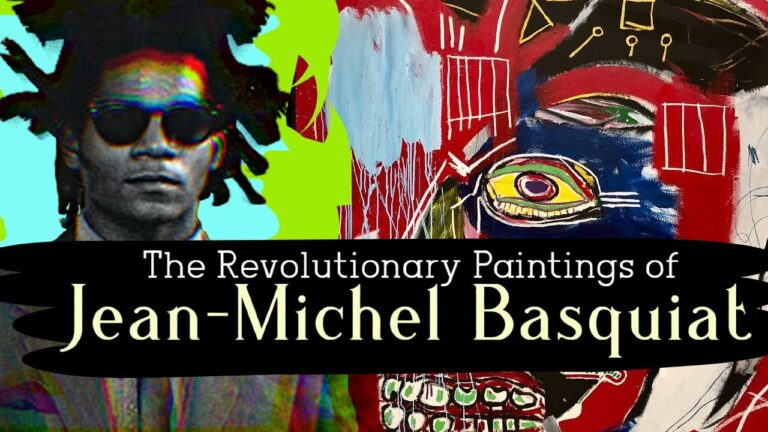
“The idea of the unrecognized genius slaving away in a garret is a deliciously foolish one,” says artist and critic Rene Ricard, as portrayed by Michael Wincott, in Julian Schnabel’s Basquiat. “We must credit the life of Vincent Van Gogh for really sending this myth into orbit.” And “no one wants to be part of a generation that ignores another Van Gogh. In this town, one is at the mercy of the recognition factor.” The town to which he refers is, of course, New York, in which the titular Jean-Michel Basquiat lived the entirety of his short life — and created the body of work that has continued not just to appreciate enormously in value, but to command the attention of all who so much as glimpse it.
As a film Basquiat has much to recommend it, not least David Bowie’s appearance as Andy Warhol. But as one would expect from a biopic about an artist directed by one of his contemporaries, it takes a subjective view of Basquiat’s life and career. “The Revolutionary Paintings of Jean-Michel Basquiat,” the […]
|
|
|
|