|
Digest of new articles at openculture.com, your source for the best cultural and educational resources on the web ͏ ͏ ͏ ͏ ͏ ͏ ͏ ͏ ͏ ͏ ͏ ͏ ͏ ͏ ͏ ͏ ͏ ͏ ͏ ͏ ͏ ͏ ͏ ͏ ͏ ͏ ͏ ͏ ͏ ͏ ͏ ͏ ͏ ͏ ͏ ͏ ͏ ͏ ͏ ͏ ͏ ͏ ͏ ͏ ͏ ͏ ͏ ͏ ͏ ͏ ͏ ͏ ͏ ͏ ͏ ͏ ͏ ͏ ͏ ͏ ͏ ͏ ͏ ͏ ͏ ͏ ͏ ͏ ͏ ͏ ͏ ͏ ͏ ͏ ͏ ͏ ͏ ͏ ͏ ͏ ͏ ͏ ͏ ͏ ͏ ͏ ͏
|
|
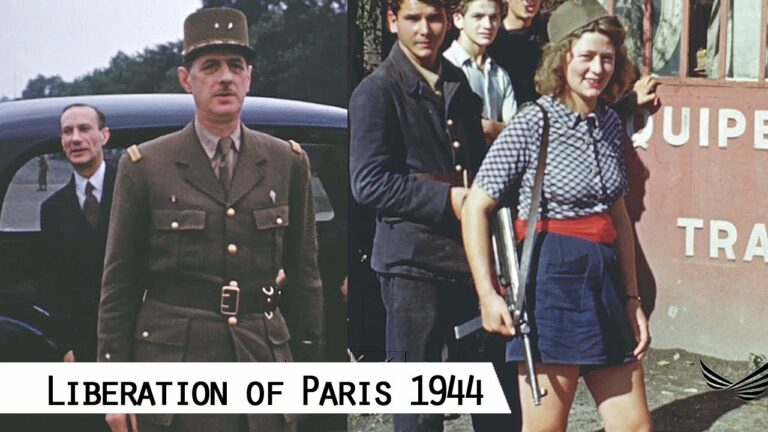
The above footage of Paris’ liberation in August 1944 looks and feels not dissimilar to a Hollywood movie. Part of its power owes to its being in color, a vanishingly rare quality in real film of World War II. But we must also credit its having been shot by a genuine Hollywood filmmaker, George Stevens. Having got his start in pictures as a teenager in the early nineteen-twenties (not long before making the cinematic-historical accomplishment of figuring out how to get Stan Laurel’s light-colored eyes to show up on film), Stevens became a respected director in the following decade. Swing Time, Gunga Din, The More the Merrier: with hits like that, he would seem to have had it made.
But it was just then, as F. X. Feeney tells it in the DGA Quarterly, that the war became unignorable. “The dangerous artistry of Leni Riefenstahl’s 1935 valentine to Adolf Hitler, Triumph of the Will, moved Stevens to volunteer for frontline service in World War II despite his being old enough to dodge a uniform […]
|
|
|
|
|
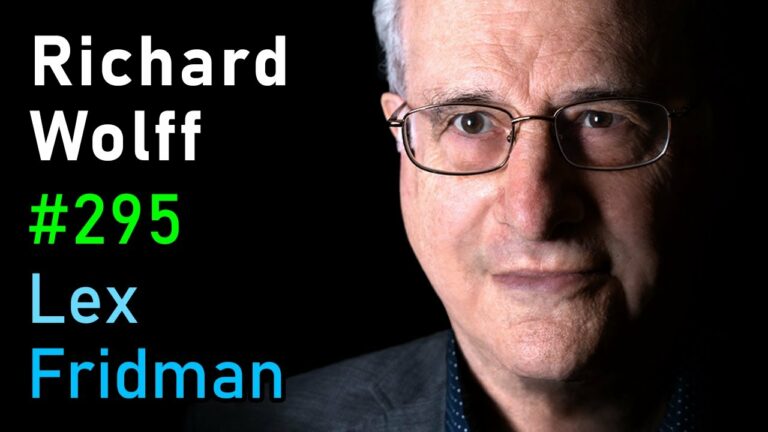
Lex Fridman, a Russian-American computer scientist and artificial intelligence researcher, hosts a popular podcast where he often interviews academics and helps them reach a surprisingly large audience. In recent weeks, he’s had long and wide-ranging conversations with NYU social psychologist Jonathan Haidt, Princeton historian Stephen Kotkin (on the history of Russia and the Ukraine war), and Stanford historian Norman Naimark (on genocide). Above you can now find his conversation with Marxist economist, Richard Wolff.
Fridman prefaces the lengthy conversation by saying, “This is a heavy topic, in general, and for me personally, given my family history in the Soviet Union, in Russia and Ukraine. Today, the words Marxism, Socialism and Communism are used to attack and divide, much more than to understand and learn. With this podcast, I seek the latter. I believe we need to study the ideas of Karl Marx, as well as their various implementations throughout the 20th and 21st centuries…. We need to consider seriously the ideas we demonize, and to challenge the ideas we dogmatically accept as true, even when […]
|
|
|
|
|
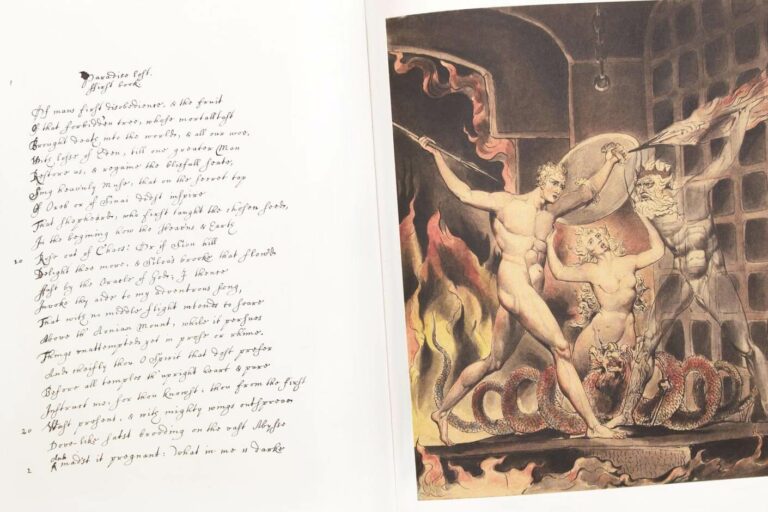
In The Marriage of Heaven and Hell, William Blake adds a note to the text that became a famous adage about John Milton’s Paradise Lost: the 10,000-line, 17th century blank verse epic about the war between heaven and hell and the failed testing of God’s premium product, human beings. Milton “wrote in fetters when he wrote of Angels & God, and at liberty when he wrote Devils & Hell,” Blake declared, “because he was a true Poet and of the Devil’s party without knowing it.” The statement inspired “other Romantic and Gothic writers to view Satan as a hero,” the British Library writes.
Blake himself illustrated Paradise Lost in three separate commissions over the course of his career as an engraver and printer. His deep admiration for the poem helped it become a “Bible of the Romantic movement,” writes the manuscript publisher SP Books in their introduction to a rare new book publication of the only surviving manuscript of the work.
Only 1,000 numbered, large format copies of this printing are available. (We […]
|
|
|
|
|
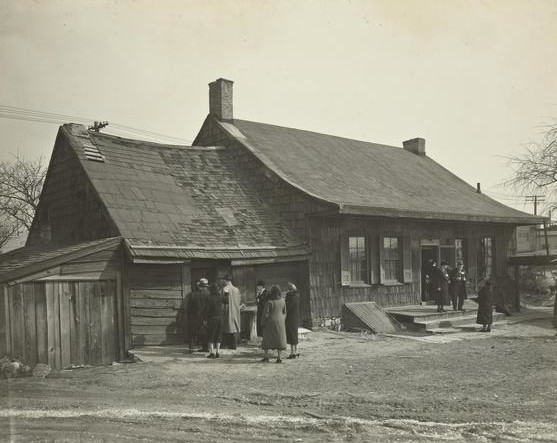
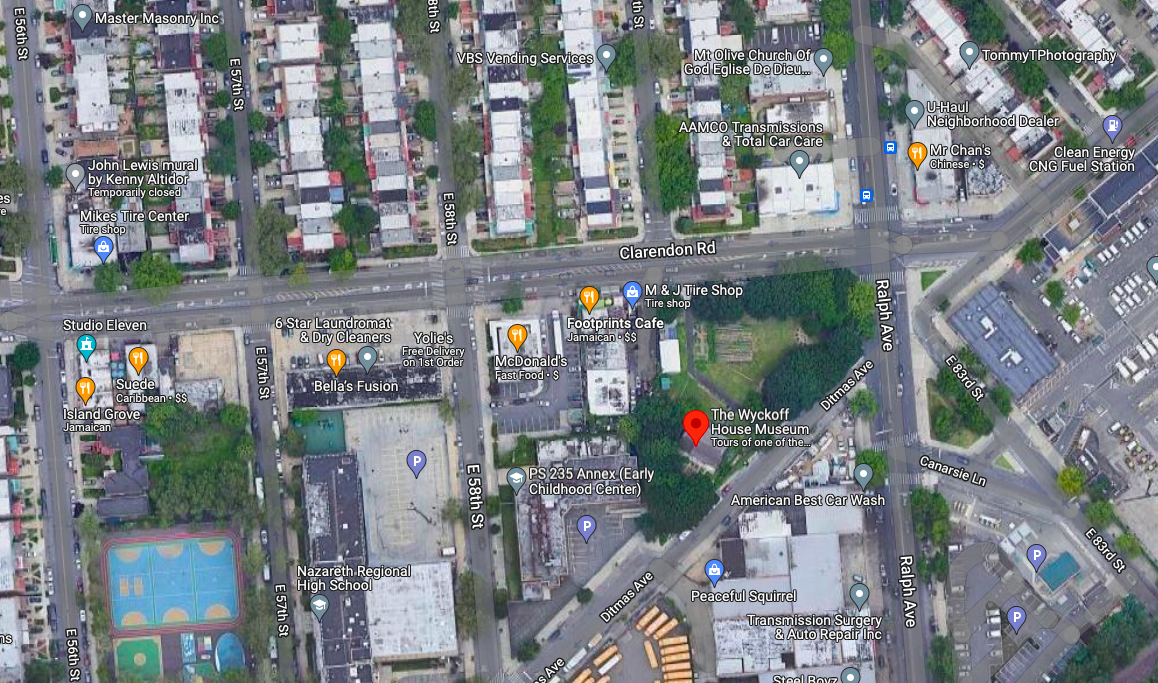
Most 21st-century Brooklyn public elementary schoolers have taken or will take a field trip to the Wyckoff House, a modest wooden cabin surrounded by tire shops and fast food outlets.
The oldest building in NYC by a longshot, it was also the first structure in the five boroughs to achieve historic landmark status.
Primary sources place the original occupants, Pieter Claesen Wyckoff and his wife, Grietje Van Ness-Wyckoff, in the original part of the house around 1652. A single room with a packed earth floor, unglazed windows, a large open hearth, and doors at either end, it would have been pretty tight quarters for a family of 13, as host Thijs Roes of the history series New Netherland Now notes, during his above tour of the premises.
Two parlors were added in the 18th-century, and three bedrooms in the early 19th. Typical Dutch Colonial features include an H frame structure, shingled walls, split Dutch doors, and deep, flared “spring” eaves.
 […] […]
|
|
|
|
|
Nirvana’s cultural staying power is a testament to the cross-generational magic that happened when Kurt Cobain, Krist Novoselić, and Dave Grohl played together for only a handful of years in the 90s. Their influence goes far deeper than 90s nostalgia for a grunge trend or the celebrity status of the late Cobain. Now almost 30 years after the frontman’s 1994 suicide, we see that influence on a generation born too late to see him live — one influenced more by hip hop than guitar rock and far less interested in challenging the capitalist status quo.
For artists like rapper Post Malone, born July 4, 1995, Cobain is a major songwriting influence, even if Post Malone’s music sounds little like Nirvana. “I loved Kurt so much,” says Malone, “and he’s been such an inspiration to me, musically.” To prove his love, he’s tattooed Cobain on “two different parts of his body,” Sheldon Pearce writes at The New Yorker, though Cobain might not have “reciprocated the love — the rapper’s stint shilling for Bud Light probably wouldn’t fly, and Cobain […]
|
|
|
|