|
Digest of new articles at openculture.com, your source for the best cultural and educational resources on the web ͏ ͏ ͏ ͏ ͏ ͏ ͏ ͏ ͏ ͏ ͏ ͏ ͏ ͏ ͏ ͏ ͏ ͏ ͏ ͏ ͏ ͏ ͏ ͏ ͏ ͏ ͏ ͏ ͏ ͏ ͏ ͏ ͏ ͏ ͏ ͏ ͏ ͏ ͏ ͏ ͏ ͏ ͏ ͏ ͏ ͏ ͏ ͏ ͏ ͏ ͏ ͏ ͏ ͏ ͏ ͏ ͏ ͏ ͏ ͏ ͏ ͏ ͏ ͏ ͏ ͏ ͏ ͏ ͏ ͏ ͏ ͏ ͏ ͏ ͏ ͏ ͏ ͏ ͏ ͏ ͏ ͏ ͏ ͏ ͏ ͏ ͏
|
|
I will let Vox preface the video above:
Ever since Qatar won the rights to host the FIFA World Cup in 2010, its treatment of migrant workers has made international headlines. News stories and human rights organizations revealed migrant workers who built the stadiums, hotels, and all the new infrastructure required for the World Cup were being forced to work, not getting paid, unable to leave, and in some cases, dying.
At the heart of the abuse faced by migrant workers is the kafala system. A system prevalent in Gulf states that ties workers to their sponsors, it often gives sponsors almost total control of migrant workers’ employment and immigration status.
Due to all the scrutiny Qatar has been under, some reforms have been put in place, but the kafala system is more than a law — it’s a practice. And while these reforms exist on paper, human rights organizations say there’s still a long way to go.
To understand how hundreds of thousands of migrant workers were stuck in an exploitative system while building the stadiums for the World Cup, watch our […]
|
|
|
|
|
Is there really a division in today’s culture between those who create and the merely receptive masses? Your Pretty Much Pop host gathers three artists in different media about the place of the artist in society: sci-fi author Brian Hirt, art photographer and academic Amir Zaki, and musician/novelist/ex-English prof John Andrew Fredrick, who leads a band called The Black Watch.
We touch on art education, the self-understanding of artists, the relation between artist and consumer, art vs. commerce, bad art vs. non-art, and much more.
Listen to Amir talking about photography on a past PMP episode. Listen to John talk about his music with Mark on Nakedly Examined Music. Listen to John’s new EP. Brian brings up the Decoder Ring podcast episode “The Storytelling Craze.” Listen to Mark’s tunes.
Follow us @blackwatchmusic, @amir_zaki_, and @MarkLinsenmayer.
[…]
|
|
|
|
|
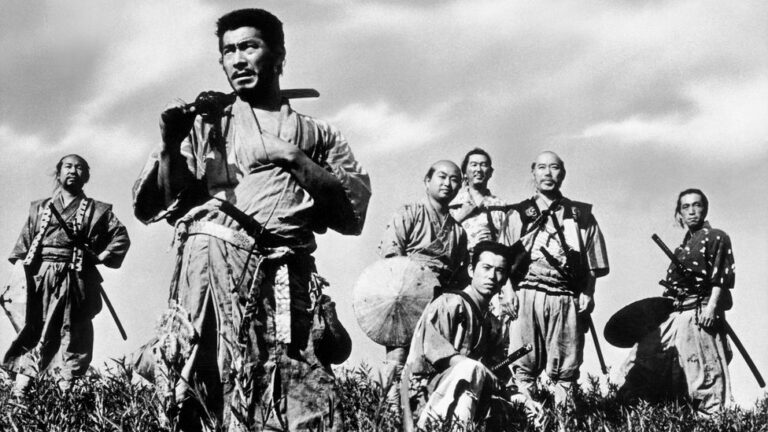
Last week, we featured the results of this decade’s Sight and Sound poll to determine the greatest films of all time. Nobody could possibly agree with every single one of its rankings, but then, some of the joy of cinephilia lies in disagreement — and even more of it in doing a few rankings of one’s own. Such is the project of video essayist Lewis Bond in the video just above from his Youtube channel The Cinema Cartography. It presents a list of the thirty greatest films, beginning at number thirty and ending at number one, weaving through a variety of time periods, cultures, and aesthetics.
We would expect no less from The Cinema Cartography, previously featured here on Open Culture for videos on subjects like cities and places in film, cinematography, and animation, as well as on specific auteurs like David Lynch, Quentin Tarantino, and Andrei Tarkovsky. None of Tarantino’s films make the cut for the top thirty here, though they do face formidable competition, including Lynch’s Mulholland Dr. and both Andrei Rublev and Mirror by […]
|
|
|
|
|
Here’s a vintage football [aka soccer] post in celebration of the World Cup…
Albert Camus once said, “After many years in which the world has afforded me many experiences, what I know most surely in the long run about morality and obligations, I owe to football.”
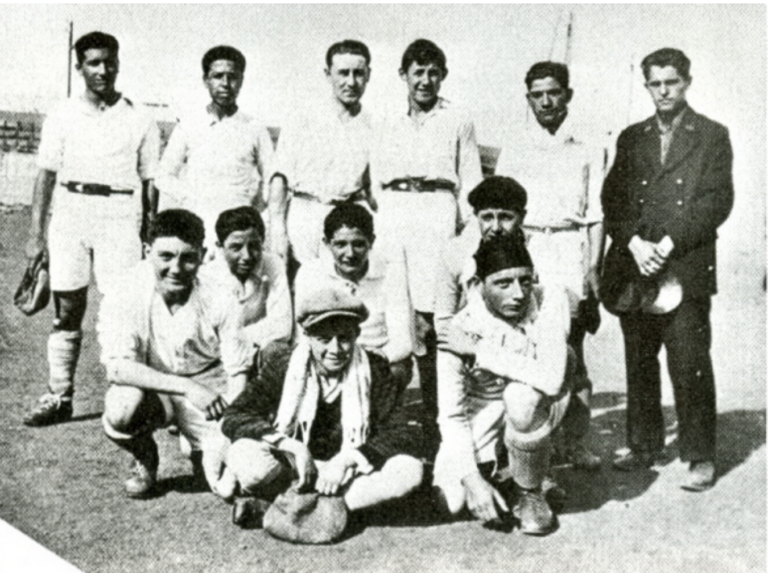
He was referring to his college days when he played goalie for the Racing Universitaire d’Alger (RUA) junior team. Camus was a decent player, though not the great player that legend later made him out to be.
For Jim White, author of A Matter of Life and Death: A History of Football in 100 Quotations, soccer perhaps taught Camus a few things about selflessness, cooperation, bravery and resilience. That’s a sunny way of looking at things. But perhaps The Telegraph gets at the deeper, darker life lessons Camus took away from soccer:
[T]here is something appropriate about a philosopher like Camus stationing himself between the sticks [that is, in goal]. It is a lonely calling, an individual isolated within a team ethic, one who plays to different […]
|
|
|
|
|
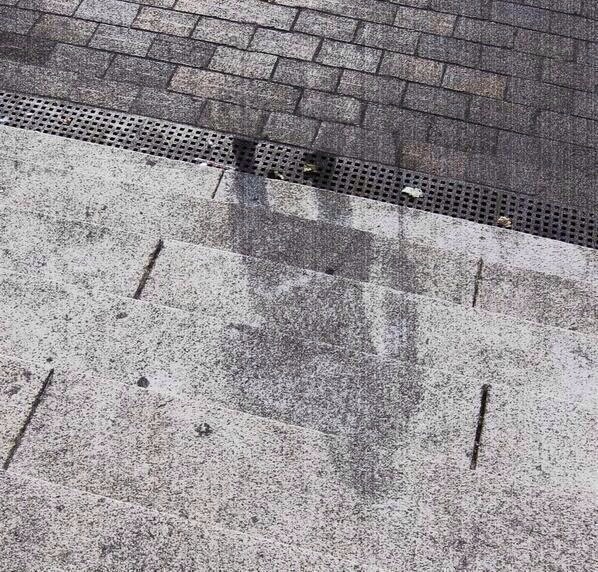
At 8:15 on the morning of August 6, 1945, a person sat on a flight of stone stairs leading up to the entrance of the Sumitomo Bank in Hiroshima, Japan. Seconds later, an atomic bomb detonated just 800 feet away, and the person sitting on the stairs was instantly incinerated. Gone like that. But not without leaving a mark.
As the Google Cultural Institute explains it, “Receiving the rays directly, the victim must have died on the spot from massive burns. The surface of the surrounding stone steps was turned whitish by the intense heat rays. The place where the person was sitting became dark like a shadow.”
That shadow lasted for years, until eventually rain and wind began to erode it. When a new Sumitomo Bank was built, the steps were relocated to the Hiroshima Peace Memorial Museum, where they’re now preserved. You can see the “Human Shadow Etched in Stone” above.
Related Content:
[…]
|
|
|
|