|
Digest of new articles at openculture.com, your source for the best cultural and educational resources on the web ͏ ͏ ͏ ͏ ͏ ͏ ͏ ͏ ͏ ͏ ͏ ͏ ͏ ͏ ͏ ͏ ͏ ͏ ͏ ͏ ͏ ͏ ͏ ͏ ͏ ͏ ͏ ͏ ͏ ͏ ͏ ͏ ͏ ͏ ͏ ͏ ͏ ͏ ͏ ͏ ͏ ͏ ͏ ͏ ͏ ͏ ͏ ͏ ͏ ͏ ͏ ͏ ͏ ͏ ͏ ͏ ͏ ͏ ͏ ͏ ͏ ͏ ͏ ͏ ͏ ͏ ͏ ͏ ͏ ͏ ͏ ͏ ͏ ͏ ͏ ͏ ͏ ͏ ͏ ͏ ͏ ͏ ͏ ͏ ͏ ͏ ͏
|
|
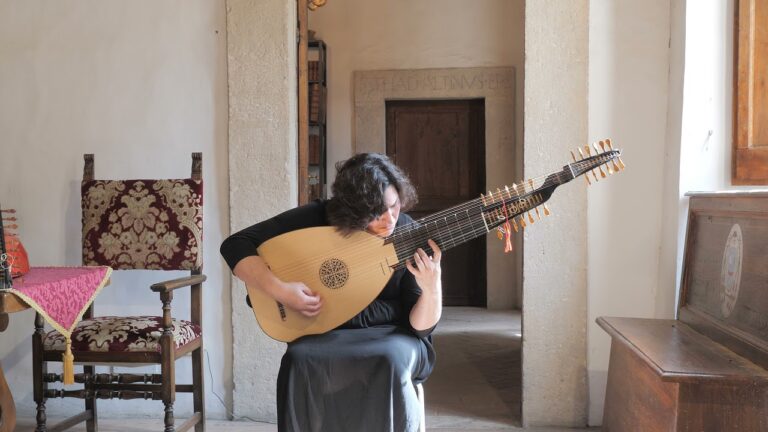
In the two videos here, see Argentine lutenist Evangelina Mascardi play passionate renditions of J.S. Bach compositions on the rich, resonant Baroque lute. In Bach’s time, lutenists were some of the most widely-admired instrumental players, and it’s easy to see why. The Baroque lute is not an easy instrument to play. Much less so were the theorbo and chitarrone, instruments like it but with longer necks for longer bass strings. We see Mascardi concentrate with utmost intensity on every note, a virtuoso on an instrument that Bach himself could not master.
Indeed, there has been significant debate over whether Bach actually composed his four pieces for solo lute for that instrument and not another. For one thing, he seems to have had a “weak grasp” of the instrument, guitarist and lutenist Cameron O’Connor writes in an examination of the evidence.
“The lute may have been an intimidating subject even for Bach.” There are several problems with authenticating existing copies of the music, and “none of the pieces in staff notation is playable on the standard Baroque lute without […]
|
|
|
When first published in 1985, Margaret Atwood’s The Handmaid’s Tale drew acclaim for how it combined and made new the genre conventions of the dystopian, historical, and fantasy novel. But the book has enjoyed its greatest fame in the past decade, thanks in part to a 2017 adaptation on Hulu and a sequel, The Testaments, published two years thereafter. It’s even become prominent in mass culture, frequently referenced in discussions of real-life politics and society in the manner of Nineteen Eighty-Four or Fahrenheit 451.
Like George Orwell and Ray Bradbury’s famous works, The Handmaid’s Tale also seems at risk of becoming less often read than publicly referenced — and therefore, no small amount of the time, publicly misinterpreted. The only way to fortify yourself against such abuse of literature is, of course, actually to read the book. Fortunately, The Handmaid’s Tale is now widely available, unlike certain books in certain places that have been subject to bans. It is against such banning that the latest edition of Atwood’s novel stands, printed and bound using only fireproof materials.
“Across the United States and […]
|
When first published in 1985, Margaret Atwood’s The Handmaid’s Tale drew acclaim for how it combined and made new the genre conventions of the dystopian, historical, and fantasy novel. But the book has enjoyed its greatest fame in the past decade, thanks in part to a 2017 adaptation on Hulu and a sequel, The Testaments, published two years thereafter. It’s even become prominent in mass culture, frequently referenced in discussions of real-life politics and society in the manner of Nineteen Eighty-Four or Fahrenheit 451.
Like George Orwell and Ray Bradbury’s famous works, The Handmaid’s Tale also seems at risk of becoming less often read than publicly referenced — and therefore, no small amount of the time, publicly misinterpreted. The only way to fortify yourself against such abuse of literature is, of course, actually to read the book. Fortunately, The Handmaid’s Tale is now widely available, unlike certain books in certain places that have been subject to bans. It is against such banning that the latest edition of Atwood’s novel stands, printed and bound using only fireproof materials.
“Across the United States and […]
|
|
|
|
|
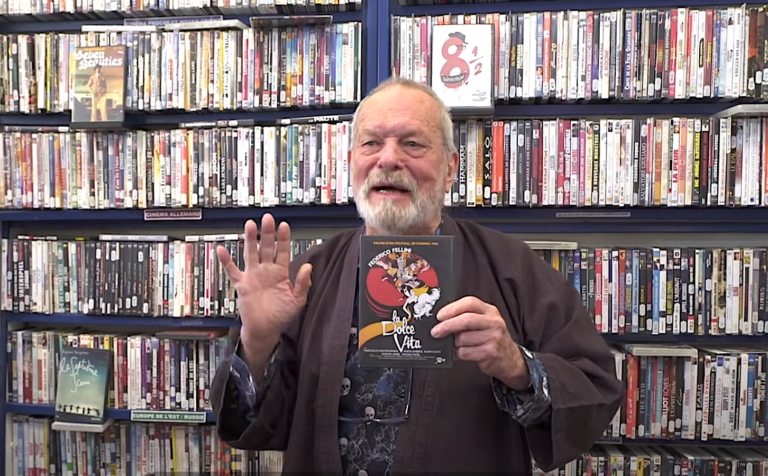
Letting a beloved film director wander through the aisles of a well-stocked video store feels like such guaranteed YouTube fodder that it’s a surprise it really hasn’t been done until recently. But then I remind myself that the video store itself is a thing of the past, and to see one so well stocked, Library of Alexandria style, is news itself. For the above video, the director browsing the DVDs is none other than madcap genius Terry Gilliam. The video store is Paris’ JM Video. The chat as expected is marvelous. (Only 20 minutes? I’m sure many of us could listen to Gilliam rabbit on about his favorite films for twice, thrice that.)
Along the way, here are some things we learn:
- Some of his favorite filmmakers are Stanley Kubrick, Lina Wertmuller, Federico Fellini, and one of his current friends, Albert Dupontel, the French actor-director who has used Gilliam in several of his films.
- He is thanked in the credits of Tarantino’s Reservoir Dogs. Why? Because when Tarantino was at the Sundance Institute with his script, it was only Gilliam […]
|
|
|
|
|
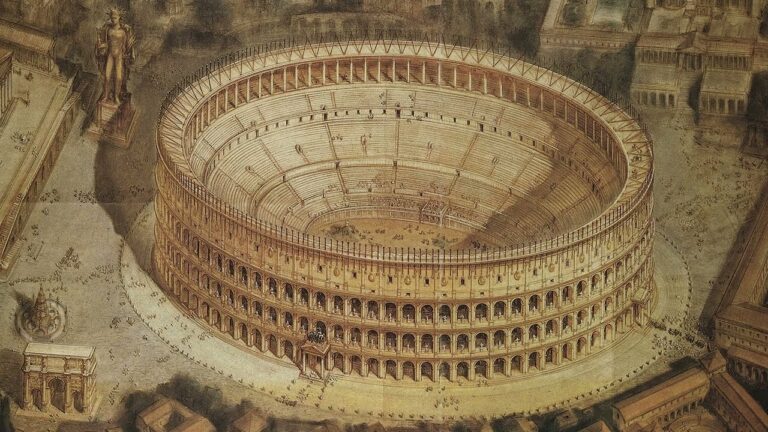
Last year we told you about the plan to install a retractable floor in the Colosseum, thus restoring a feature it boasted in its ancient glory days. Though the state pledged €10 million, the budget of an ambitious renovation will surely come to many times that — but still, we may imagine, only a fraction of the money it took to build the Colosseum in the first place. In fact we have to imagine it, since we have no records of what that icon of Rome actually cost. In the video above, history Youtuber Garrett Ryan, creator of the channel Told in Stone, does so by not just marshaling all his knowledge of the ancient world but also crowdsourcing others’ knowledge of modern construction techniques and expenses.
First, Ryan must reckon the cost of the Colosseum in sestertii, the “big brass coins” common in Rome of the first century AD. “At the time the Colosseum was built,” he says, “one sestertius could buy two loaves of bread, four cups of cheap wine, or a single cup of good wine.”
The average […]
|
|
|
|