|
Digest of new articles at openculture.com, your source for the best cultural and educational resources on the web ͏ ͏ ͏ ͏ ͏ ͏ ͏ ͏ ͏ ͏ ͏ ͏ ͏ ͏ ͏ ͏ ͏ ͏ ͏ ͏ ͏ ͏ ͏ ͏ ͏ ͏ ͏ ͏ ͏ ͏ ͏ ͏ ͏ ͏ ͏ ͏ ͏ ͏ ͏ ͏ ͏ ͏ ͏ ͏ ͏ ͏ ͏ ͏ ͏ ͏ ͏ ͏ ͏ ͏ ͏ ͏ ͏ ͏ ͏ ͏ ͏ ͏ ͏ ͏ ͏ ͏ ͏ ͏ ͏ ͏ ͏ ͏ ͏ ͏ ͏ ͏ ͏ ͏ ͏ ͏ ͏ ͏ ͏ ͏ ͏ ͏ ͏
|
|
By now, we’ve all heard of the recent technological advances that allow us to have plausible-sounding conversations with artificial-intelligence systems. Though near-science-fictionally impressive, such developments have yet to hone in on one particular world-changing application. In the meantime, those fascinated by its potential are trying to put it to all manner of different uses, some of them eminently practical and others less so. Far-fetched though it may seem, what if the “killer app” of such AI chatting turned out to be conversation with historical figures, even ones dead for millennia?

Such is the promise of the new site Character.AI, on which, writes the New York Times Cade Metz, “users can chat with reasonable facsimiles of everyone from Queen Elizabeth or William Shakespeare to Billie Eilish or Elon Musk (there are several versions).
Anyone you want to invoke, or concoct, is available for conversation.” Having learned from “reams of general dialogue as well as from articles, news stories, books and other digital text,” the system […]
|
|
|
|
|
Robespierre is an immortal figure not because he reigned supreme over the Revolution for a few months, but because he was the mouthpiece of its purest and most tragic discourse.
– François Furet, Interpreting the French Revolution
Cal Arts animation student Michelle Cheng’s character design primer, above, draws attention to the many hats an animator must be prepared to wear when bringing to life a figure who actually existed:
Artist…
Researcher…
Costume designer…
Hairstylist…
Psychologist…
Her choice of Maximilien Robespierre, one of the most influential figures of the French Revolution, suggests that Cheng enjoys a challenge.
As historian Peter McPhee writes in The Robespierre Problem: An Introduction:
Was Robespierre the first modern dictator, icily fanatical, an obsessive who used his political power to try to impose his rigid ideal of a land of Spartan […]
|
|
|
|
|
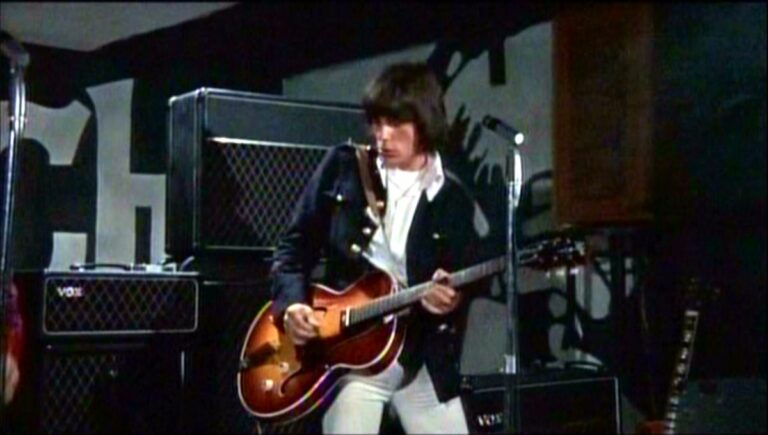
Note: With the passing of Jeff Beck, we’re bringing back a vintage post from our archive featuring the early years of the legendary guitarist. You can read his obituary here.
Art film and rock and roll have, since the 60s, been soulmates of a kind, with many an acclaimed director turning to musicians as actors, commissioning rock stars as soundtrack artists, and filming scenes with bands. Before Nicolas Roeg, Jim Jarmusch, David Lynch, Martin Scorsese and other rock-loving auteurs did all of the above, there was Michelangelo Antonioni, who barreled into the English-language market, under contract with Metro-Goldwyn-Mayer, with a trilogy of films steeped in the sights and sounds of sixties counterculture.
Blowup, the first and by far the best of these, though scored by jazz pianist Herbie Hancock, prominently featured the Yardbirds—with both Jimmy Page and Jeff Beck. In the memorable scene above, Beck smashes his guitar to bits after his amp goes on the fritz. The Italian director “envisioned a scene similar to that of Pete Townshend’s famous ritual of smashing his guitar on stage,” notes […]
|
|
|
|
|
The Chrysler Building was once the tallest structure in the world — a heyday that ended up lasting less than a year. The loss of that glorious title owed to the completion of the Empire State Building, twelve blocks away, in 1931. But it was all in the spirit of the game, the Chrysler Building having itself one-upped its close competitor 40 Wall Street (then called the Bank of Manhattan Trust Building) by installing a non-functional spire atop its signature crown at the last moment. But however much of a triumph it represented, that moment was poorly timed: the very next day would bring the Wall Street Crash of 1929, harbinger of the Great Depression. The subsequent decade would inspire little public favor for extravagant monuments in the Big Apple.
Yet compared to the life of a tower, economic cycles are short indeed. By now the Chrysler Building has seen the United States of America through a fair few ups and downs, only gaining appreciation all the while. Removed from its immediate historical context, we can more keenly appreciate architect William […]
|
|
|
|
|
Images courtesy of University of Tuebingen
That people wore clothes back in the Stone Age will hardly come as a surprise to anyone who grew up watching The Flintstones. That show, never wholly reliant on established archaeological fact, didn’t get too specific about its time period. But it turns out, based on recently published discoveries by a team of researchers from the University of Tübingen, the Senckenberg Centre for Human Evolution and Palaeoenvironment, and Leiden University, that Stone Agers were dressing themselves as early as 300,000 years ago — over one hundred millennia earlier than previously thought.
“This is suggested by cut marks on the metatarsal and phalanx of a cave bear discovered at the Lower Paleolithic site of Schöningen in Lower Saxony, Germany,” says the University of Tübingen’s site. The location of such marks indicate that the bear was not simply butchered but carefully skinned.
A cave bear’s winter coat “consists of both long outer hairs that form an airy protective layer and short, dense hairs that provide particularly good insulation” — making […]
|
|
|
|