|
Digest of new articles at openculture.com, your source for the best cultural and educational resources on the web ͏ ͏ ͏ ͏ ͏ ͏ ͏ ͏ ͏ ͏ ͏ ͏ ͏ ͏ ͏ ͏ ͏ ͏ ͏ ͏ ͏ ͏ ͏ ͏ ͏ ͏ ͏ ͏ ͏ ͏ ͏ ͏ ͏ ͏ ͏ ͏ ͏ ͏ ͏ ͏ ͏ ͏ ͏ ͏ ͏ ͏ ͏ ͏ ͏ ͏ ͏ ͏ ͏ ͏ ͏ ͏ ͏ ͏ ͏ ͏ ͏ ͏ ͏ ͏ ͏ ͏ ͏ ͏ ͏ ͏ ͏ ͏ ͏ ͏ ͏ ͏ ͏ ͏ ͏ ͏ ͏ ͏ ͏ ͏ ͏ ͏ ͏
|
|
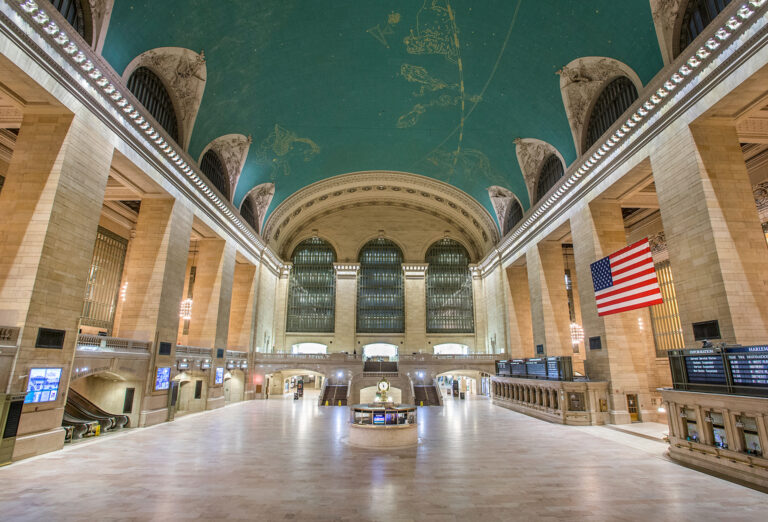
New Yorkers can be a maddeningly closed-mouth bunch, selfishly guarding our secret haunts lest they be overrun with newcomers and tourists…
But there’s not much we can do to deflect interest from Grand Central Teminal’s whispering gallery, a wildly popular acoustic anomaly in the tiled passageway just outside its famous Oyster Bar.
So we invite you to bring a friend, position yourselves in opposite corners, facing away from each other, and murmur your secrets to the wall.
Your friend will hear you as clearly as if you’d been whispering directly into their ear…and 9 times out of 10, a curious onlooker will approach to ask what exactly is going on.
Initiate them!
Sharing secrets of this order cultivates civic pride, a powerful force that Jacqueline Kennedy Onassis harnessed when developers threatened to obscure Grand Central’s beauty with a towering addition designed by Modernist architect Marcel Breuer.
Onassis wrote to Mayor Abraham Beame in 1975, hoping to enlist him in the fight to spare midtown Manhattan’s jewel from an […]
|
|
|
|
|
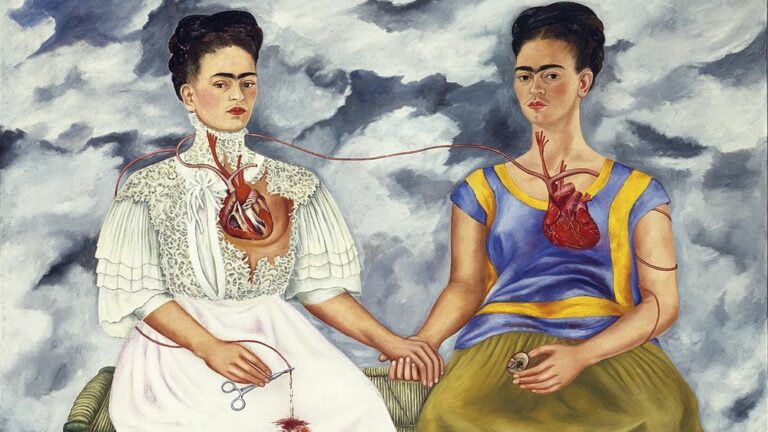
One can appreciate the art of Frida Kahlo while knowing nothing of the art of her onetime husband, the Mexican muralist Diego Rivera. But the experience of certain of her paintings can be greatly enriched by some knowledge of their relationship, the clearest example being The Two Fridas, which Kahlo painted in 1939 after their divorce. The largest of her numerous self-portraits, it presents the artist as a set of doppelgängers set apart by their attire: one wears a European dress, and the other a traditional Mexican one. The resulting tableau could, on one level, reflect her dual heritage; it also, as Kahlo herself put it, shows “the Frida Diego loved, and the one he didn’t.”
The Two Fridas is the subject of the video essay above from Great Art Explained. “The darker-skinned Frida on the right is the indigenous Mexican Frida that was adored by her husband,” explains its host, gallerist James Payne.
“The lighter-skinned Frida on the left is the European Frida that he rejected.” Presenting herself in the former fashion “sent a clear message […]
|
|
|
|
|
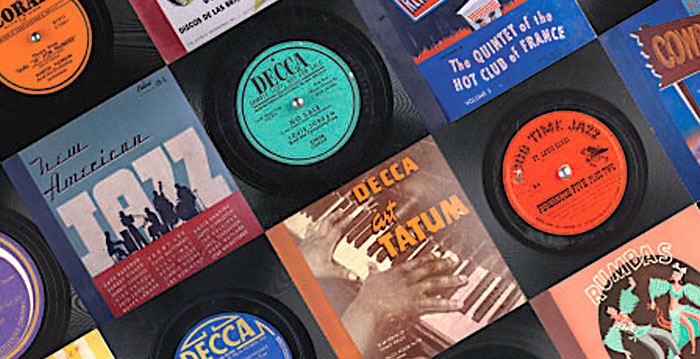
We may have yet to develop the technology of time travel, but recorded music comes pretty close. Those who listen to it have experienced how a song or an album can, in some sense, transport them right back to the time they first heard it. But older records also have the much stranger power to conjure up eras we never experienced. You can musically send yourself as far back as the nineteen-twenties with the above Youtube playlist of digitized 78 RPM records from the George Blood collection.
George Blood is the head of the audio-visual digitization company George Blood Audio, which has been participating in the Internet Archive’s Great 78 Project. “The brainchild of the Archive’s founder, Brewster Kahle, the project is dedicated to the preservation and discovery of 78rpm records,” writes The Vinyl Factory’s Will Pritchard.
The piece quotes Blood himself as saying that his company has been digitizing five to six thousand records per month with the ambitious goal of creating a “reference collection of sound recordings from the period of approximately […]
|
|
|
|
|
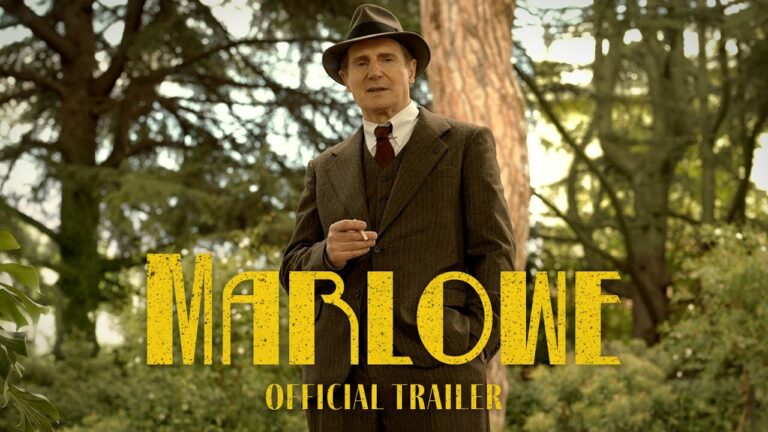
Behold the new trailer for Marlowe, a new film directed by Neil Jordan. As the title suggests, the film centers around Philip Marlowe, the gumshoe detective that Raymond Chandler first unveiled in The Big Sleep in 1939. Between then and now, Marlowe has been portrayed in films by Humphrey Bogart, Robert Mitchum, Elliott Gould, and James Garner. Now, Liam Neeson takes his turn. Here’s how the producers pitch the film:
MARLOWE, a gripping noir crime thriller set in late 1930’s Los Angeles, centers around a street-wise, down on his luck detective; Philip Marlowe, played by Liam Neeson, who is hired to find the ex-lover of a glamorous heiress (Diane Kruger), daughter of a well-known movie star (Jessica Lange). The disappearance unearths a web of lies, and soon Marlowe is involved in a dangerous, deadly investigation where everyone involved has something to hide.
Marlowe arrives in theaters on February 15.
Related Content
Raymond Chandler’s Ten Commandments for Writing a Detective Novel
[…]
|
|
|
|
|
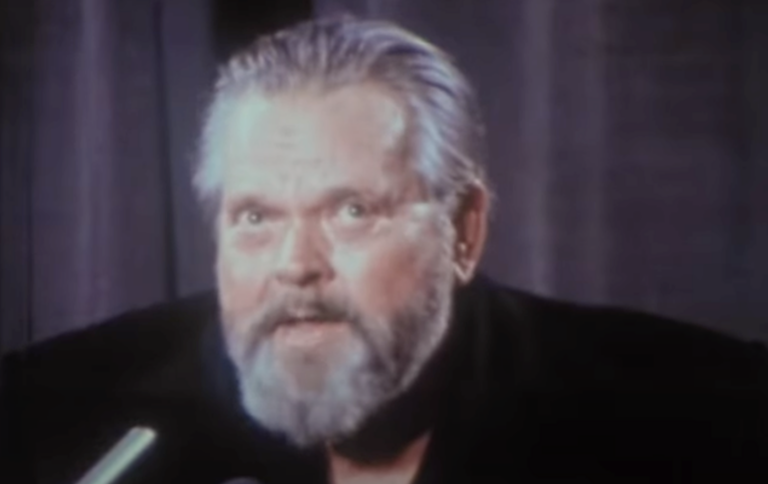
As we’ve previously noted here on Open Culture, Orson Welles was not given to mincing words about his colleagues. And the older he got, the fewer words he minced, as evidenced by the clip above from a talk he gave at a Paris film school in 1982. During the Q&A, he took a question that quoted Elia Kazan’s remarks on the difficulty of raising money in America for a film about Puerto Ricans. Or rather, he heard part of the question and launched right into his thundering response: “Mademoiselle, you have chosen the wrong metteur en scene, because Elia Kazan is a traitor.”
Welles took a minute to elaborate: “He is a man who sold to McCarthy all his companions at a time when he could continue to work in New York at high salary. And having sold all of his people to McCarthy, he then made a film called On the Waterfront which was a celebration of the informer. And therefore, no question which uses him as an example can be answered by me.” Welles made a […]
|
|
|
|