|
Digest of new articles at openculture.com, your source for the best cultural and educational resources on the web ͏ ͏ ͏ ͏ ͏ ͏ ͏ ͏ ͏ ͏ ͏ ͏ ͏ ͏ ͏ ͏ ͏ ͏ ͏ ͏ ͏ ͏ ͏ ͏ ͏ ͏ ͏ ͏ ͏ ͏ ͏ ͏ ͏ ͏ ͏ ͏ ͏ ͏ ͏ ͏ ͏ ͏ ͏ ͏ ͏ ͏ ͏ ͏ ͏ ͏ ͏ ͏ ͏ ͏ ͏ ͏ ͏ ͏ ͏ ͏ ͏ ͏ ͏ ͏ ͏ ͏ ͏ ͏ ͏ ͏ ͏ ͏ ͏ ͏ ͏ ͏ ͏ ͏ ͏ ͏ ͏ ͏ ͏ ͏ ͏ ͏ ͏
|
|
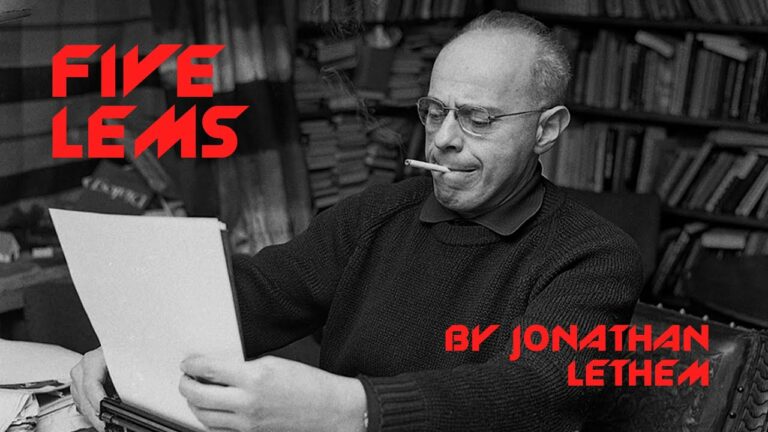
Who was Stanislaw Lem? The Polish science fiction writer, novelist, essayist, and polymath may best be known for his 1961 novel Solaris (adapted for the screen by Andrei Tarkosvky in 1972 and again by Steven Soderbergh in 2014). Lem’s science fiction appealed broadly outside of SF fandom, attracting the likes of John Updike, who called his stories “marvelous” and Lem a poet of “scientific terminology” for readers “whose hearts beat faster when the Scientific American arrives each month.”
Updike’s characterization is but one version of Lem. There are several more, writes Jonathan Lethem in an essay for the London Review of Books, penned for Lem’s 100th anniversary – at least five different Lems with five different literary personalities. Only the first is a “hard science fiction writer,” the genre originating not with Mary Shelley’s Frankenstein, but “in H.G. Wells’ technological prognostications.”
Represented best in the pages of Astounding Stories and other sci-fi pulps, hard sci-fi “advertises consumer goods like personal robots and flying cars. It valorizes space travel that culminates in successful, if difficult, contact with the […]
|
|
|
|
|
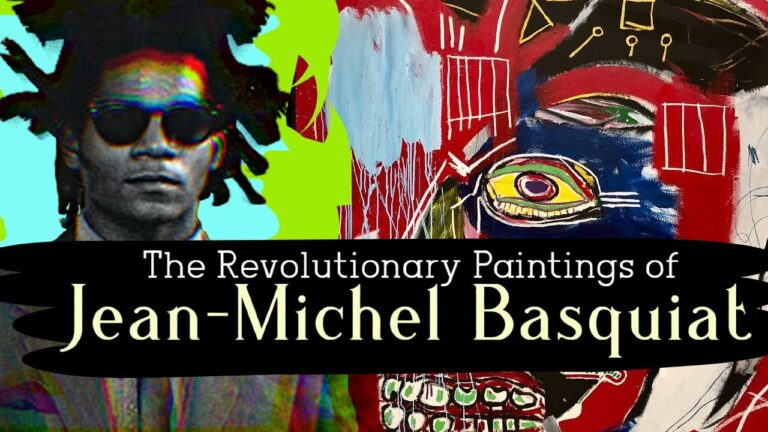
“The idea of the unrecognized genius slaving away in a garret is a deliciously foolish one,” says artist and critic Rene Ricard, as portrayed by Michael Wincott, in Julian Schnabel’s Basquiat. “We must credit the life of Vincent Van Gogh for really sending this myth into orbit.” And “no one wants to be part of a generation that ignores another Van Gogh. In this town, one is at the mercy of the recognition factor.” The town to which he refers is, of course, New York, in which the titular Jean-Michel Basquiat lived the entirety of his short life — and created the body of work that has continued not just to appreciate enormously in value, but to command the attention of all who so much as glimpse it.
As a film Basquiat has much to recommend it, not least David Bowie’s appearance as Andy Warhol. But as one would expect from a biopic about an artist directed by one of his contemporaries, it takes a subjective view of Basquiat’s life and career. “The Revolutionary Paintings of Jean-Michel Basquiat,” the […]
|
|
|
|
|
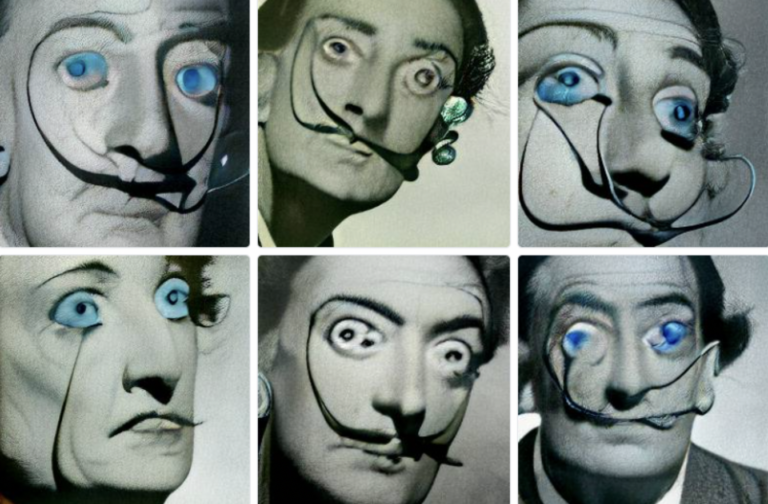
DALL-E, an artificial intelligence system that generates viable-looking art in a variety of styles in response to user supplied text prompts, has been garnering a lot of interest since it debuted this spring.
It has yet to be released to the general public, but while we’re waiting, you could have a go at DALL-E Mini, an open source AI model that generates a grid of images inspired by any phrase you care to type into its search box.
Co-creator Boris Dayma explains how DALL-E Mini learns by viewing millions of captioned online images:
Some of the concepts are learnt (sic) from memory as it may have seen similar images. However, it can also learn how to create unique images that don’t exist such as “the Eiffel tower is landing on the moon” by combining multiple concepts together.
Several models are combined together to achieve these results:
• an image encoder that turns raw images into a sequence of numbers with its […]
|
|
|
|
|
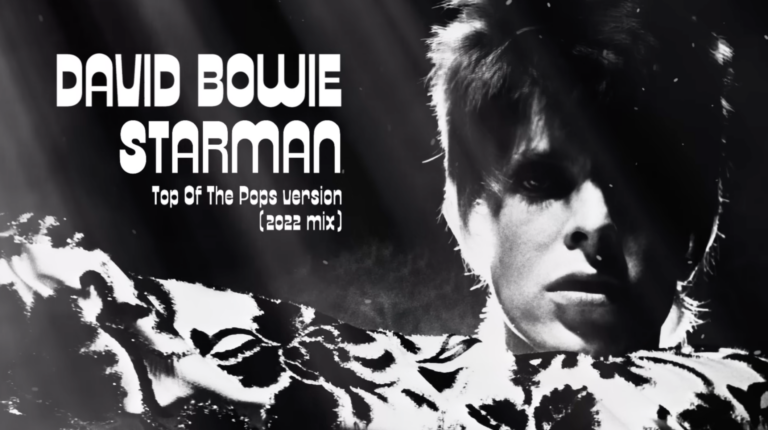
David Bowie’s fans have now been enjoying the character of Ziggy Stardust for a full five decades. That’s hardly a bad run, given that the opening track of The Rise and Fall of Ziggy Stardust and the Spiders from Mars announces that the end of the world will come in just five years. Released on June 16th, 1972, that album gave the public its introduction to the title character, an androgynous rock star from a distant star who one day arrives, messiah-like, on the dying Earth. But as the musical story goes, the resulting fame proves too much for him: the hapless Ziggy ends up in shambles, victimized by Earthly desires in all their manifestations.
One could read into all this certain aspirations and fears on the part of Ziggy Stardust’s creator-performer, the young David Bowie. Broad critical consensus holds that it was on the previous year’s Hunky Dory that Bowie first showed his true artistic potential.
Though that album, his fourth, boasted signature-songs-to-be like “Changes” and “Life on Mars?”, Bowie declared (no doubt to the label’s frustration) that he wouldn’t bother promoting […]
|
|
|
|
|
“The inhabitants of fifteenth-century Florence included Brunelleschi, Ghiberti, Donatello, Masaccio, Filippo Lippi, Fra Angelico, Verrocchio, Botticelli, Leonardo, and Michelangelo,” writes essayist and venture capitalist Paul Graham. “There are roughly a thousand times as many people alive in the U.S. right now as lived in Florence during the fifteenth century. A thousand Leonardos and a thousand Michelangelos walk among us.” But “to make Leonardo you need more than his innate ability. You also need Florence in 1450”: its community of artists, and indeed everyone of all classes who constituted its uncommonly fruitful society.
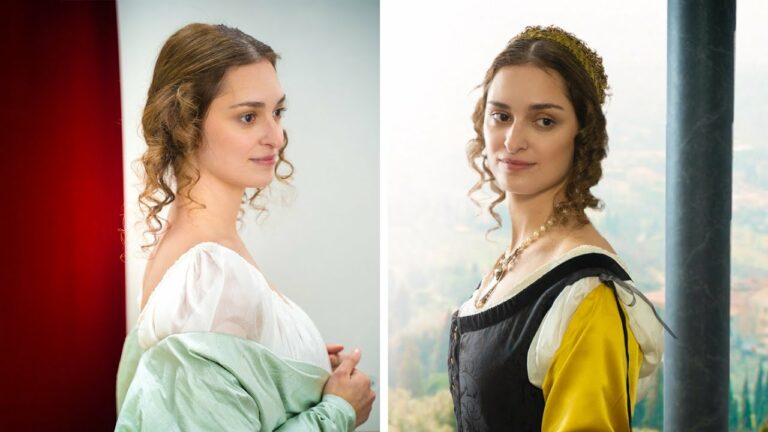
Florence’s cultural flourishing lasted into the sixteenth century. Above, you can see a morning in the life of one Florentine of the 1500s recreated in a video by Crow’s Eye Productions. Previously featured here on Open Culture for their re-creations of the dressing processes of the fourteenth, seventeenth, and eighteenth centuries, they show us this time how a woman would put herself together — or by the help, be put together — in turn-of-the-sixteenth-century Florence, which, “like many other Italian regions, had developed its own distinctive fashion […]
|
|
|
|