|
Digest of new articles at openculture.com, your source for the best cultural and educational resources on the web ͏ ͏ ͏ ͏ ͏ ͏ ͏ ͏ ͏ ͏ ͏ ͏ ͏ ͏ ͏ ͏ ͏ ͏ ͏ ͏ ͏ ͏ ͏ ͏ ͏ ͏ ͏ ͏ ͏ ͏ ͏ ͏ ͏ ͏ ͏ ͏ ͏ ͏ ͏ ͏ ͏ ͏ ͏ ͏ ͏ ͏ ͏ ͏ ͏ ͏ ͏ ͏ ͏ ͏ ͏ ͏ ͏ ͏ ͏ ͏ ͏ ͏ ͏ ͏ ͏ ͏ ͏ ͏ ͏ ͏ ͏ ͏ ͏ ͏ ͏ ͏ ͏ ͏ ͏ ͏ ͏ ͏ ͏ ͏ ͏ ͏ ͏
|
|
In the story of World War II we all know, a handful of murderous villains and flawed yet capable defenders of democracy drive the narrative. The authors of a Kings College London project argue that this conventional history shows “a preoccupation with the culpability of statesmen….. Above all else, the debate about war in 1939 revolves around personalities.” But there is another way to see the causes of war: through the escalating arms race of the 1930s, despite the global push for disarmament following World War I’s devastation.
The leaders of Germany, Italy and Japan wanted war, yet their ability to wage it, and the ways in which that war played out, came down to logistical contests between war machines. “First in Berlin, then in Rome and finally in Tokyo,” writes historian Joseph Maiolo, “the ebb and flow of arms competition compelled leaders to make now-or-never decisions about war.” Such decisions produced a wealth of unintended consequences, and led to catastrophic losses of life. Air, sea, and land power created at an unheard-of industrial scale turned war into an assembly […]
|
|
|
|
|
In literature, graphic descriptions of menace and dismemberment by monsters are as old as Beowulf and much, much older still, though it wasn’t until Horace Walpole’s 18th century novel The Castle of Otranto inspired the gothic romance novel that horror-qua-horror came into fashion. Without Walpole, and better-known gothic innovators like Mary Shelley and Bram Stoker, we’d likely never have had Edgar Allan Poe, H.P. Lovecraft, or Stephen King. But nowadays when we think of horror, we usually think of film—and all of its various contemporary subgenres, including creepy psychological twists on good-old-fashion monster movies, like The Babadook.
But from whence came the horror film? Was it 1931, a banner horror year in which audiences saw both Boris Karloff in James Whale’s Frankenstein and Bela Lugosi in Tod Browning’s Dracula? Certainly classic films by masters of the genre, but they did not originate the horror movie. There is, of course, F.W. Murnau’s terrifying silent Nosferatu from 1922 (and the real life horror of its deceased director’s missing head).
And what about German expressionism? “A case can be made,” argued […]
|
|
|
|
|
Piet Mondrian’s New York City I was recently discovered to have been hanging upside-down on display for the past 75 years, which made for a cultural story practically designed to go viral. Unsurprisingly, some of those keeping it in circulation have read it as proof positive of the fraudulence of “modern art.” How good could Mondrian be, after all, if nobody else over the past three-quarters of a century could tell that his painting wasn’t right-side-up? That isn’t a cogent criticism, of course: New York City I dates from 1941, by which time Mondrian’s work had long since become austere even by the standards of abstract art, employing only lines and blocks of color.
“The way the picture is currently hung shows the multicolored lines thickening at the bottom, suggesting an extremely simplified version of a skyline,” writes the Guardian‘s Philip Oltermann.
But “the similarly named and same-sized oil painting, New York City, which is on display in Paris at the Centre Pompidou, has the thickening of lines at the top,” and “a photograph of Mondrian’s studio, taken a few […]
|
|
|
|
|
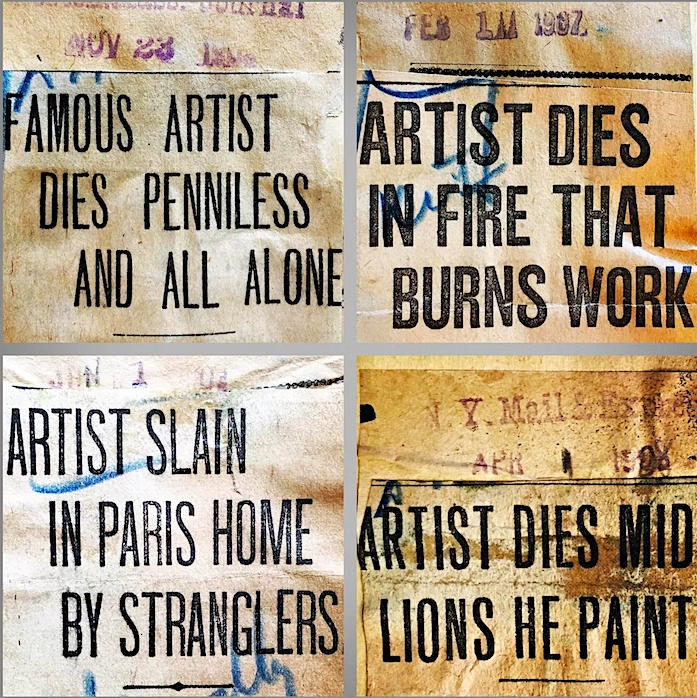
Oh to go behind the scenes at a world class museum, to discover treasures that the public never sees.
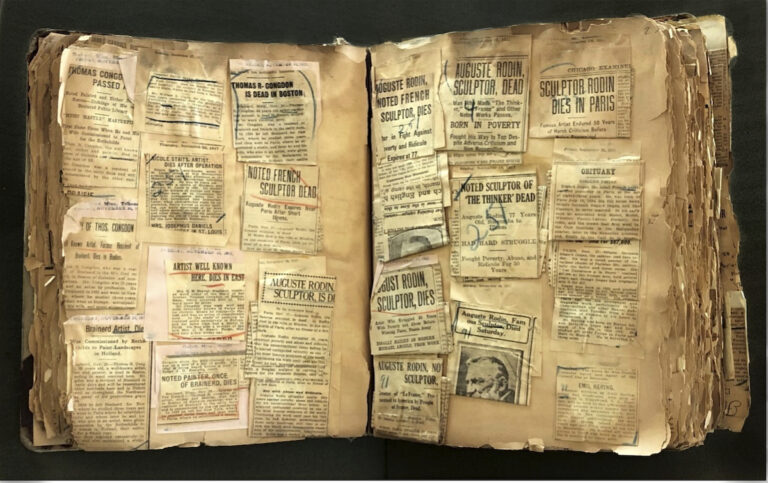
Among the most compelling – and unexpected – at the Metropolitan Museum of Art in New York City are a pair of crumbing scrapbooks, their pages thick with yellowing obituaries and death notices for a wide array of late 19th and early 20th-century painters, sculptors, and photographers.
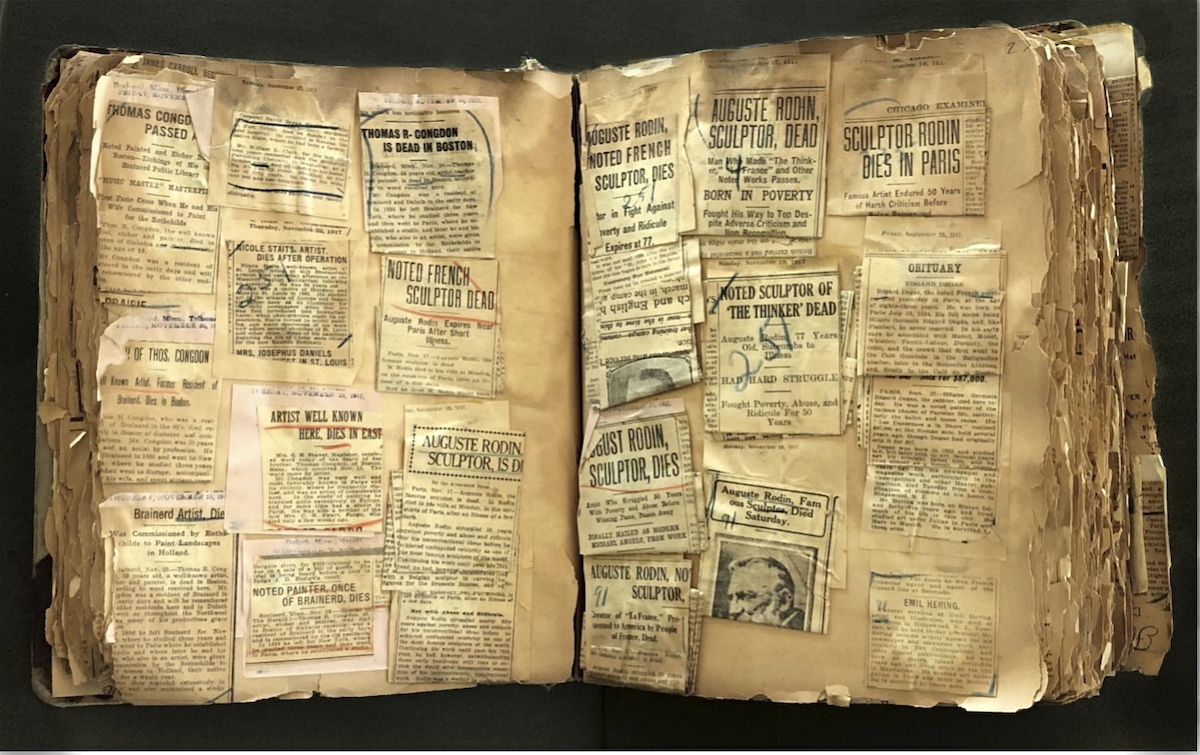
Some names, like Auguste Rodin or Jules Breton, are still familiar to many 21st-century art lovers.
Others, like Francis Davis Millet, who served as a Union Army drummer boy during the Civil War and perished on the Titanic, were much admired in their day, but have largely faded from memory.
The vast majority are requiems of a sort for those who toiled in obscurity. They may not have received much attention in life, but the circumstances of their deaths by suicide, murder, or bizarre accident had the whiff […]
|
|
|
|
|
For many Open Culture readers, the Halloween season offers an opportunity — not to say an excuse — to re-experience classic horror films: F.W. Murnau’s Nosferatu from 1922, for instance, or even George Méliès The Haunted Castle, which launched the whole form in 1896. This year, may we suggest a home screening of the formidable work of vintage cinema that is 1968’s The Astro Zombies? Written, produced, and directed by Ted Mikels — auteur of The Corpse Grinders and Blood Orgy of the She-Devils — it features not just “a mad astro-scientist” played by John Carradine and “two gore-crazed, solar-powered killer robot zombies,” but “a bloody trail of girl-next-door victims; Chinese communist spies; deadly Mexican secret agents led by the insanely voluptuous Tura Satana” and an “intrepid CIA agent” on the case of it all.
You can watch The Astro Zombies for free, and newly remastered in HD to boot, at Kino Cult, the new streaming site from film and video distributor Kino Lorber. Pull up the front page and you’ll be treated to a wealth of titillating viewing options of […]
|
|
|
|