|
Digest of new articles at openculture.com, your source for the best cultural and educational resources on the web ͏ ͏ ͏ ͏ ͏ ͏ ͏ ͏ ͏ ͏ ͏ ͏ ͏ ͏ ͏ ͏ ͏ ͏ ͏ ͏ ͏ ͏ ͏ ͏ ͏ ͏ ͏ ͏ ͏ ͏ ͏ ͏ ͏ ͏ ͏ ͏ ͏ ͏ ͏ ͏ ͏ ͏ ͏ ͏ ͏ ͏ ͏ ͏ ͏ ͏ ͏ ͏ ͏ ͏ ͏ ͏ ͏ ͏ ͏ ͏ ͏ ͏ ͏ ͏ ͏ ͏ ͏ ͏ ͏ ͏ ͏ ͏ ͏ ͏ ͏ ͏ ͏ ͏ ͏ ͏ ͏ ͏ ͏ ͏ ͏ ͏ ͏
|
|
I got hooked on Duolingo a few years ago. Since then, I’ve used it daily to practice languages like French, Spanish, Finnish, Chinese, and Japanese. But none of those courses is quite as popular with as many users as the one for English, which is widely spoken around the world — and, inevitably, almost as widely misspoken around the world. Even non-English-speaking countries tend to put up some English-language signage, sparse and strange though it can often be: a handwritten grocer’s sign warning customers not to “finger the peaches”; a notice mounted just above a urinal that urges visitors to “please urinate with precision and elegance.”
These examples come, unsurprisingly, from Japan, whose awkward but vividly memorable written English has long circulated in Western media. That made Tokyo the ideal location for the Museum of Wonky English, a pop-up collaboration between Duolingo Japan and creative agency UltraSuperNew that, as the latter’s site describes it, exhibits “sixteen of the best examples of wonky English found all over Japan.”
When “visitors look at the signs, menus, clothes, and […]
|
|
|
|
|
For a medieval knight, physical combat in a full suit of armor could hardly have been a simple matter — but then, nor could the task of putting it on in the first place. You can see the latter depicted in the video above from Norwegian history buff Ola Onsrud. He describes the armor as a “detailed reconstruction based on the effigy of the Black Prince (1330-1376) in the Canterbury Cathedral, other relevant effigies, paintings in fourteenth-century manuscripts and late fourteenth-century armor displayed in The Royal Armories in Leeds.” If you’ve so much as glanced at such imagery, Onsrud’s armor should strike you as looking quite like the real deal.
But this is functional clothing, after all, and as such must be put to the test. Onsrud does so in the video just below, a demonstration of how the wearer of such armor would actually do hand-to-hand combat. “To make comments, the visor of my helmet is open through most of the video,” he notes.
“This will of course make my face an interesting target for my […]
|
|
|
|
|
Many of us can remember a time when artificial intelligence was widely dismissed as a science-fictional pipe dream unworthy of serious research and investment. That time, safe to say, has gone. “Within a decade,” writes blogger Samuel Hammond, the development of artificial intelligence could bring about a world in which “ordinary people will have more capabilities than a CIA agent does today. You’ll be able to listen in on a conversation in an apartment across the street using the sound vibrations off a chip bag” (as previously featured here on Open Culture.) “You’ll be able to replace your face and voice with those of someone else in real time, allowing anyone to socially engineer their way into anything.”
And that’s the benign part. “Death-by-kamikaze drone will surpass mass shootings as the best way to enact a lurid revenge. The courts, meanwhile, will be flooded with lawsuits because who needs to pay attorney fees when your phone can file an airtight motion for you?” All this “will be enough to make the stablest genius feel schizophrenic.” But “it doesn’t have […]
|
|
|
|
|
Most casual viewers of Hieronymus Bosch’s paintings must acknowledge his artistic skill, and many must also wonder whether he was completely out of his mind. But insanity, however vividly suggested by his imagery, isn’t an especially compelling explanation for that imagery. Bosch painted in a particular place and time — the Netherlands of the late fifteenth and early sixteenth century, to be specific — but he also painted within a dominant worldview.”He grew up in a time of deep religious anxiety,” says Youtuber Hochelaga in the video essay above. “Ideas about sin, death, and the devil were becoming more sophisticated,” and “there was a genuine fear that demonic forces lived amongst the population.”
Hence the analyses like that of Great Art Explained, which frames Bosch’s best-known painting The Garden of Early Delights as an expression of “hardcore Christianity.” But something about the triptych’s sheer elaborateness and grotesquerie demands further inquiry. Hochelaga explores the possibility that Bosch worked in a condition of not just fearful piety, but psychological affliction.
“There is a disease called St. Anthony’s fire,” he says, contracted […]
|
|
|
|
|
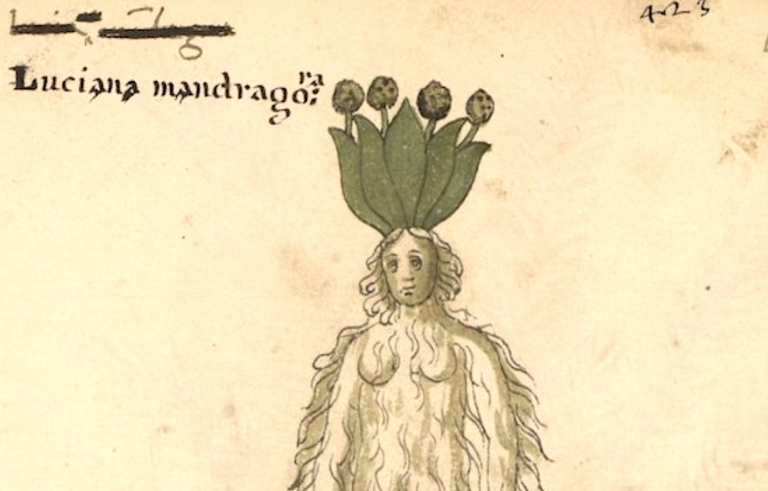
No matter where you may stand on herbal medicine as a viable 21st-century option, it’s not hard to imagine we’d have all been true believers back in the 15th-century.
In an article for Heart Views, cardiologist Rachel Hajar lists some common herbal treatments of the Middle Ages:
Headache and aching joints were treated with sweet-smelling herbs such as rose, lavender, sage, and hay. A mixture of henbane and hemlock was applied to aching joints. Coriander was used to reduce fever. Stomach pains and sickness were treated with wormwood, mint, and balm. Lung problems were treated with a medicine made of liquorice and comfrey. Cough syrups and drinks were prescribed for chest and head-colds and coughs.
If nothing else, such approaches sound rather more pleasant than bloodletting.
Monks were responsible for the study and cultivation of medicinal herbs.
You may recall how one of Friar Lawrence’s daily tasks in Romeo and Juliet involved venturing into the monastery garden, to fill his basket full “baleful weeds and precious-juicèd flowers.”
(The powerful sleeping potion he concocted for the young lovers may […]
|
|
|
|