|
Digest of new articles at openculture.com, your source for the best cultural and educational resources on the web ͏ ͏ ͏ ͏ ͏ ͏ ͏ ͏ ͏ ͏ ͏ ͏ ͏ ͏ ͏ ͏ ͏ ͏ ͏ ͏ ͏ ͏ ͏ ͏ ͏ ͏ ͏ ͏ ͏ ͏ ͏ ͏ ͏ ͏ ͏ ͏ ͏ ͏ ͏ ͏ ͏ ͏ ͏ ͏ ͏ ͏ ͏ ͏ ͏ ͏ ͏ ͏ ͏ ͏ ͏ ͏ ͏ ͏ ͏ ͏ ͏ ͏ ͏ ͏ ͏ ͏ ͏ ͏ ͏ ͏ ͏ ͏ ͏ ͏ ͏ ͏ ͏ ͏ ͏ ͏ ͏ ͏ ͏ ͏ ͏ ͏ ͏
|
|
…I would like not to underestimate the value of the world view which is the result of scientific effort. We have been led to imagine all sorts of things infinitely more marvelous than the imaginings of poets and dreamers of the past.
– Richard Feynman
In 1955, theoretical physicist Richard Feynman gave a talk on the value of science to members of the National Academy of Sciences at at Caltech University.
In the wake of the destruction of Hiroshima and Nagasaki, his involvement with the Manhattan Project had been cause for serious depression and soul searching.
He concluded that the pursuit of scientific knowledge remained valuable to society, even though such knowledge comes without operating instructions, and thus can be put to evil purposes.
In the Caltech speech, he cited the life improving technological and medical breakthroughs that are the result of scientific explorations, as well as the scientific field’s allegiance to the concept that we must be free to dissent, question, and discuss:
If we suppress all discussion, all criticism, proclaiming “This […]
|
|
|
|
|
For a twenty-first-century television fan, watching old network sitcoms can take some getting used to. Nothing about them takes more getting used to than their laugh tracks, which must strike anyone who didn’t grow up hearing them as utterly bizarre. But was it really so long ago that we took for granted — nay, expected — an eruption of pre-recorded laughter after each and every punch line? As late as the nineteen-nineties, even sitcoms well-regarded for their sophistication and subversiveness added “canned laughter” to their soundtracks. Take Seinfeld, the show famously “about nothing,” scenes from one of whose episodes you can watch without a laugh track in the video above.
The episode in question is one of Seinfeld‘s best-known: “The Soup Nazi,” originally broadcast on NBC on November 2, 1995. These scenes portray Jerry, George and Elaine’s encounters with the title figure, a harsh soup-restaurant proprietor based on Ali “Al” Yeganeh, owner of Soup Kitchen International in New York. (Unaware of the character’s real-life counterpart, actor Larry Thomas based his performance on that of Omar Sharif in Lawrence of Arabia.)
With the laugh […]
|
|
|
|
|
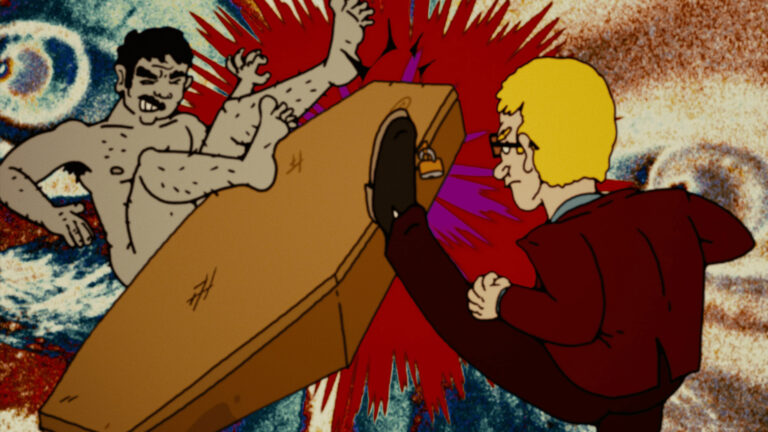
Self-improvement is a wonderful thing, and we obviously embrace the idea here at Open Culture. But corporate leadership trainings and self-help seminars can often serve to break people down rather than build them up. The cult-like mentality one finds in such environs should not surprise us: 1 in 5 business leaders have “psychopathic tendencies”; many self-help gurus actually do become — or start out as — narcissistic cult leaders. In the short film above by filmmaker Joey Izzo we see one corporate leadership training course that immediately devolved into a nightmarish scene of abuse and humiliation.
Based on an interview with Gene Church — a participant in the 1970 four-day leadership seminar in Palo Alto, California — the film mixes animation, photography, and dramatic recreations filmed in 16mm, portraying “an unconventional Mind Dynamics class where participants were forced to find a ‘moment of truth’ through a number of degrading and often violent acts,” writes Rob Munday at Short of the Week.
Participants of the men-only encounter group each paid $1000 for the privilege. All of them were distributers of a […]
|
|
|
|
|
This past Tuesday, April 26, experimental German electronic composer and musician Klaus Schulze died, leaving a musical legacy as significant as they come in the past half-century or so. Crowned the “godfather of techno,” Pitchfork writes, he was integral to both Krautrock (as 1970s German progressive rock was unflatteringly called) and the “Berlin School” of techno, and he “laid the groundwork for ambient, IDM, and many other sub-genres of contemporary electronic music. His relevance never waned.” Although a legend among those in the know, Schulze isn’t known in broader popular culture.
He should be, and will be, says Oscar-winning Dune composer Hans Zimmer, who worked parts of Schulze’s 1978 composition “Frank Herbert” (below) into the 2021 film’s score. “Klaus Schulze’s music has never been as relevant as it is now,” said Zimmer.
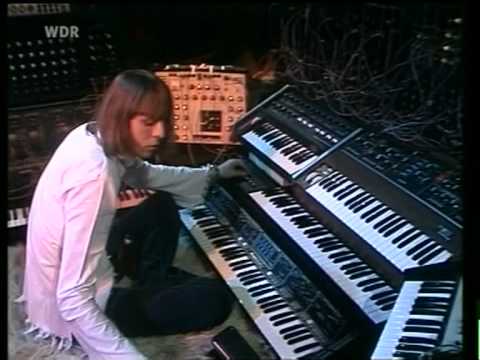
Soon afterward, Schulz recorded a new album, Deus Arrakis, scheduled for release on June 10. “I needed more of that spice,” the 74-year-old composer said. (See him above, sitting cross-legged, with blonde Prince Valiant ‘do, performing “For Barry Graves” live in Köln in 1977.) “From there I felt completely unleashed […]
|
|
|
|
|
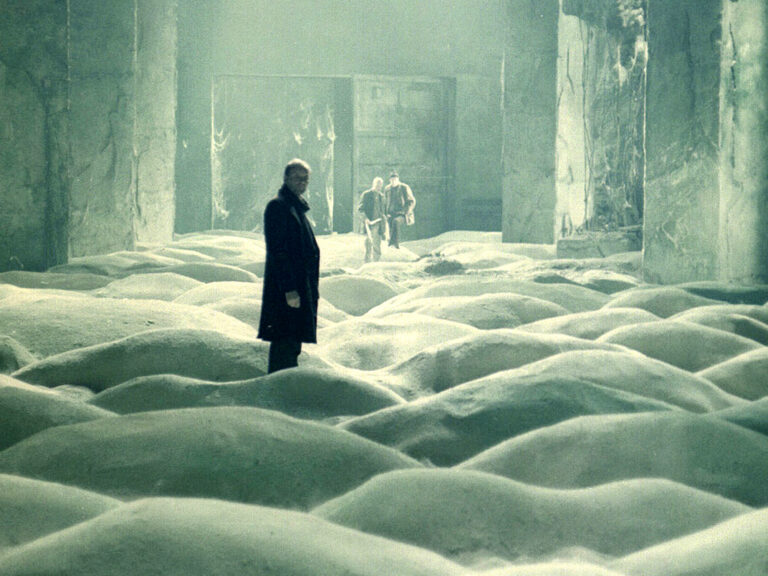
The stench of Vladimir Putin and his invasion of Ukraine shouldn’t taint everything Russian, especially some of its finest cinema. So we’ll give you this heads up: Mosfilm, the largest and oldest film studio in Russia, has posted several major films by Andrei Tarkovsky (1932-1986), on its official YouTube channel. Above, you can watch Stalker, which we’ve covered amply here on Open Culture. Below, stream The Mirror, Andrei Rublev, and Ivan’s Childhood. Stream other Mosfilm movies here.
The Mirror
Andrei Rublev
Ivan’s Childhood
Related Content:
The Masterful Polaroid Pictures Taken by Filmmaker Andrei Tarkovsky
Tarkovsky’s Advice to Young Filmmakers: Sacrifice Yourself for Cinema
Andrei Tarkovsky Calls Kubrick’s 2001: A Space Odyssey a “Phony” Film “With Only Pretensions to Truth”
Slavoj Žižek Explains the Artistry of Andrei Tarkovsky’s Films: Solaris, Stalker & More
Watch Stalker, Andrei Tarkovsky’s Mind-Bending Masterpiece Free Online
[…]
|
|
|
|