|
Digest of new articles at openculture.com, your source for the best cultural and educational resources on the web ͏ ͏ ͏ ͏ ͏ ͏ ͏ ͏ ͏ ͏ ͏ ͏ ͏ ͏ ͏ ͏ ͏ ͏ ͏ ͏ ͏ ͏ ͏ ͏ ͏ ͏ ͏ ͏ ͏ ͏ ͏ ͏ ͏ ͏ ͏ ͏ ͏ ͏ ͏ ͏ ͏ ͏ ͏ ͏ ͏ ͏ ͏ ͏ ͏ ͏ ͏ ͏ ͏ ͏ ͏ ͏ ͏ ͏ ͏ ͏ ͏ ͏ ͏ ͏ ͏ ͏ ͏ ͏ ͏ ͏ ͏ ͏ ͏ ͏ ͏ ͏ ͏ ͏ ͏ ͏ ͏ ͏ ͏ ͏ ͏ ͏ ͏
|
|
Some histories tell us more about their narrators than their characters. The story of tattoos in ancient Egypt is one example. While tattoos and other forms of body modification have been part of nearly every ancient culture, Egyptologists have found many more tattooed female than male mummies at ancient burial sites. Since tattooing seemed to be an almost “exclusively female practice in ancient Egypt,” writes archeologist Joann Fletcher, “mummies found with tattoos were usually dismissed by the (male) excavators who seemed to assume the women were of ‘dubious status,’ described in some cases as ‘dancing girls.'”
There is no evidence, however, to suggest that tattoos in ancient Egypt specifically marked dancers, prostitutes, concubines, or individuals of a lower class (and thus of little interest to some early archaeologists). One mummy described as a concubine “was actually a high-status priestess named Amunet, as revealed by her funerary inscriptions.” Early archaeologists stubbornly clung to derogatory 19th-century assumptions about tattoos (and class, dancing, sex, and religion), even when discussing tattooed Egyptian women whose burials obviously showed they were priestesses or extended members of […]
|
|
|
|
|
“We’re drowning in music,” says Michael Spitzer, professor of music at the University of Liverpool. “If you were born in Beethoven’s time, you’d be lucky if you heard a symphony twice in your lifetime, whereas today, it’s as accessible as running water.” We shouldn’t take music, or running water, for granted, and the comparison should give us pause: do we need music –- for example, nearly any recording of any Beethoven symphony we can think of -– to flow out of the tap on demand? What does it cost us? Might there be a middle way between hearing Beethoven whenever and hearing Beethoven almost never?
The story of how humanity arrived at its current relationship with music is the subject of the Big Think interview with Spitzer above, in which he covers 40,000 years in 8 minutes: “from bone flutes to Beyoncé.” We begin with his thesis that “we in the West” think of music history as the history of great works and great composers. This misconception “tends to reduce music into an object,” and a commodity. Furthermore, we “overvalue […]
|
|
|
|
|
Take a look at photos of Bush Tetras — a three-girl-one-guy No Wave/Post-Punk band from the early 1980s downtown Manhattan scene. Now, look at the photograph above, “Marcel Breuer and His Harem,” by Bauhaus photographer Erich Consemüller, taken sometime around 1927. Except for the fact that Breuer looks more like Ron Mael of Sparks sans mustache than drummer Dee Pop, one might mistake this for a photo of the punk band. This raises a few questions: did art students Bush Tetras look to the women of the Bauhaus for their style? Or did the women of the Bauhaus look to the future and see punk? The second scenario seems more likely since the women of Bauhaus have not, until recently, been terribly well-known.
I personally feel cheated after studying art and art history in college many years ago and only now getting introduced to several significant artists of the radical German art school founded by Walter Gropius. All of its famous exponents and art stars are men, but […]
|
|
|
|
|
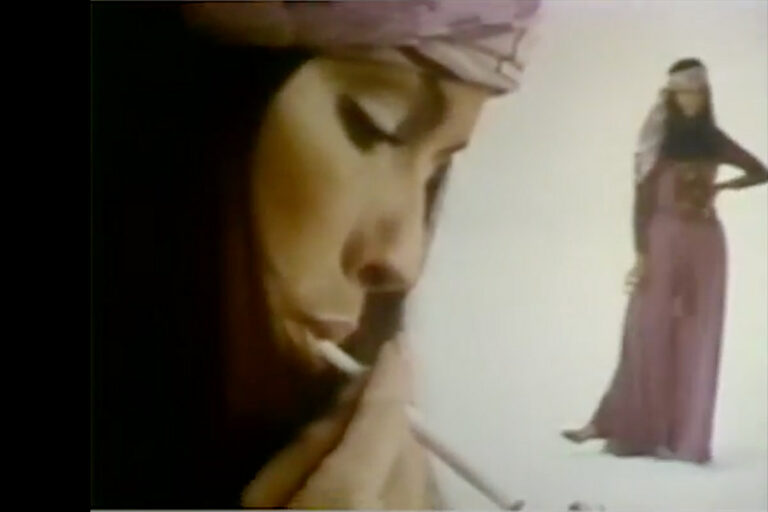
The slogan “You’ve come a long way, baby” still has some pop-cultural currency. But how many Americans under the age of sixty remember what it advertised? The line was first rolled out in 1968 to promote Virginia Slims, the then-new brand of cigarettes marketed explicitly to women. “Every ad in the campaign put a woman front and center, equating smoking Virginia Slims with being independent, stylish, confident and liberated,” says the American Association of Advertising Agencies. “The slogan itself spoke directly about the progress women all over America were fighting for.”
Such was the zeitgeist power of Virginia Slims that they became the very last cigarette brand ever advertised on American TV, at 11:59 p.m on January 2, 1971, during The Tonight Show Starring Johnny Carson. Richard Nixon had signed the Public Health Cigarette Smoking Act, which banned cigarette advertisements on broadcast media, on April 1, 1970. But it didn’t take effect immediately, the tobacco industry having managed to negotiate for itself one last chance to air commercials during the college football games of New Year’s Day 1971.
“The […]
|
|
|
|
|
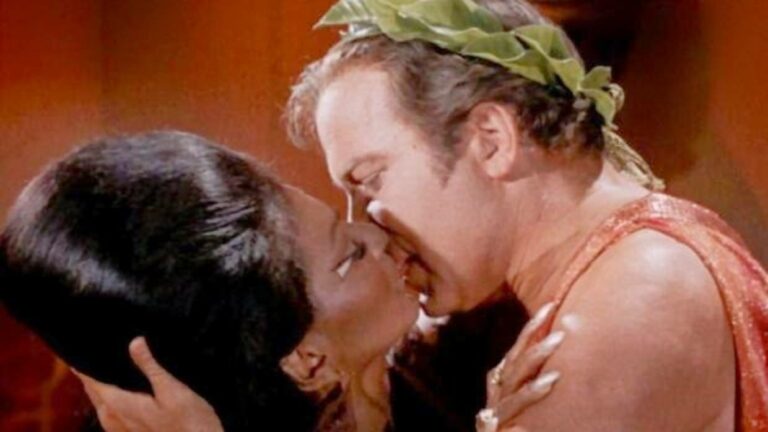
The original Star Trek ran for only three seasons, but in that short time it had, to put it mildly, an outsized cultural impact. That partly had to do with the series having aired in the late nineteen-sixties, an era when a host of long-standing norms in American society (as well as in other societies across the world) seemed to have come up for re-negotiation. Through its science-fictional premises and twenty-third-century setting, Star Trek could deal with the present in ways that would have been difficult for other, ostensibly more realistic programs.
In “Plato’s Stepchildren,” an episode from 1968, several members of the Enterprise’s crew find themselves captive on a planet of telekinetic, ancient-Greece-worshipping sadists. It was there that Star Trek staged one of its most memorable moments, a kiss between William Shatner’s Captain Kirk and the late Nichelle Nichols’ Lieutenant Uhura. It arises not out of a relationship that has developed organically between the characters, but out of compulsion by the powers of their “Platonian” captors, who force the humans to perform for their entertainment.
Despite that narrative loophole, the […]
|
|
|
|