|
Digest of new articles at openculture.com, your source for the best cultural and educational resources on the web ͏ ͏ ͏ ͏ ͏ ͏ ͏ ͏ ͏ ͏ ͏ ͏ ͏ ͏ ͏ ͏ ͏ ͏ ͏ ͏ ͏ ͏ ͏ ͏ ͏ ͏ ͏ ͏ ͏ ͏ ͏ ͏ ͏ ͏ ͏ ͏ ͏ ͏ ͏ ͏ ͏ ͏ ͏ ͏ ͏ ͏ ͏ ͏ ͏ ͏ ͏ ͏ ͏ ͏ ͏ ͏ ͏ ͏ ͏ ͏ ͏ ͏ ͏ ͏ ͏ ͏ ͏ ͏ ͏ ͏ ͏ ͏ ͏ ͏ ͏ ͏ ͏ ͏ ͏ ͏ ͏ ͏ ͏ ͏ ͏ ͏ ͏
|
|
Letting a beloved film director wander through the aisles of a well-stocked video store feels like such guaranteed YouTube fodder that it’s a surprise it really hasn’t been done until recently. But then I remind myself that the video store itself is a thing of the past, and to see one so well stocked, Library of Alexandria style, is news itself. For the above video, the director browsing the DVDs is none other than madcap genius Terry Gilliam. The video store is Paris’ JM Video. The chat as expected is marvelous. (Only 20 minutes? I’m sure many of us could listen to Gilliam rabbit on about his favorite films for twice, thrice that.)
Along the way, here are some things we learn:
- Some of his favorite filmmakers are Stanley Kubrick, Lina Wertmuller, Federico Fellini, and one of his current friends, Albert Dupontel, the French actor-director who has used Gilliam in several of his films.
- He is thanked in the credits of Tarantino’s Reservoir Dogs. Why? Because when Tarantino was at the Sundance Institute with his script, it was only Gilliam […]
|
|
|
|
|
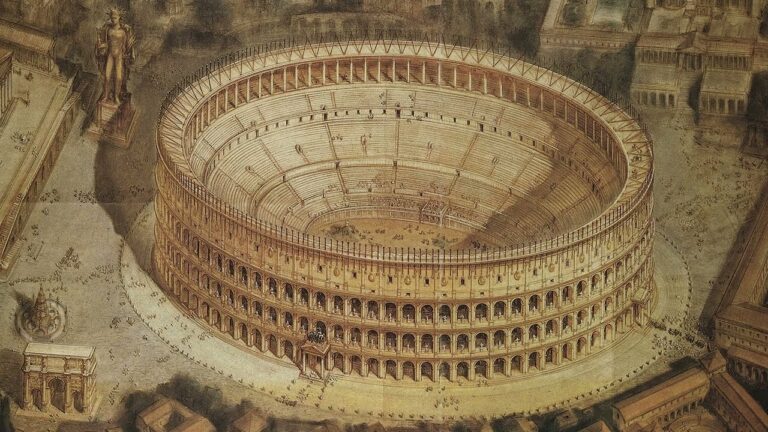
Last year we told you about the plan to install a retractable floor in the Colosseum, thus restoring a feature it boasted in its ancient glory days. Though the state pledged €10 million, the budget of an ambitious renovation will surely come to many times that — but still, we may imagine, only a fraction of the money it took to build the Colosseum in the first place. In fact we have to imagine it, since we have no records of what that icon of Rome actually cost. In the video above, history Youtuber Garrett Ryan, creator of the channel Told in Stone, does so by not just marshaling all his knowledge of the ancient world but also crowdsourcing others’ knowledge of modern construction techniques and expenses.
First, Ryan must reckon the cost of the Colosseum in sestertii, the “big brass coins” common in Rome of the first century AD. “At the time the Colosseum was built,” he says, “one sestertius could buy two loaves of bread, four cups of cheap wine, or a single cup of good wine.”
The average […]
|
|
|
|
|
It would be awfully clichéd to call Seoul, where I live, a place of contrasts between old and new. And yet that texture really does manifest everywhere in Korean life, most palpably on the streets of the capital. In my favorite neighborhoods, one passes through a variety of different eras walking down a single alley. “Third-wave” coffee shops and “newtro” bars coexist with family restaurants unchanged for decades and even small industrial workshops. Those workshops produce clothing, plumbing fixtures, printed matter, electronics, and much else besides, in many cases late into the night. For all its reputation as a high-tech “Asian Tiger,” this remains, clearly and presently, a country that makes things.
You can see just how Korea makes things on the Youtube channel All Process of World, which has drawn tens of millions of views with its videos of factories: factories making forks, bricks, sliced tuna, sheepskin jackets, bowling balls, humanoid robots. The scale of these Korean industrial operations ranges from the massive to the artisanal; some products are unique to twenty-first century life, and others […]
|
|
|
|
|
When we speak of a “lost art,” we do not always mean that humans have forgotten certain production methods. Modern craftspeople can recover or reasonably approximate old techniques and materials, and produce artifacts that can be passed off as authentic by the unscrupulous. The spirit of the thing, however, can never be recovered. Try as they might, scholars and conservators will never be able to enter the mind of a Medieval scribe or manuscript illuminator. Their social world has disappeared into a distant mist; we can only dimly guess at what their lives were like.
Thus, for many years, the reception of Hieronymus Bosch — the bizarre fantasist from the Netherlands whose visions of Earth, Heaven, and Hell have amused and terrified viewers — stressed the proto-Surrealism of his work, assuming he must have had other intentions than proselytizing.
Most recent interpretation, however, has pulled in the other direction, stressing the degree to which Bosch and his contemporaries believed in a universe that was exactly as weird as he depicted it, […]
|
|
|
|