|
Digest of new articles at openculture.com, your source for the best cultural and educational resources on the web ͏ ͏ ͏ ͏ ͏ ͏ ͏ ͏ ͏ ͏ ͏ ͏ ͏ ͏ ͏ ͏ ͏ ͏ ͏ ͏ ͏ ͏ ͏ ͏ ͏ ͏ ͏ ͏ ͏ ͏ ͏ ͏ ͏ ͏ ͏ ͏ ͏ ͏ ͏ ͏ ͏ ͏ ͏ ͏ ͏ ͏ ͏ ͏ ͏ ͏ ͏ ͏ ͏ ͏ ͏ ͏ ͏ ͏ ͏ ͏ ͏ ͏ ͏ ͏ ͏ ͏ ͏ ͏ ͏ ͏ ͏ ͏ ͏ ͏ ͏ ͏ ͏ ͏ ͏ ͏ ͏ ͏ ͏ ͏ ͏ ͏ ͏
|
|
This past month, on the eve of the June 22nd feast of St Alban, the library of Trinity College Dublin announced that it had digitized the “13th century masterpiece” the Book of St Alban, a richly illustrated manuscript that “features 54 individual works of medieval art and has fascinated readers across the centuries, from royalty to renaissance scholars.”
Created by the Benedictine monk Matthew Paris, the manuscript “chronicles the life of St Alban,” notes The Irish Times, “and also outlines the construction of St Alban’s Cathedral in Hertfordshire.” The text and illustrations explain the origins of a cult of St. Alban, the first English martyr, that began to spring up after his 4th century death.
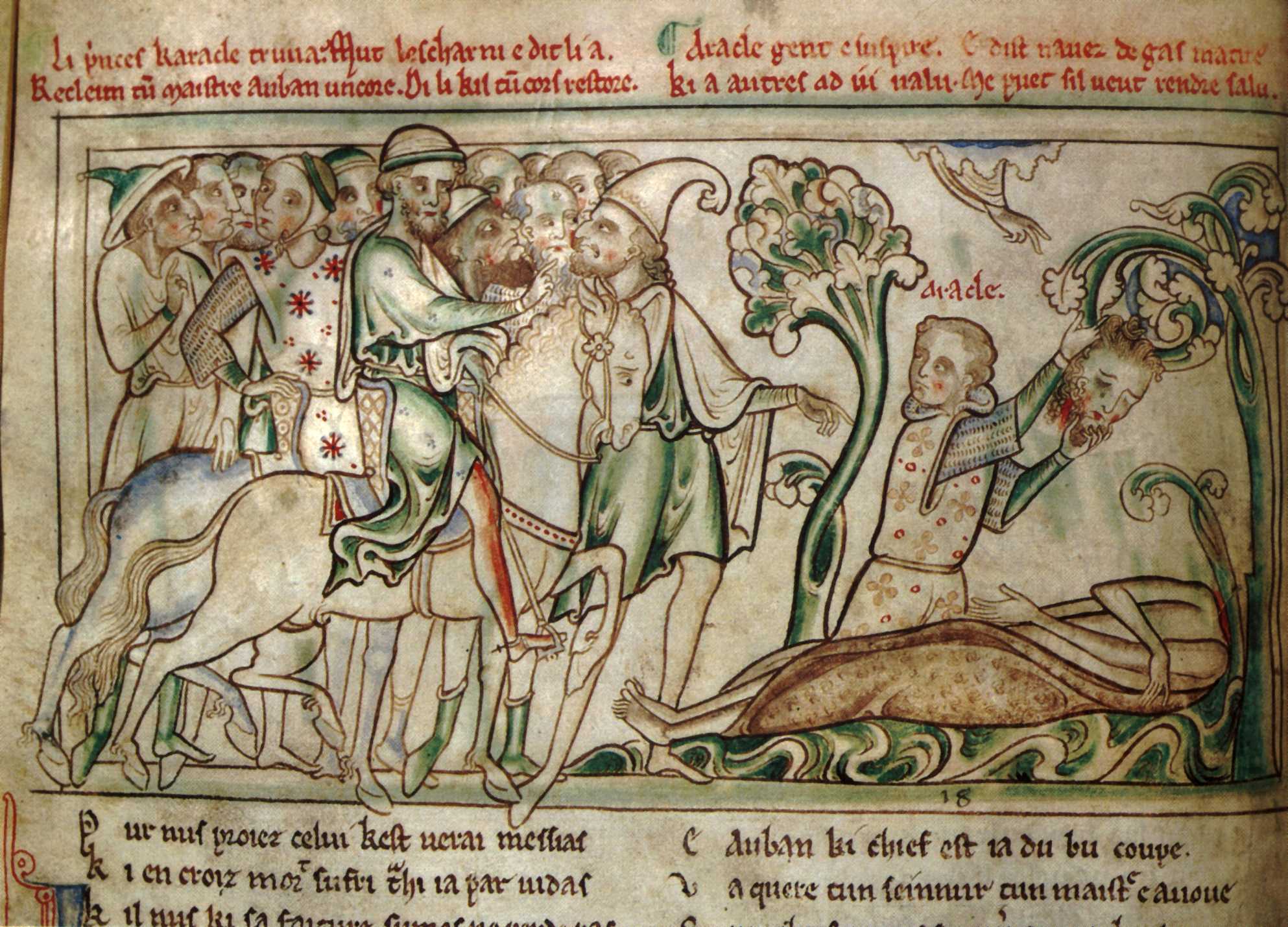
According to the Venerable Bede, the English monk who wrote the Ecclesiastical History of the English People, the martyrdom of Alban involved a few miraculous events. Sentenced to die for his refusal to renounce Christianity, Alban supposedly petitioned God to dry up the River Ver so he could more […]
|
|
|
|
|
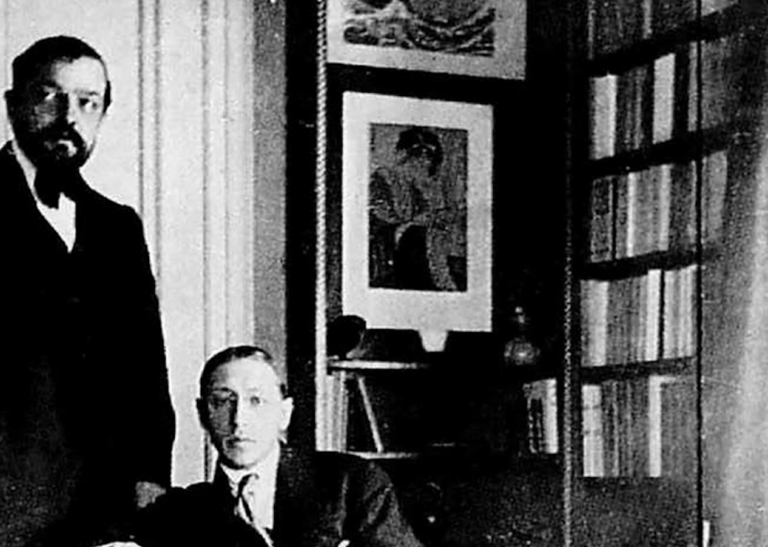
Erik Satie knew his way around not just the piano but the camera as well. This is evidenced by the image above, a 1911 portrait of Claude Debussy and Igor Stravinsky. Described by Christie’s as “an outstanding photograph of the two composers in the library at Debussy’s home,” it was taken by Satie at the time when Serge Diaghilev’s Ballets Russes were performing Debussy’s Jeux and Stravinsky’s The Rite of Spring. In the background appears what looks like Katsushika Hokusai’s The Great Wave Off Kanagawa, a work of art “used by Debussy on the front cover of the first edition of his symphonic sketches La mer.”
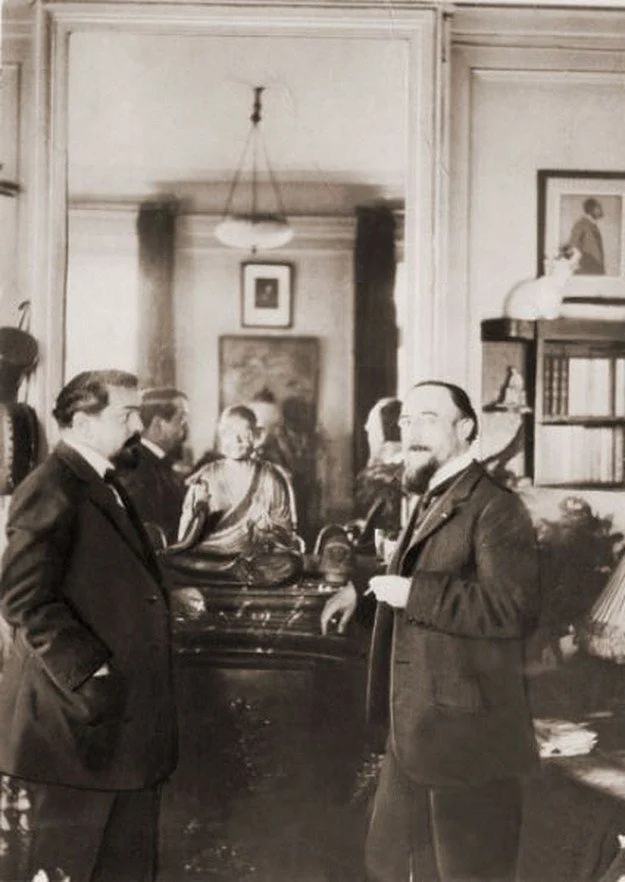
Just above appears another picture captured in Debussy’s home, this one of Debussy and Satie. “The photo was taken by Stravinsky, if my memory didn’t go wrong,” says one commenter on the r/classicalmusic subreddit. Another expresses confusion about the subjects themselves: “I thought they didn’t like each other?”
One responder explains that “they were friends at first, for quite some time, but later […]
|
|
|
|
|
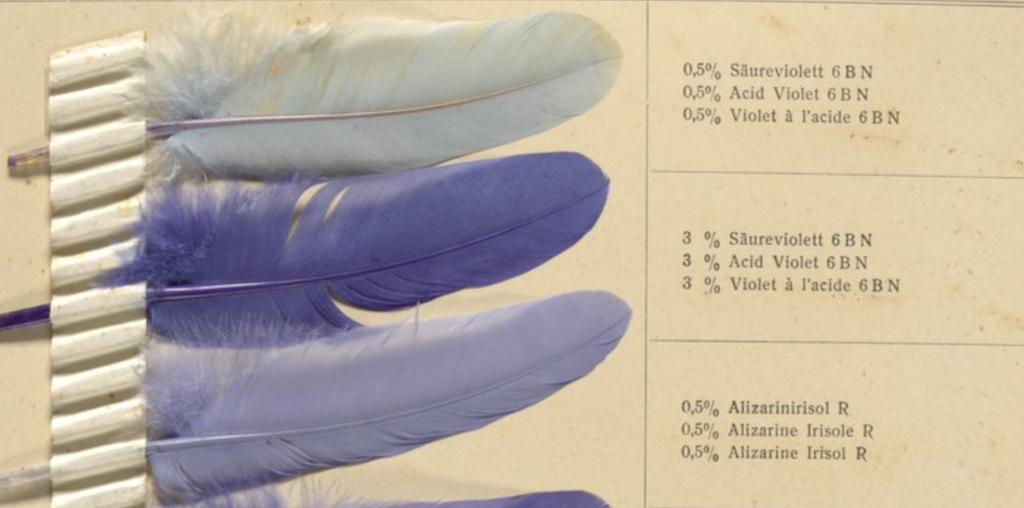
Perhaps the 143 colors showcased in The Bayer Company’s early 20th-century sample book, Shades on Feathers, could be collected in the field, but it would involve a lot of travel and patience, and the stalking of several endangered if not downright extinct avian species.
Far easier, and much less expensive, for milliners, designers and decorators to dye plain white feathers exotic shades, following the instructions in the sample book.
Such artificially obtained rainbows owe a lot to William Henry Perkin, a teenage student of German chemist August Wilhelm von Hofmann, who spent Easter vacation of 1856 experimenting with aniline, an organic base his teacher had earlier discovered in coal tar. Hoping to hit on a synthetic form of quinine, he accidentally hit on a solution that colored silk a lovely purple shade – an inadvertent eureka moment that ranks right up there with penicillin and the pretzel.
A Science Museum Group profile details what happened next:
Perkin named the colour mauve and the […]
|
|
|
|
|
For Gen X’ers who spent their twenties scouting the cities young people go to retire, and Millennials who spent their youth dancing to N’Sync, TLC, and the Spice Girls, nostalgia for simpler times just makes psychological sense. The 1990s was the last decade in which we had a shared set of references, “before the internet splintered mass culture,” Sadie Dingfelder writes at The Washington Post. “In the 90s, everyone listened to the same one or two radio stations in their city that played all the Top 40 hits, spanning all kinds of genres,” says DJ Matt Bailer.
This means that everyone who heard “No Scrubs” enough times to sing each note also heard the Smashing Pumpkins’ biggest hits, and learned to love them equally. It means that we could love the music of Billy Corgan without being subjected to the terrible opinions of Billy Corgan. As the baby-faced singer/songwriter aged, he has become, in his own words, a “bitter contrarian,” “carnival barker,” and “class-A heel,” he says, referencing his later career in professional wrestling.
The assessment may seem mild considering Corgan’s appearances […]
|
|
|
|