|
Digest of new articles at openculture.com, your source for the best cultural and educational resources on the web ͏ ͏ ͏ ͏ ͏ ͏ ͏ ͏ ͏ ͏ ͏ ͏ ͏ ͏ ͏ ͏ ͏ ͏ ͏ ͏ ͏ ͏ ͏ ͏ ͏ ͏ ͏ ͏ ͏ ͏ ͏ ͏ ͏ ͏ ͏ ͏ ͏ ͏ ͏ ͏ ͏ ͏ ͏ ͏ ͏ ͏ ͏ ͏ ͏ ͏ ͏ ͏ ͏ ͏ ͏ ͏ ͏ ͏ ͏ ͏ ͏ ͏ ͏ ͏ ͏ ͏ ͏ ͏ ͏ ͏ ͏ ͏ ͏ ͏ ͏ ͏ ͏ ͏ ͏ ͏ ͏ ͏ ͏ ͏ ͏ ͏ ͏
|
|
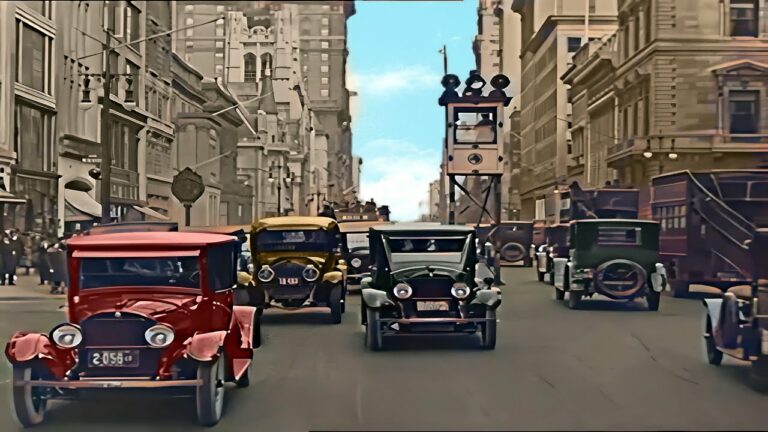
Woody Allen’s Midnight in Paris stars Owen Wilson as a Hollywood screenwriter on vacation in the French capital. Alas, the City of Lights as it is in the twenty-first century doesn’t satisfy him. When he walks his streets he thinks only of the nineteen-twenties, when a traveler in Paris could easily cross paths with the likes of Paul Gauguin, Henri Matisse, and Edgar Degas — as well as expatriates from Pablo Picasso and Djuna Barnes to F. Scott Fitzgerald and Ernest Hemingway. Or so he imagines, at any rate, and so he goes on to experience when he finds himself transported back in time to the city of the “Lost Generation” at each stroke of midnight.
With the video above, you, too, can take a trip to nineteen-twenties Paris — as well as nineteen-twenties New York, Chicago, San Francisco, London, Berlin, Stockholm, Copenhagen, Amsterdam, Nice, Geneva, Milan, and Venice. A compilation of period footage sourced from the Prelinger Archives, it lightly colorizes, adds ambient sound, and in other ways enhances its disparate materials to make them feel all of a piece.
And indeed, […]
|
|
|
|
|
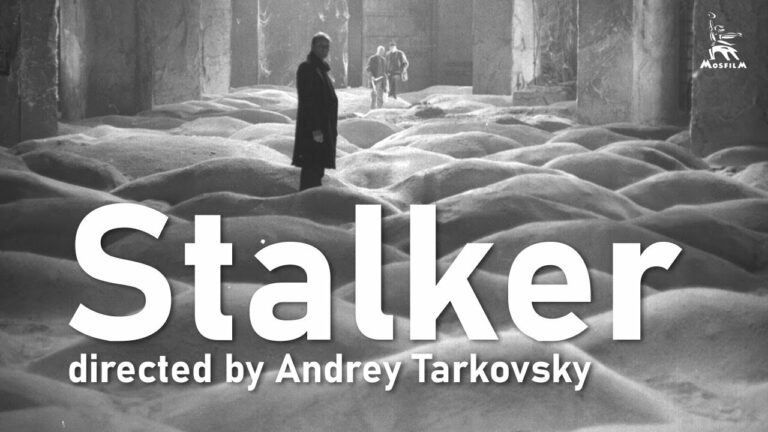
Recently we’ve featured films by Sergei Eisenstein, a pioneer of cinema as we know it, and Andrei Tarkovsky, one of the most respected auteurs in the history of the art form. They’re all free to watch on Youtube, as is Sergei Bondarchuk’s epic adaptation of War and Peace from the late nineteen-sixties and Karen Shakhnazarov’s eight-part Anna Karenina, which came out just a few years ago. For all this we have Mosfilm to thank. Once the national film studio of the Soviet Union — equipped with the kind of resources that made it more or less the Hollywood of the U.S.S.R. — Mosfilm remains in operation as a production company, as well as a Youtube channel.
Mosfilm’s playlist of Soviet movies now offers more than 70 English-subtitled features, each one labeled by genre. The dozen comedies currently free to watch include Leonid Gaidai’s massively successful crime-and-society comedy The Diamond Arm (1969) and Eldar Ryazanov’s satirical Carnival Night (1956).
The versatile Ryazanov also directed pictures of other types for Mosfilm, including the musical Hussar Ballad (1962) and the melodrama Railway Station […]
|
|
|
|
|
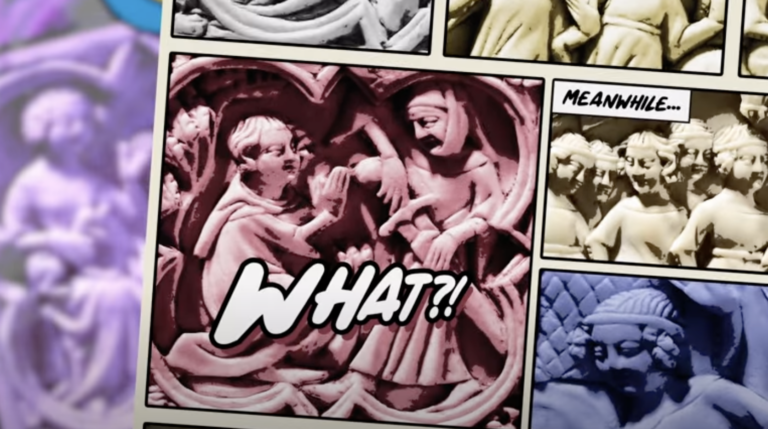
The Châtelaine de Vergy, a courtly romance that was wildly popular in the mid-13th century, would’ve made a crowd pleasing graphic novel adaptation. It’s got sex, treachery, a trio of violent deaths, and a cute pup in a supporting role.
Seeing as how the form had yet to be invented, medieval audiences got the next best thing – a Gothic ivory casket on which the story is rendered as a series of carved pictures that start on the lid and wrap around the sides.
In an earlier video for the British Museum’s Curator’s Corner series, Late Medieval Collections Curator Naomi Speakman admitted that the purpose of such deluxe caskets is difficult to pin down. Were they tokens from one lover to another? Wedding gifts? Jewelry boxes? Document cases?
Unclear, but the intricate carvings’ narrative has definitely been identified as that of The Châtelaine de Vergy, a steamy secular alternative to the religious scenes whose depiction consumed a fair number of medieval elephant tusks.
In addition to the early-14th century […]
|
|
|
|
|
The Polish film industry has produced a few internationally-known auteurs, including Andrzej Wajda, Krzysztof Kieślowski, and Roman Polanski, but a handful of critically-lauded directors cannot represent the scope of any national cinema. Without a wider appreciation of Poland’s film history, we lack crucial context for understanding its most famous artists. Now, a new archive called 35mm.online gives us hundreds of films and animations by Polish filmmakers, a unique opportunity to immerse oneself in the country’s cinematic art like never before.
Polish film history can broadly be divided into films made before WWII and those made after, when the country came under strict Communist control. The first period includes a silent film industry that began with the origins of cinema itself and made a star of actress Pola Negri, whose films were screened in Berlin with German-language title cards. Many movies made in the sound era took direction, no pun intended, from filmmaker Aleksander Ford, a champion of Communist aesthetic theory. “Cinema cannot be a cabaret,” he once told the Soviet Kino magazine, “it must be a school.” Ford made […]
|
|
|
|
|
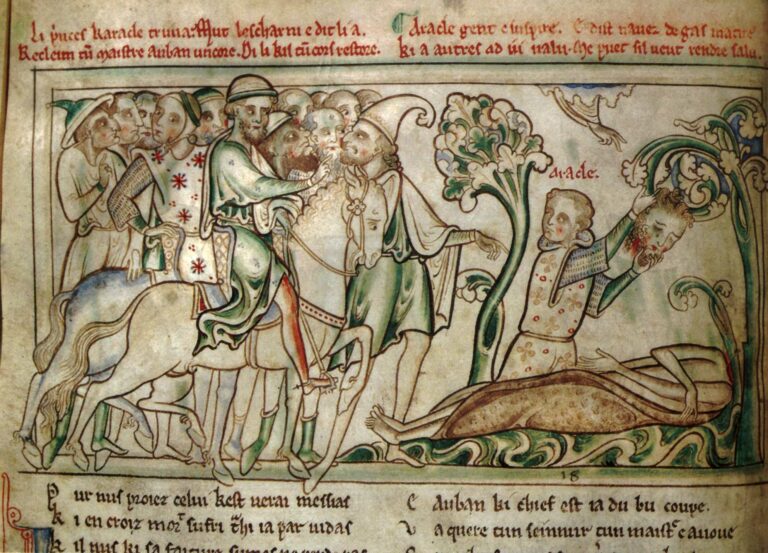
This past month, on the eve of the June 22nd feast of St Alban, the library of Trinity College Dublin announced that it had digitized the “13th century masterpiece” the Book of St Alban, a richly illustrated manuscript that “features 54 individual works of medieval art and has fascinated readers across the centuries, from royalty to renaissance scholars.”
Created by the Benedictine monk Matthew Paris, the manuscript “chronicles the life of St Alban,” notes The Irish Times, “and also outlines the construction of St Alban’s Cathedral in Hertfordshire.” The text and illustrations explain the origins of a cult of St. Alban, the first English martyr, that began to spring up after his 4th century death.
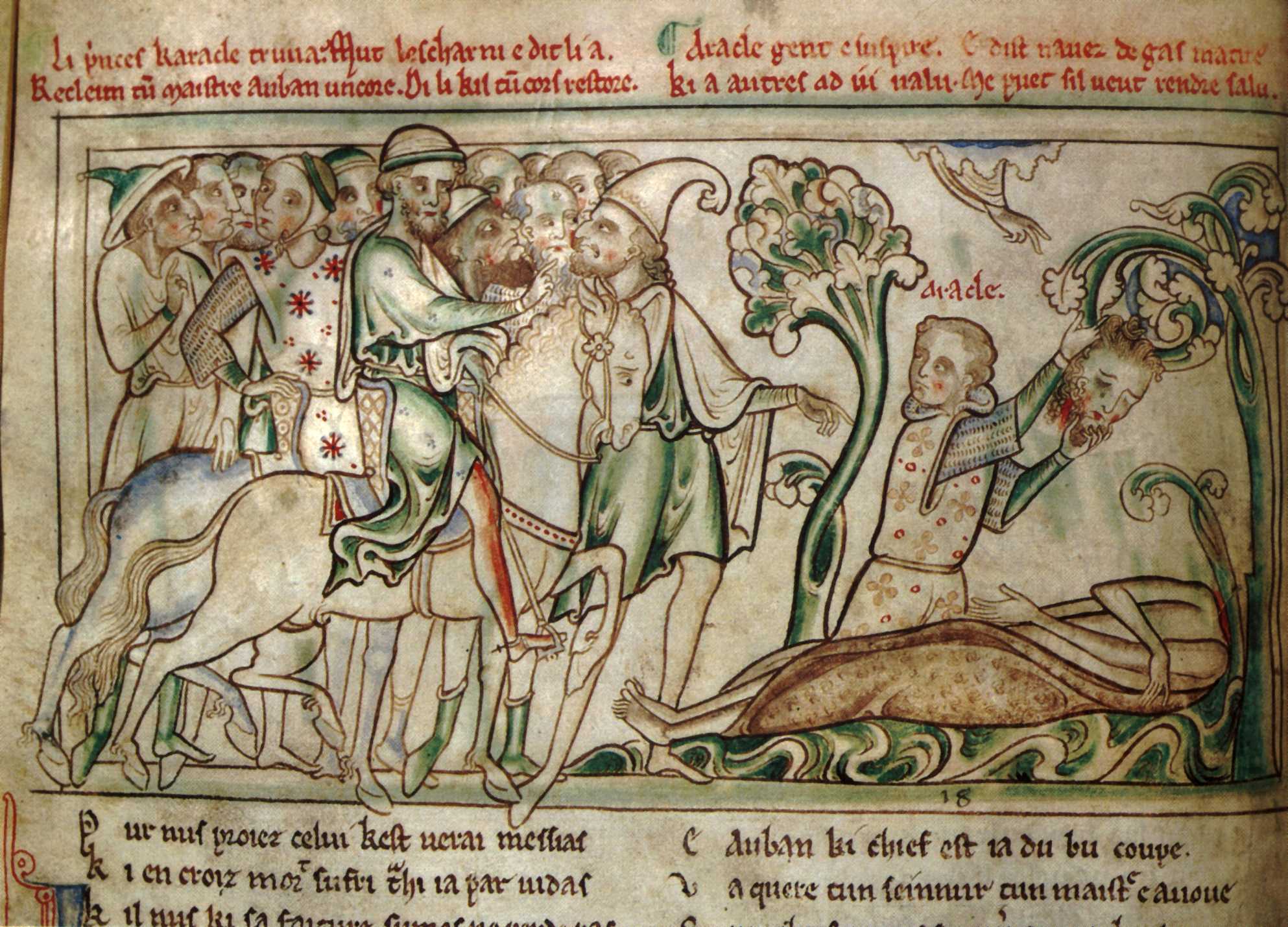
According to the Venerable Bede, the English monk who wrote the Ecclesiastical History of the English People, the martyrdom of Alban involved a few miraculous events. Sentenced to die for his refusal to renounce Christianity, Alban supposedly petitioned God to dry up the River Ver so he could more […]
|
|
|
|