|
Digest of new articles at openculture.com, your source for the best cultural and educational resources on the web ͏ ͏ ͏ ͏ ͏ ͏ ͏ ͏ ͏ ͏ ͏ ͏ ͏ ͏ ͏ ͏ ͏ ͏ ͏ ͏ ͏ ͏ ͏ ͏ ͏ ͏ ͏ ͏ ͏ ͏ ͏ ͏ ͏ ͏ ͏ ͏ ͏ ͏ ͏ ͏ ͏ ͏ ͏ ͏ ͏ ͏ ͏ ͏ ͏ ͏ ͏ ͏ ͏ ͏ ͏ ͏ ͏ ͏ ͏ ͏ ͏ ͏ ͏ ͏ ͏ ͏ ͏ ͏ ͏ ͏ ͏ ͏ ͏ ͏ ͏ ͏ ͏ ͏ ͏ ͏ ͏ ͏ ͏ ͏ ͏ ͏ ͏
|
|
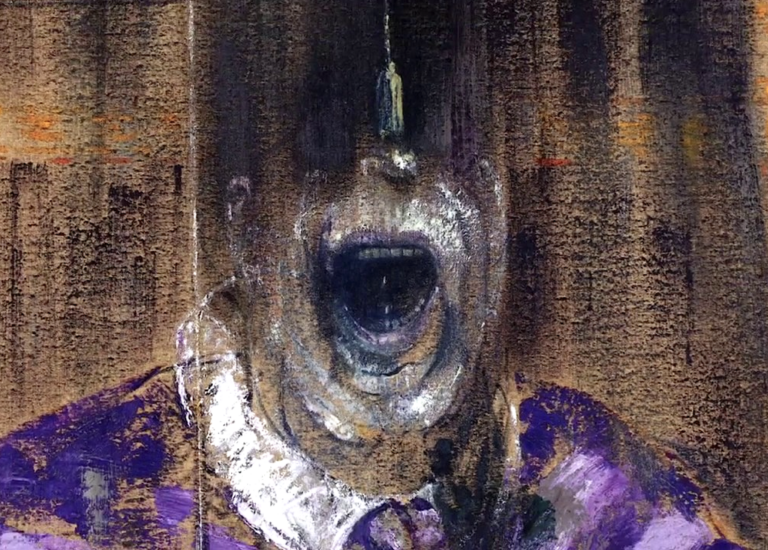
The paintings of Francis Bacon continue to trouble their viewers, not least those viewers who try to slot his work into a particular genre or movement. Bacon rose to prominence painting the human body, hardly an uncommon subject, but he did so in the middle of the twentieth century, just when abstraction had achieved near-complete domination of Western art. Though his work may not have been deliberately fashionable, it wasn’t straightforwardly realistic either. Even as they incorporated humanity, his artistic visions twisted it out of shape, often in complicatedly grotesque or bloody ways. What could have inspired such enduringly nightmarish work?
That question underlies Francis Bacon: A Brush with Violence, the 2017 BBC Two documentary above. Some answers are to be found in the painter’s life, whose fragile and asthmatic early years were shadowed by the formidable presence of the elder Bacon, a Boer War veteran and racehorse trainer. As Bacon’s friend and dealer Lord Gowrie says, “His father got his stable boys to whip him, and I think that started one or two things off.” Like many studies, […]
|
|
|
|
|
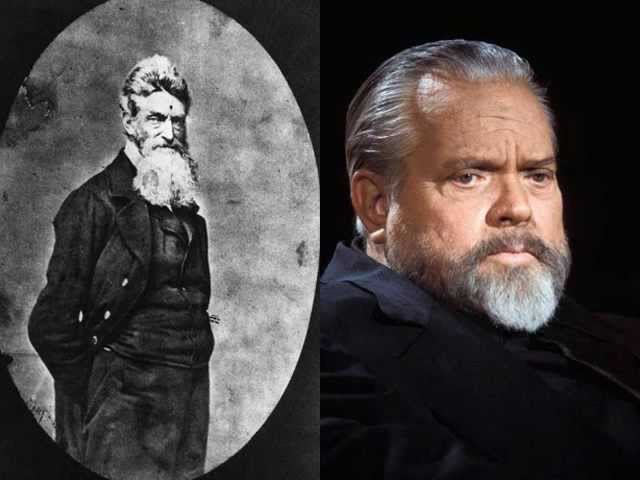
Orson Welles was only 25 years old when he directed and starred in Citizen Kane, a film still widely considered the best ever made. Even then, he’d already been a household name for at least three years, since his controversially realistic radio adaptation of H. G. Wells’ The War of the Worlds. But Welles’ high profile at a young age came as a result of serious work at an even younger one. His earlier efforts include Marching Song, a never-produced stage play about the abolitionist John Brown, which he co-wrote with his former schoolmaster Roger Hill when he was just seventeen years old.
Published only in 2019, Marching Song proves that Welles had been working in the fragmented-biography narrative form well before Citizen Kane. It also shows the depth of his fascination with the figure of John Brown. As research, Welles and Hill visited historical sites including Harper’s Ferry, the Virginia town in which Brown, in October of 1859, led the raid on a federal armory meant as the first blow in a large-scale slave-liberation movement. As every American learns in school, […]
|
|
|
|
|
Throughout history, determined artists have worked on available surfaces – scrap wood, cardboard, walls…
Ben Wilson has created thousands of works using chewing gum as his canvas.
Specifically, chewing gum spat out by careless strangers.
His work has become a defining featuring of London’s Millennium Bridge, a modern structure spanning the Thames, and connecting such South Bank attractions as Tate Modern and the Shakespeare’s Globe with St. Paul’s Cathedral to the north.
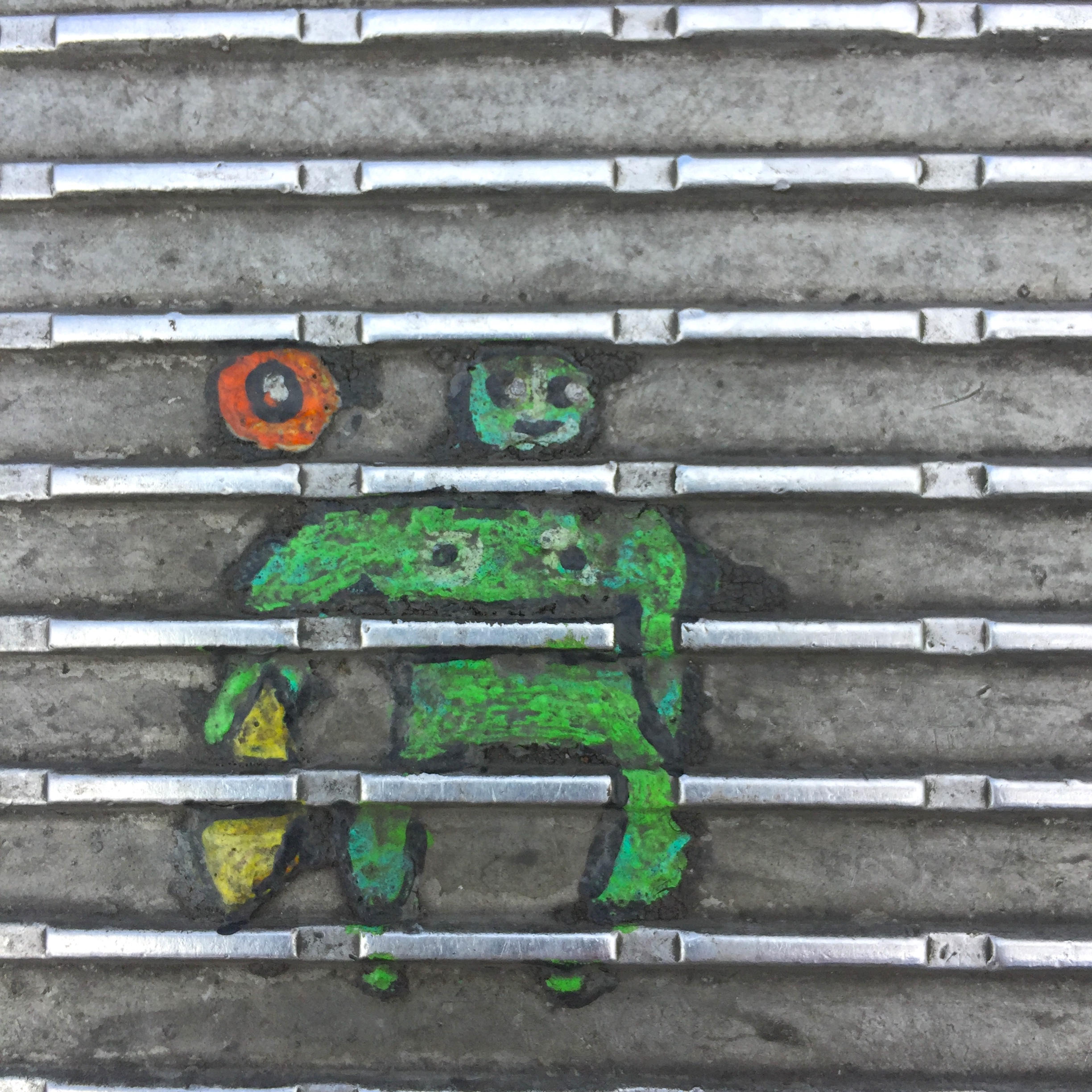


A 2021 profile in The Guardian documents the creation process:
The technique is very precise. He first softens the oval of flattened gum a little with a blowtorch, sprays it with lacquer and then applies three coats of acrylic enamel, usually to a design from his latest book of requests that come from people who stop and crouch and talk. He uses tiny modelers’ brushes, quick-drying his work […]
|
|
|
|
|
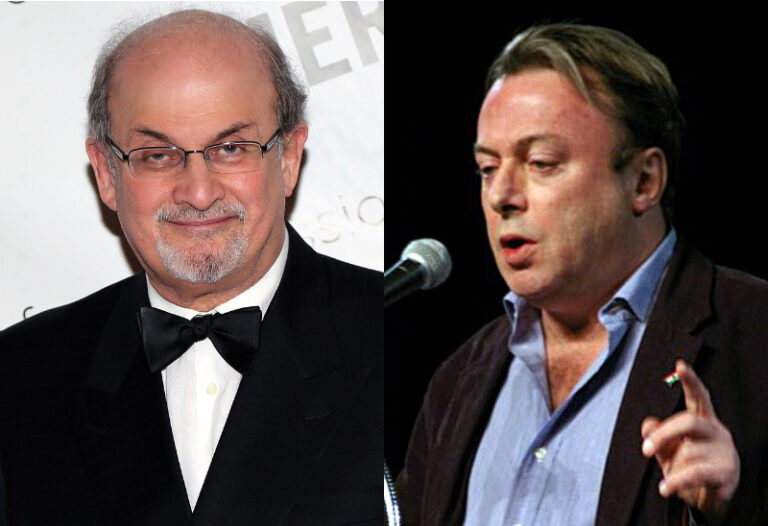
I have often been asked if Christopher defended me because he was my close friend. The truth is that he became my close friend because he wanted to defend me. –Salman Rushdie
Salman Rushdie remains in critical condition after suffering multiple stab wounds while on stage in New York, a shocking occurrence but not quite surprising given that the author has lived with a death sentence over his head since 1989. (You can read the history of that controversy here.) The nation of Iran has denied any responsibility for the attack on the author, but it’s probably safe to assume that his 1988 novel The Satanic Verses has something to do with it, over thirty years after the fact.
“Even before the fatwa,” Steven Erlanger writes in The New York Times, “the book was banned in a number of countries, including India, Bangladesh, Sudan and Sri Lanka.” Protests of the novel resulted in several deaths and attacks on booksellers. Rushdie had not set out to enrage much of the Islamic world, but neither had he any interest in appeasing its conservative leaders. […]
|
|
|
|
|
There could be few more American styles of dwelling than the tract house, and few more American architects than Frank Lloyd Wright. But Wright, of course, never designed a tract house. Each of his dwellings, to say nothing of his public buildings, was in every sense a one-off, not just in its layout and its details but in its relationship to its context. Wright believed, as he declared in his book The Natural House, that a building should be “as dignified as a tree in the midst of nature.” This he held true even for relatively modest residences, as evidenced by the series of “Usonian houses” he began in the late nineteen-thirties.
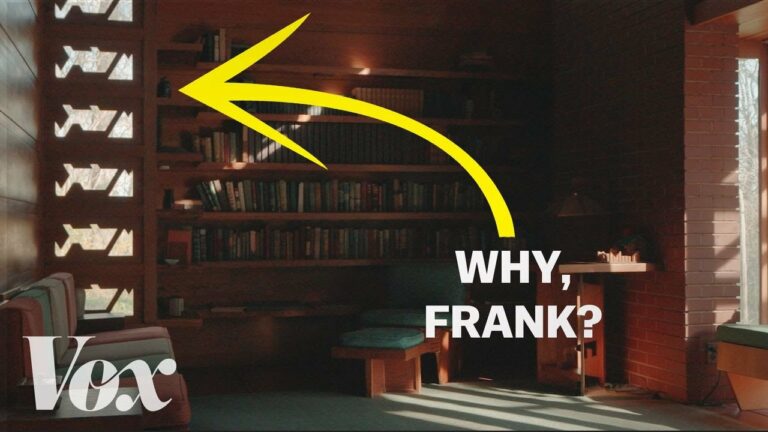
The Vox video above features the “cypress-and-brick masterpiece” that is Pope-Leighey House in Alexandria, Virginia, which Wright completed in 1941. “Bounded by the humble budget of the Pope family” — Loren Pope, its head was working as a newspaper copy editor at the time — “this structure nonetheless exhibits the distinct features characteristic of his formidable vision and style.”
So says the house’s page at the […]
|
|
|
|