|
Digest of new articles at openculture.com, your source for the best cultural and educational resources on the web ͏ ͏ ͏ ͏ ͏ ͏ ͏ ͏ ͏ ͏ ͏ ͏ ͏ ͏ ͏ ͏ ͏ ͏ ͏ ͏ ͏ ͏ ͏ ͏ ͏ ͏ ͏ ͏ ͏ ͏ ͏ ͏ ͏ ͏ ͏ ͏ ͏ ͏ ͏ ͏ ͏ ͏ ͏ ͏ ͏ ͏ ͏ ͏ ͏ ͏ ͏ ͏ ͏ ͏ ͏ ͏ ͏ ͏ ͏ ͏ ͏ ͏ ͏ ͏ ͏ ͏ ͏ ͏ ͏ ͏ ͏ ͏ ͏ ͏ ͏ ͏ ͏ ͏ ͏ ͏ ͏ ͏ ͏ ͏ ͏ ͏ ͏
|
|
Image bySociety for Culture, Art and International Cooperation Adligat, via Wikimedia Commons
You could say that Haruki Murakami is a Japanese writer. And given that he was born in Japan to Japanese parents, grew up in Japan, and lives in Japan still today, you’d have geography, culture, and biology on your side. Yet Alfred Birnbaum, one of Murakami’s own English translators, has called him “an American writer who happens to write in Japanese.” To understand how this could be requires a consideration of not just Murakami’s writing, but the writers whose books inspired him. Take the hard-boiled novelist Raymond Chandler, whose The Long Goodbye appears on the list of Murakami’s five favorite books just posted at Literary Hub.
“I have translated all the novels of Raymond Chandler,” Murakami once said. “I like his style so much. I have read The Long Goodbye five or six times.” He must have read it for the first time in Kobe, where he grew up in the 1950s and 60s, and whose bookstores offered an abundance of […]
|
|
|
|
|
Image via Wikimedia Commons
You may have come into contact at some point with Tracey Emin’s My Bed, an art installation that reproduces her private space during a time when she spent four days as a shut-in in 1998, “heartbroken”: the bed’s unmade, the bedside strewn with cigarettes, moccasins, a bottle of booze, food, and “what appears to be a sixteen year old condom”…. If you were savvy enough to be Tracey Emin in 1998—and none of us were—you would have sold that messy room for over four million dollars last year at a Christie’s auction. I doubt another buyer of that caliber will come along for a knock-off, but this doesn’t mean the messes we make while slobbing around our own homes are without their own, intangible, value.
Those messes, in fact, may be seedbeds of creativity, confirming a cliché as persistent as the one about doctors’ handwriting, and perhaps as accurate. It seems a messy desk, room, or studio may genuinely be a mark of genius at work. Albert […]
|
|
|
|
|
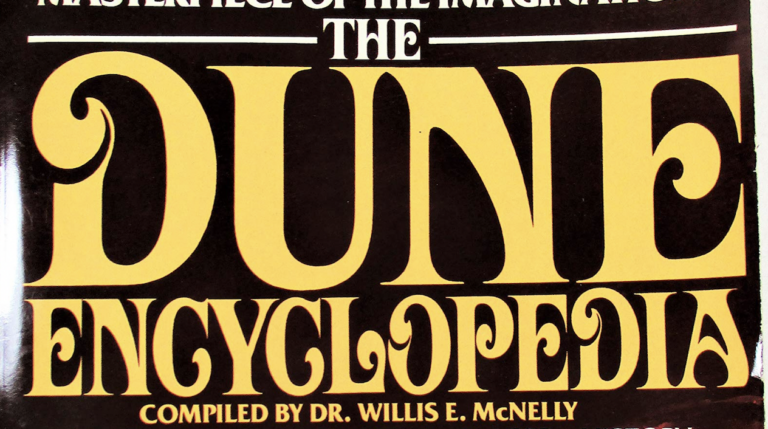
When David Lynch’s Hollywood version of Dune opened in theaters in 1984, Universal Studios distributed a printed a glossary to keep its audiences from getting confused. They got confused anyway, in part because of the film’s having been hollowed out in editing, and in part because the sheer elaborateness of Frank Herbert’s alternate reality poses potentially insurmountable challenges to faithful adaptation. Even many of the original Dune novels’ readers needed more help than a couple pages of definitions could offer. Luckily for them, the same year that saw the release of Lynch’s Dune also saw the publication of The Dune Encyclopedia, authorized by Herbert himself.
“Here is a rich background (and foreground) for the Dune Chronicles, including scholarly bypaths and amusing sidelights,” Herbert writes in the book’s introduction. “Some of the contributions are sure to arouse controversy, based as they are on questionable sources.” He couldn’t have known how right he was. Today The Dune Encyclopedia stands as what Inverse’s Ryan Britt calls “the most controversial Dune book ever”; long out of […]
|
|
|
|
|
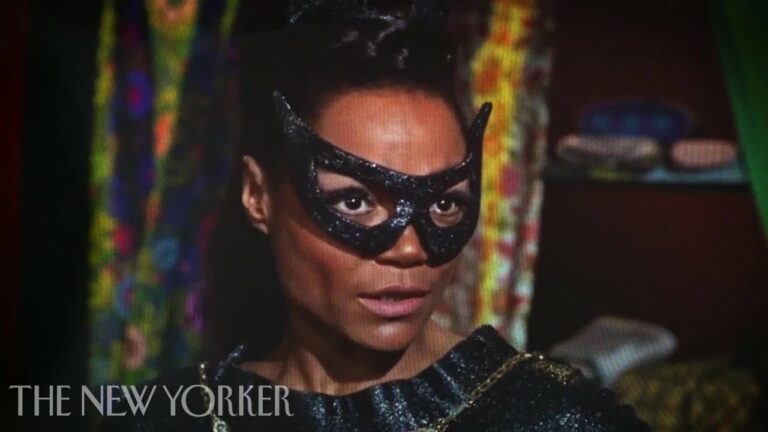
Actress Eartha Kitt amassed dozens of stage and screen credits, but is perhaps most fondly remembered for her iconic turn as Catwoman in the Batman TV series, a role she took over from white actress Julie Newmar.
The producers congratulated themselves on this “provocative, off-beat” casting, executives at network affiliates in Southern states expressed outrage, and Kitt’s 9-year-old daughter, Kitt Shapiro, understood that her mother’s new gig was a “really big deal.”
As Shapiro recalled to Closer Weekly:
This was 1967, and there were no women of color at that time wearing skintight bodysuits, playing opposite a white male with sexual tension between them! She knew the importance of the role and she was proud of it. She really is a part of history. She was one of the first really beautiful black women — her, Lena Horne, Dorothy Dandridge — who were allowed to be sexy without being stereotyped. It does take a village, but I do think she helped blaze a trail.
Eartha Kitt was a trailblazer in […]
|
|
|
|