|
Digest of new articles at openculture.com, your source for the best cultural and educational resources on the web ͏ ͏ ͏ ͏ ͏ ͏ ͏ ͏ ͏ ͏ ͏ ͏ ͏ ͏ ͏ ͏ ͏ ͏ ͏ ͏ ͏ ͏ ͏ ͏ ͏ ͏ ͏ ͏ ͏ ͏ ͏ ͏ ͏ ͏ ͏ ͏ ͏ ͏ ͏ ͏ ͏ ͏ ͏ ͏ ͏ ͏ ͏ ͏ ͏ ͏ ͏ ͏ ͏ ͏ ͏ ͏ ͏ ͏ ͏ ͏ ͏ ͏ ͏ ͏ ͏ ͏ ͏ ͏ ͏ ͏ ͏ ͏ ͏ ͏ ͏ ͏ ͏ ͏ ͏ ͏ ͏ ͏ ͏ ͏ ͏ ͏ ͏
|
|
A man of various accomplishments, Theodor Adorno is perhaps most widely known as the very image of the midcentury European intellectual in exile. After his Jewish background got him forced out of Nazi Germany, he spent fifteen years in England and the United States. Despite his geographical distance from the troubles of the Continent — and even after the end of the Second World War — he understandably remained very much concerned with the nature of not just Hitler himself but all those who supported him. This led to such studies as his 1947 essay “Wagner, Nietzsche and Hitler” as well as (in collaboration with Berkeley researchers Else Frenkel-Brunswik, Daniel Levinson, and Nevitt Sanford) the 1950 book The Authoritarian Personality.
The Authoritarian Personality‘s best-known tool to diagnose the titular personal and social condition is a quantitative system called the “California F-scale” — the F stands for fascism — which produces a score based on a subject’s response to a set of propositions. “To create a personality test that actually revealed latent […]
|
|
|
|
|
“The starship Titanic was a monstrously pretty sight as it lay beached like a silver Arcturan Megavoidwhale among the laserlit tracery of its construction gantries”–writes Douglas Adams in The Life, The Universe and Everything, the third novel in the Hitchhiker’s Guide trilogy–“a brilliant cloud of pins and needles of light against the deep interstellar blackness; but when launched, it did not even manage to complete its very first radio message —an SOS—before undergoing a sudden and gratuitous total existence failure.”
This paragraph is a tiny humorous flourish in a series of novels filled with hundreds of them, but for some reason—possibly its relationship to the original doomed luxury liner–the Starship Titanic would go on to have an amazingly detailed second life as a video game. And while a paperback copy of any of Adams’ work is readily available, it can take some hunting to find a workable version of the game.
Douglas Adams designed the game himself, starting in 1996. A decade earlier, he had helped design the text-based adventure game adaptation of Hitchhiker’s Guide, and had expressed a […]
|
|
|
|
|
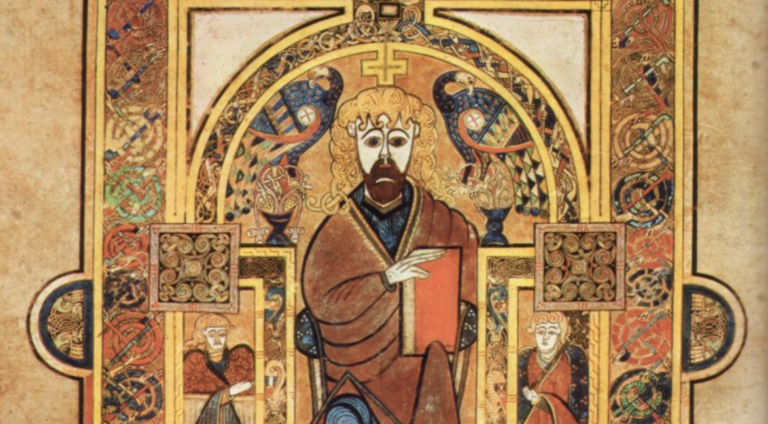
If you know nothing else about medieval European illuminated manuscripts, you surely know the Book of Kells. “One of Ireland’s greatest cultural treasures” comments Medievalists.net, “it is set apart from other manuscripts of the same period by the quality of its artwork and the sheer number of illustrations that run throughout the 680 pages of the book.” The work not only attracts scholars, but almost a million visitors to Dublin every year. “You simply can’t travel to the capital of Ireland,” writes Book Riot’s Erika Harlitz-Kern, “without the Book of Kells being mentioned. And rightfully so.”
The ancient masterpiece is a stunning example of Hiberno-Saxon style, thought to have been composed on the Scottish island of Iona in 806, then transferred to the monastery of Kells in County Meath after a Viking raid (a story told in the marvelous animated film The Secret of Kells). Consisting mainly of copies of the four gospels, as well as indexes called “canon tables,” the manuscript is believed to have been made primarily for display, […]
|
|
|
|
|
Image by Bernd Schwabe, via Wikimedia Commons
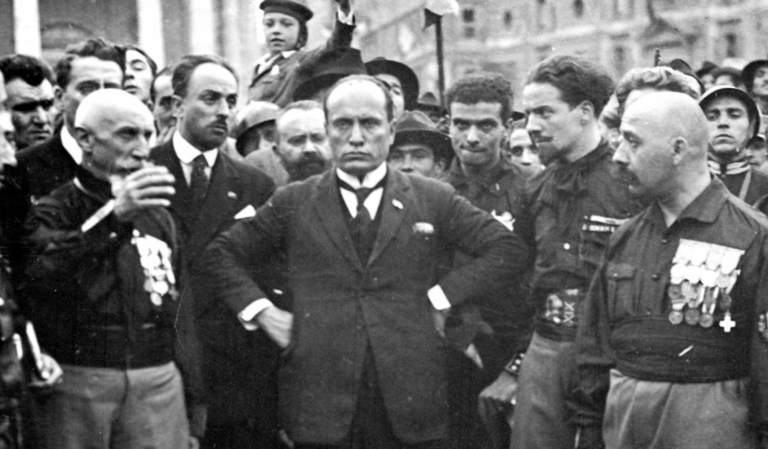
At least when I was in grade school, we learned the very basics of how the Third Reich came to power in the early 1930s. Paramilitary gangs terrorizing the opposition, the incompetence and opportunism of German conservatives, the Reichstag Fire. And we learned about the critical importance of propaganda, the deliberate misinforming of the public in order to sway opinions en masse and achieve popular support (or at least the appearance of it). While Minister of Propaganda Joseph Goebbels purged Jewish and leftist artists and writers, he built a massive media infrastructure that played, writes PBS, “probably the most important role in creating an atmosphere in Germany that made it possible for the Nazis to commit terrible atrocities against Jews, homosexuals, and other minorities.”
How did the minority party of Hitler and Goebbels take over and break the will of the German people so thoroughly that they would allow and participate in mass murder? Post-war scholars of totalitarianism like Theodor Adorno and Hannah […]
|
|
|
|
|
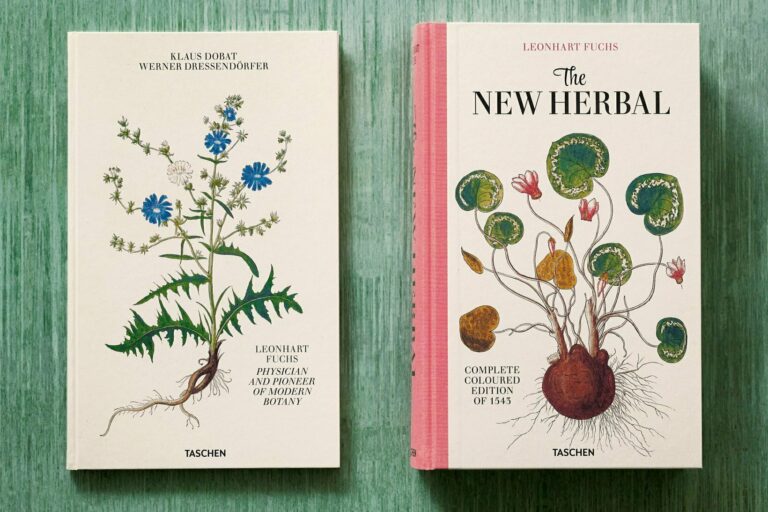
We’ve all have heard of the fuchsia, a flower (or genus of flowering plant) native to Central and South America but now grown far and wide. Though even the least botanically literate among us know it, we may have occasional trouble spelling its name. The key is to remember who the fuchsia was named for: Leonhart Fuchs, a German physician and botanist of the sixteenth century. More than 450 years after his death, Fuchs is remembered as not just the namesake of a flower, but as the author of an enormous book detailing the varieties of plants and their medicinal uses. His was a landmark achievement in the form known as the herbal, examples of which we’ve featured here on Open Culture from ninth- and eighteenth-century England.

But De Historia Stirpium Commentarii Insignes, as this work was known upon its initial 1542 publication in Latin, has worn uncommonly well through the ages. Or rather, Fuchs’ personal, hand-colored original has, coming down to us in […]
|
|
|
|