|
Digest of new articles at openculture.com, your source for the best cultural and educational resources on the web ͏ ͏ ͏ ͏ ͏ ͏ ͏ ͏ ͏ ͏ ͏ ͏ ͏ ͏ ͏ ͏ ͏ ͏ ͏ ͏ ͏ ͏ ͏ ͏ ͏ ͏ ͏ ͏ ͏ ͏ ͏ ͏ ͏ ͏ ͏ ͏ ͏ ͏ ͏ ͏ ͏ ͏ ͏ ͏ ͏ ͏ ͏ ͏ ͏ ͏ ͏ ͏ ͏ ͏ ͏ ͏ ͏ ͏ ͏ ͏ ͏ ͏ ͏ ͏ ͏ ͏ ͏ ͏ ͏ ͏ ͏ ͏ ͏ ͏ ͏ ͏ ͏ ͏ ͏ ͏ ͏ ͏ ͏ ͏ ͏ ͏ ͏
|
|
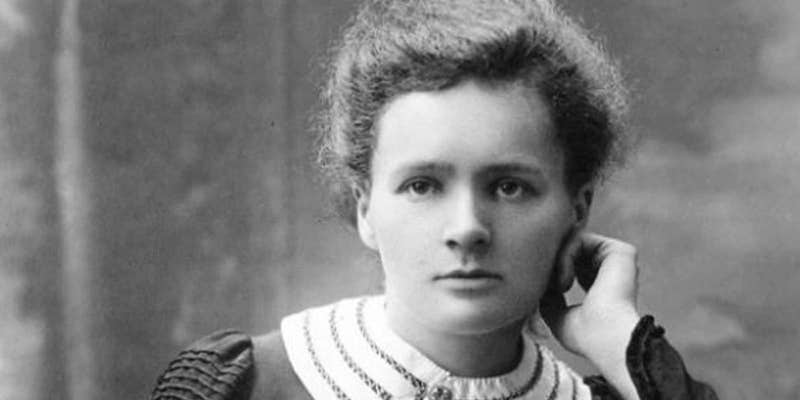
For her groundbreaking research on radioactivity, Marie Curie won the Nobel Prize. Or rather, she won two, one for physics and another for chemistry, making her the only Nobel Laureate in more than one science. What’s more, her first Nobel came in 1903, the very same year she completed her PhD thesis at the Sorbonne. In Recherches sur les substances radioactives (or Research on Radioactive Substances), Curie “talks about the discovery of the new elements radium and polonium, and also describes how she gained one of the first understandings of the new physical phenomenon of radioactivity.”
So says science Youtuber Toby Hendy in the introduction below to Curie’s thesis–a thesis that made her the first woman in France to receive a doctoral degree in physics. “Following on from the discovery of X-rays by Wilhelm Roentgen in 1895 and Henri Becquerel’s discovery that uranium salts emitted similar penetration properties,” says The Document Centre, Curie “investigated uranium rays as a starting point, but in the process discovered that the […]
|
|
|
|
|
In 1965, Lou Reed was a 23-year-old graduate stalled in a music and art career he wasn’t sure would take off. A few years earlier a doo-wop single recorded with high school friends had been released to no avail. More recently, a parody of dance-craze singles “Do the Ostrich”, created by Reed and performed by a pick-up band of musicians, had also made its way onto wax and then right out of people’s memories. However, John Cale was in that pick-up band, and soon the two were fast friends. It was Cale who helped record Reed’s demo tape of songs that year. And it was Reed who took the tape and mailed it back to himself as a “poor man’s copyright.”
That demo tape has now been unsealed and these never-before heard recordings are heading to LP and CD and streaming. Above you can hear a very early version of “I’m Waiting for the Man,” that would get radically reworked for the Velvet Underground’s debut album.
Over rudimentary guitar plucking, Reed’s demo is slower, has harmonies, and a more decided […]
|
|
|
|
|
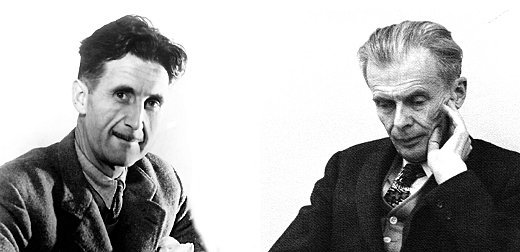
In 1949, George Orwell received a curious letter from his former high school French teacher.
Orwell had just published his groundbreaking book Nineteen Eighty-Four, which received glowing reviews from just about every corner of the English-speaking world. His French teacher, as it happens, was none other than Aldous Huxley who taught at Eton for a spell before writing Brave New World (1931), the other great 20th century dystopian novel.
Huxley starts off the letter praising the book, describing it as “profoundly important.” He continues, “The philosophy of the ruling minority in Nineteen Eighty-Four is a sadism which has been carried to its logical conclusion by going beyond sex and denying it.”
Then Huxley switches gears and criticizes the book, writing, “Whether in actual fact the policy of the boot-on-the-face can go on indefinitely seems doubtful. My own belief is that the ruling oligarchy will find less arduous and wasteful ways of governing and of satisfying its lust for power, and these ways will resemble those which I described in […]
|
|
|
|
|
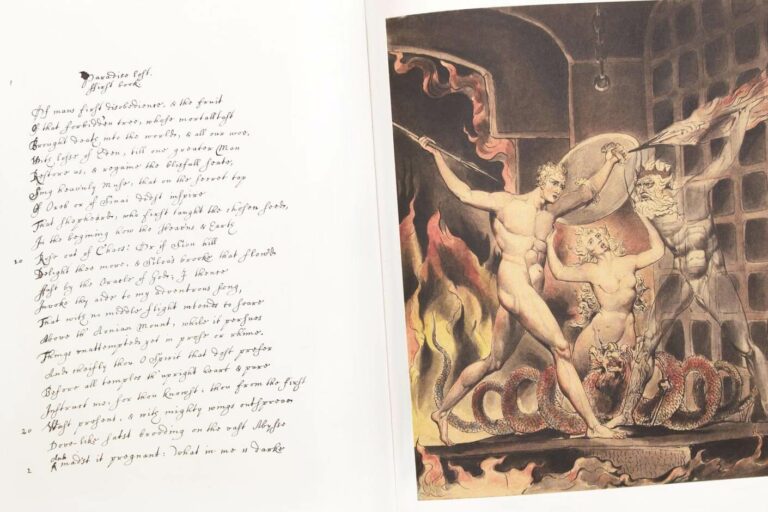
In The Marriage of Heaven and Hell, William Blake adds a note to the text that became a famous adage about John Milton’s Paradise Lost: the 10,000-line, 17th century blank verse epic about the war between heaven and hell and the failed testing of God’s premium product, human beings. Milton “wrote in fetters when he wrote of Angels & God, and at liberty when he wrote Devils & Hell,” Blake declared, “because he was a true Poet and of the Devil’s party without knowing it.” The statement inspired “other Romantic and Gothic writers to view Satan as a hero,” the British Library writes.
Blake himself illustrated Paradise Lost in three separate commissions over the course of his career as an engraver and printer. His deep admiration for the poem helped it become a “Bible of the Romantic movement,” writes the manuscript publisher SP Books in their introduction to a rare new book publication of the only surviving manuscript of the work.
Only 1,000 numbered, large format copies of this printing are available. (We […]
|
|
|
|
|
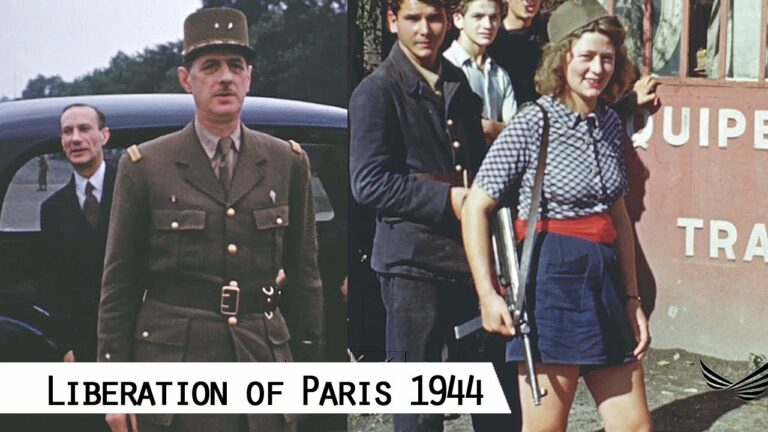
The above footage of Paris’ liberation in August 1944 looks and feels not dissimilar to a Hollywood movie. Part of its power owes to its being in color, a vanishingly rare quality in real film of World War II. But we must also credit its having been shot by a genuine Hollywood filmmaker, George Stevens. Having got his start in pictures as a teenager in the early nineteen-twenties (not long before making the cinematic-historical accomplishment of figuring out how to get Stan Laurel’s light-colored eyes to show up on film), Stevens became a respected director in the following decade. Swing Time, Gunga Din, The More the Merrier: with hits like that, he would seem to have had it made.
But it was just then, as F. X. Feeney tells it in the DGA Quarterly, that the war became unignorable. “The dangerous artistry of Leni Riefenstahl’s 1935 valentine to Adolf Hitler, Triumph of the Will, moved Stevens to volunteer for frontline service in World War II despite his being old enough to dodge a uniform […]
|
|
|
|