|
Digest of new articles at openculture.com, your source for the best cultural and educational resources on the web ͏ ͏ ͏ ͏ ͏ ͏ ͏ ͏ ͏ ͏ ͏ ͏ ͏ ͏ ͏ ͏ ͏ ͏ ͏ ͏ ͏ ͏ ͏ ͏ ͏ ͏ ͏ ͏ ͏ ͏ ͏ ͏ ͏ ͏ ͏ ͏ ͏ ͏ ͏ ͏ ͏ ͏ ͏ ͏ ͏ ͏ ͏ ͏ ͏ ͏ ͏ ͏ ͏ ͏ ͏ ͏ ͏ ͏ ͏ ͏ ͏ ͏ ͏ ͏ ͏ ͏ ͏ ͏ ͏ ͏ ͏ ͏ ͏ ͏ ͏ ͏ ͏ ͏ ͏ ͏ ͏ ͏ ͏ ͏ ͏ ͏ ͏
Alfred Hitchcock specialized in films about marked men: innocents, more or less, who suddenly find themselves pursued by sinister forces to the ends of the Earth. Little wonder, then, that Salman Rushdie would count himself a Hitchcock fan. The novelist references the filmmaker more than once in Salman Rushdie: Writing Under Death Threats, the DW television documentary above. He remembers a sequence from The Birds that cuts between students in a classroom and the playground outside: in one shot a blackbird comes to sit on the jungle gym, and just a few shots later it’s been joined by 500 more. “The case of what happened to The Satanic Verses was, it was something like the first blackbird.”
Rushdie refers, of course, to the fatwa called down upon him in response to that novel’s supposed blasphemies against Islam by Ayatollah Khomeini. As a result he had to spend most of the subsequent decade in hiding, under the protection of the British government. By the time of this documentary, which came out in 2018, the danger seemed to have passed.
“What’s happening now, […]
|
Alfred Hitchcock specialized in films about marked men: innocents, more or less, who suddenly find themselves pursued by sinister forces to the ends of the Earth. Little wonder, then, that Salman Rushdie would count himself a Hitchcock fan. The novelist references the filmmaker more than once in Salman Rushdie: Writing Under Death Threats, the DW television documentary above. He remembers a sequence from The Birds that cuts between students in a classroom and the playground outside: in one shot a blackbird comes to sit on the jungle gym, and just a few shots later it’s been joined by 500 more. “The case of what happened to The Satanic Verses was, it was something like the first blackbird.”
Rushdie refers, of course, to the fatwa called down upon him in response to that novel’s supposed blasphemies against Islam by Ayatollah Khomeini. As a result he had to spend most of the subsequent decade in hiding, under the protection of the British government. By the time of this documentary, which came out in 2018, the danger seemed to have passed.
“What’s happening now, […]
|
|
|
|
|
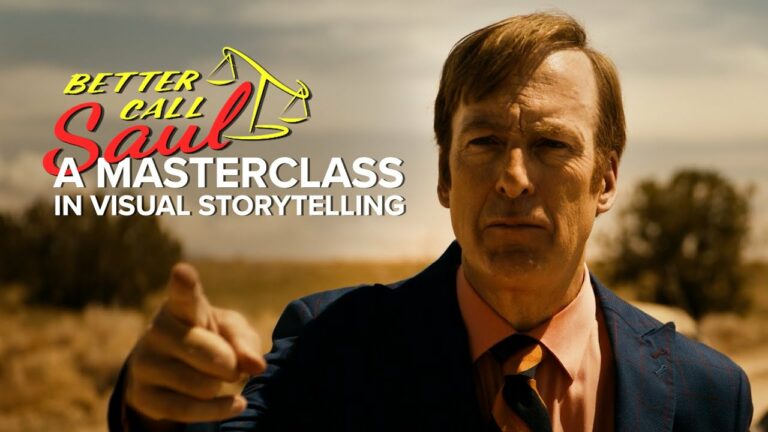
A decade ago, nobody interested in prestige dramatic television could have ignored Breaking Bad, Vince Gilligan’s AMC series about a downtrodden high-school chemistry teacher who becomes a calculating and savage crystal-meth dealer. Such was the critical and popular success of the show that, less than two years after it ended, it was resumed in the form of Better Call Saul. The title character Saul Goodman had been the aforementioned teacher-turned-dealer’s lawyer in Breaking Bad, and the later series, a prequel, traces the half-decade journey that brought him to that point: a journey that began when he was a Chicago con man named Jimmy McGill.
Better Call Saul‘s six-season run (one episode longer than Breaking Bad) came to an end this week. During that time, the show has received even stronger accolades than the one that spun it off. To get a sense of what makes it such an achievement in a field crowded with some of the most ambitious creators of popular culture today, watch the video essay above by Youtuber Thomas Flight.
Here on Open Culture, we’ve previously featured his visual analyses […]
|
|
|
|
|
Dolly Parton created her Imagination Library, a non-profit which gives books to millions of children every month, with her father, Robert Lee Parton, in mind.
“I always thought that if Daddy had an education, there’s no telling what he could have been,” she mused in her 2020 book, Songteller: My Life in Lyrics:
Because he knew how to barter, he knew how to bargain. He knew how to make everything work, and he knew how to count money. He knew exactly what everything was worth, how much he was going to make from that tobacco crop, what he could trade, and how he could make it all work
Despite his business acumen, Parton’s father never learned to read or write, a source of shame.
Parton explains how there was a time when schooling was never considered a given for children in the mountains of East Tennessee, particularly for those like her father, who came from a family of 15:
Kids had to go to work in the fields to help feed the family. Because of the weather […]
|
|
|
|
|
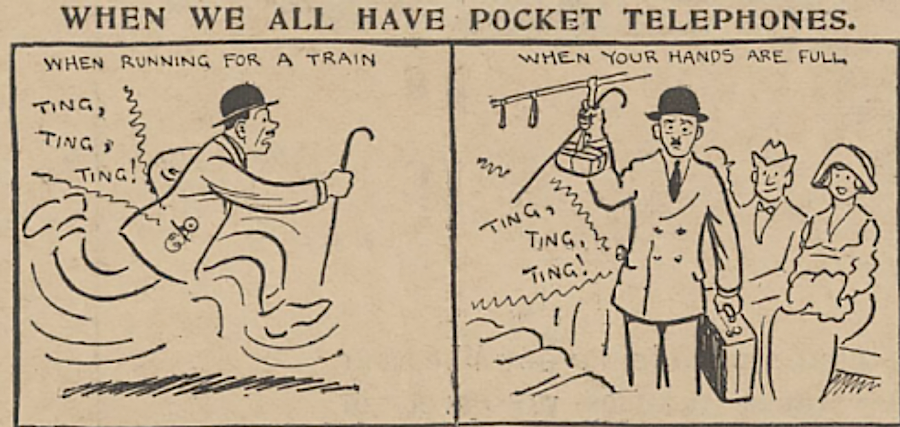
Much has been said lately about jokes that “haven’t aged well.” Sometimes it has do to with shifting public sensibilities, and sometimes with a gag’s exaggeration having been surpassed by the facts of life. As a Twitter user named Max Saltman posted not long ago, “I love finding New Yorker cartoons so dated that the joke is lost entirely and the cartoons become just descriptions of people doing normal things.” The examples included a partygoer admitting that “I haven’t read it yet, but I’ve downloaded it from the internet,” and a teacher admonishing her students to “keep your eyes on your own screen.”
All of those New Yorker cartoons appear to date from the nineteen-nineties. Even more prescient yet much older is the Daily Mirror cartoon at the top of the post, drawn by artist W. K. Haselden at some point between 1919 and 1923. It envisions a time “when we all have pocket telephones,” liable to ring at the most inconvenient times: “when running for a train,” “when your hands are full,” […]
|
|
|
|
|
According to a recent survey conducted by the Texas State Teachers Association, 70% of surveyed teachers said they were seriously thinking about leaving the teaching profession. “Lingering stress from the pandemic is a factor, but it isn’t the only one. Inadequate pay, political attacks on educators and the failure of state leaders to protect the health and safety of students and school employees also have combined to drive down the morale of teachers to the lowest level in recent memory and endanger our public school system,” TSTA President Ovidia Molina said.
We recently saw how Texas’ educational system has become a vast political minefield, with conservative legislators attempting to ban 800+ books from school libraries–primarily because the books make students feel “uncomfortable.” This week, the Keller Independent School District in Fort Worth, Texas decided to cancel an acclaimed illustrated adaptation of The Diary of Anne Frank, echoing the recent decision by a Tennessee School board to ban Maus, the Pulitzer-Prize winning graphic novel on the Holocaust […]
|
|
|
|