|
Digest of new articles at openculture.com, your source for the best cultural and educational resources on the web ͏ ͏ ͏ ͏ ͏ ͏ ͏ ͏ ͏ ͏ ͏ ͏ ͏ ͏ ͏ ͏ ͏ ͏ ͏ ͏ ͏ ͏ ͏ ͏ ͏ ͏ ͏ ͏ ͏ ͏ ͏ ͏ ͏ ͏ ͏ ͏ ͏ ͏ ͏ ͏ ͏ ͏ ͏ ͏ ͏ ͏ ͏ ͏ ͏ ͏ ͏ ͏ ͏ ͏ ͏ ͏ ͏ ͏ ͏ ͏ ͏ ͏ ͏ ͏ ͏ ͏ ͏ ͏ ͏ ͏ ͏ ͏ ͏ ͏ ͏ ͏ ͏ ͏ ͏ ͏ ͏ ͏ ͏ ͏ ͏ ͏ ͏
|
|
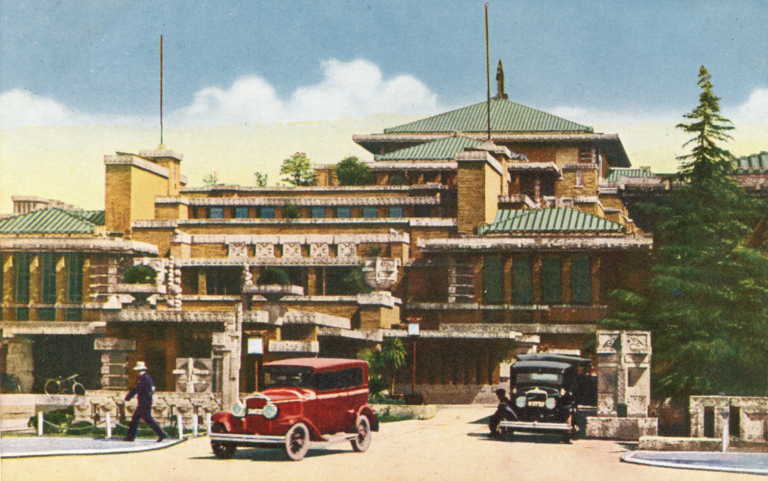
Tokyo once had a hotel by Frank Lloyd Wright. Such an architectural asset, one might assume, would be preserved at all costs, yet this one was demolished in 1967. But the fact that Wright’s Imperial Hotel stood for only 45 years won’t surprise anyone familiar with Japanese building culture, nor will the fact that it was only one of a series of Imperial Hotels that have occupied the same site. As evidenced by the Ise Grand Shrine, which has been demolished and rebuilt every twenty years since the eighth century, a structure’s value in Japan has nothing to do with its longevity. Still, this explanation may not satisfy Wright enthusiasts, the great majority of whom have only been able to see the master’s most famous Japanese building in photographs, diagrams, and postcards.
Just this year, the Frank Lloyd Trust has given us a way to experience it as nobody could in its heyday: a virtual tour video “shot” from the perspective of a flying drone. (Watch above.) It comes as an […]
|
|
|
|
|
It’s nearly impossible to communicate musicianship in words, though there are rare, successful literary attempts by greats like James Baldwin, Jack Kerouac, and jazz critic Ira Gitler, whose phrase “sheets of sound” so well captured the experience of Coltrane’s improvisational style in the late 50s. Maybe the free movements of jazz are easier to write about than other forms….
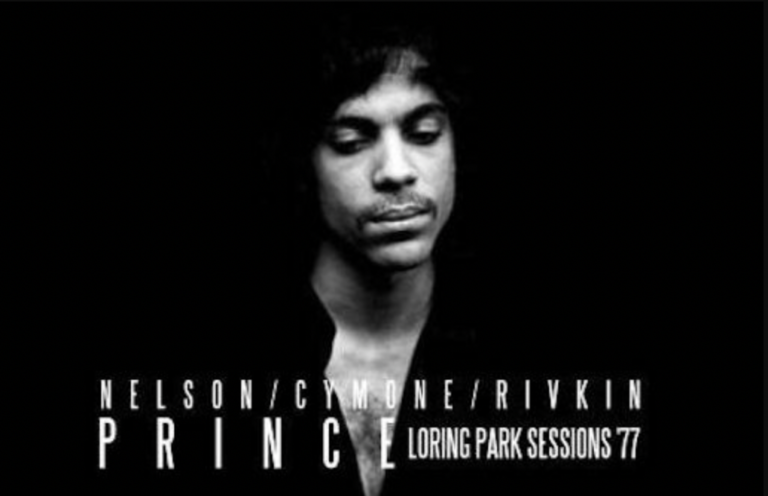
When it comes to recently departed funk/pop/rock/R&B great Prince, it feels like there’s enough written about his prodigious talent that it begins to sound like overpraise. The most interesting tributes come from fellow musicians. Yet even their comments seem exaggerated.
Prince “played everything,” said Stevie Wonder soon after the Purple One’s sudden death – every style, every instrument – which seems like an impossible feat until you read the notes for his debut album and realize that, yes, he did play everything, before he hit 20… and listen to the full range of his output to see that, yes, he “could play classical music if he wanted to,” as Wonder said. “He could play jazz if he wanted to….”
Prince’s drummer […]
|
|
|
|
|
Despite having recently begun to admit tour groups, Japan remains inaccessible to most of the world’s travelers. Having closed its gates during the onset of the COVID-19 pandemic, the country has shown little inclination to open them up again too quickly or widely. The longer this remains the case, of course, the more intense everyone’s desire to visit Japan becomes. Though different travelers have different interests to pursue in the Land of the Rising sun — temples and shrines, trains and cafés, anime and manga — all of them are surely united by one appreciation in particular: that of Japanese food.
Wherever in the world we happen to live, most of us have a decent Japanese restaurant or two in our vicinity. Alas, as anyone with experience in Japan has felt, the experience of eating its cuisine anywhere else doesn’t quite measure up; a ramen meal can taste good in a California strip mall, not the same as it would taste in a Tokyo subway station.
At least the twenty-first century affords us one convenient means of enjoying audiovisual evocations of genuine Japanese […]
|
|
|
|
|
Ambient Music must be able to accommodate many levels of listening attention without enforcing one in particular; it must be as ignorable as it is interesting.
In the original liner notes to Brian Eno’s founding document of Ambient music — 1978’s Ambient 1: Music for Airports — the artist explains that he named his genre after “an atmosphere, or a surrounding influence: a tint. My intention is to produce original pieces ostensibly (but not exclusively) for particular times and situations with a view to building up a small but versatile catalogue of environmental music suited to a wide variety of moods and atmospheres.”
In defining “environmental music,” Eno takes great pains to distinguish his new work from the makers of Muzak. Rather than recreating the familiar with instrumental schmaltz, and “stripping away all sense of doubt and uncertainty,” Ambient should stimulate listeners’ minds without disturbing or distracting them, inducing “calm and a space to think.” Rolling Stone at the time coined the derisive, but not wholly inaccurate, phrase “aesthetic white noise.”
Reverb Machine painstakingly shows in a deconstruction how Eno himself introduced as much uncertainty into the compositional […]
|
|
|
|
|
The name of Vincent Van Gogh is one of the very best known in the history of painting, and indeed the history of art. But that doesn’t mean the man himself enjoyed any success in his short lifetime. Though he was convinced that he was creating “the art of the future,” and seemingly right to believe it, the buyers of nineteenth-century European art didn’t see it quite that way. Consequently impoverished, Van Gogh had to resort to unconventional strategies to maintain his artistic productivity. Instead of professional models, for example, he hired peasants and people from the streets. And when he couldn’t paint them, he painted himself.
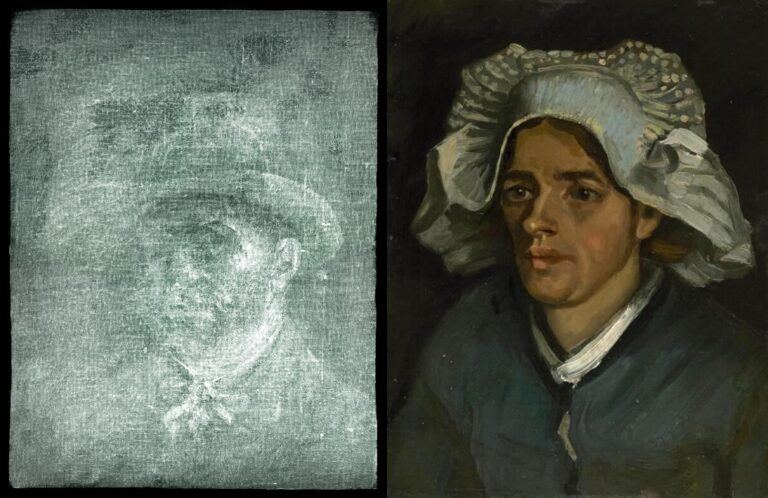
Van Gogh would also economize by re-using his canvases, a practice not unknown in his day. “However, instead of painting over earlier works,” writes Jordan Ogg at National Galleries Scotland, “he would turn the canvas around and work on the reverse.”
It seems he did this with the National Galleries Scotland’s own Head of a Peasant Woman, whose back side turns out […]
|
|
|
|