|
Digest of new articles at openculture.com, your source for the best cultural and educational resources on the web ͏ ͏ ͏ ͏ ͏ ͏ ͏ ͏ ͏ ͏ ͏ ͏ ͏ ͏ ͏ ͏ ͏ ͏ ͏ ͏ ͏ ͏ ͏ ͏ ͏ ͏ ͏ ͏ ͏ ͏ ͏ ͏ ͏ ͏ ͏ ͏ ͏ ͏ ͏ ͏ ͏ ͏ ͏ ͏ ͏ ͏ ͏ ͏ ͏ ͏ ͏ ͏ ͏ ͏ ͏ ͏ ͏ ͏ ͏ ͏ ͏ ͏ ͏ ͏ ͏ ͏ ͏ ͏ ͏ ͏ ͏ ͏ ͏ ͏ ͏ ͏ ͏ ͏ ͏ ͏ ͏ ͏ ͏ ͏ ͏ ͏ ͏
|
|
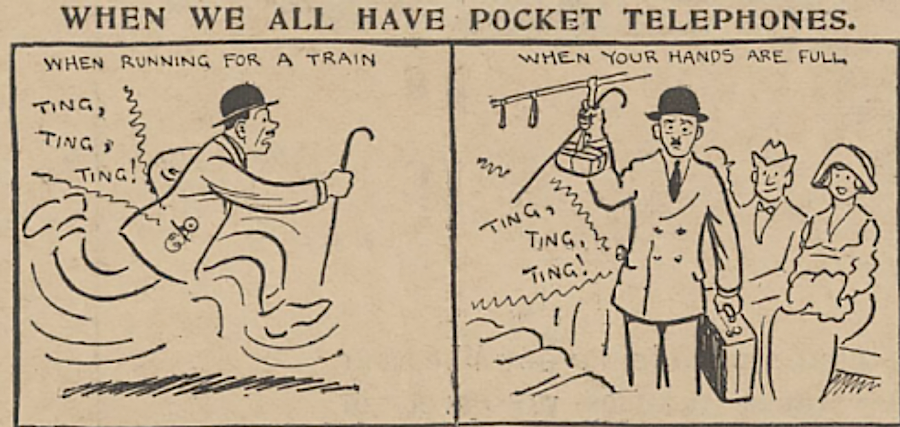
Much has been said lately about jokes that “haven’t aged well.” Sometimes it has do to with shifting public sensibilities, and sometimes with a gag’s exaggeration having been surpassed by the facts of life. As a Twitter user named Max Saltman posted not long ago, “I love finding New Yorker cartoons so dated that the joke is lost entirely and the cartoons become just descriptions of people doing normal things.” The examples included a partygoer admitting that “I haven’t read it yet, but I’ve downloaded it from the internet,” and a teacher admonishing her students to “keep your eyes on your own screen.”
All of those New Yorker cartoons appear to date from the nineteen-nineties. Even more prescient yet much older is the Daily Mirror cartoon at the top of the post, drawn by artist W. K. Haselden at some point between 1919 and 1923. It envisions a time “when we all have pocket telephones,” liable to ring at the most inconvenient times: “when running for a train,” “when your hands are full,” […]
|
|
|
|
|
According to a recent survey conducted by the Texas State Teachers Association, 70% of surveyed teachers said they were seriously thinking about leaving the teaching profession. “Lingering stress from the pandemic is a factor, but it isn’t the only one. Inadequate pay, political attacks on educators and the failure of state leaders to protect the health and safety of students and school employees also have combined to drive down the morale of teachers to the lowest level in recent memory and endanger our public school system,” TSTA President Ovidia Molina said.
We recently saw how Texas’ educational system has become a vast political minefield, with conservative legislators attempting to ban 800+ books from school libraries–primarily because the books make students feel “uncomfortable.” This week, the Keller Independent School District in Fort Worth, Texas decided to cancel an illustrated adaptation of The Diary of Anne Frank, echoing the recent decision by a Tennessee School board to ban Maus, the Pulitzer-Prize winning graphic novel on the Holocaust […]
|
|
|
|
|
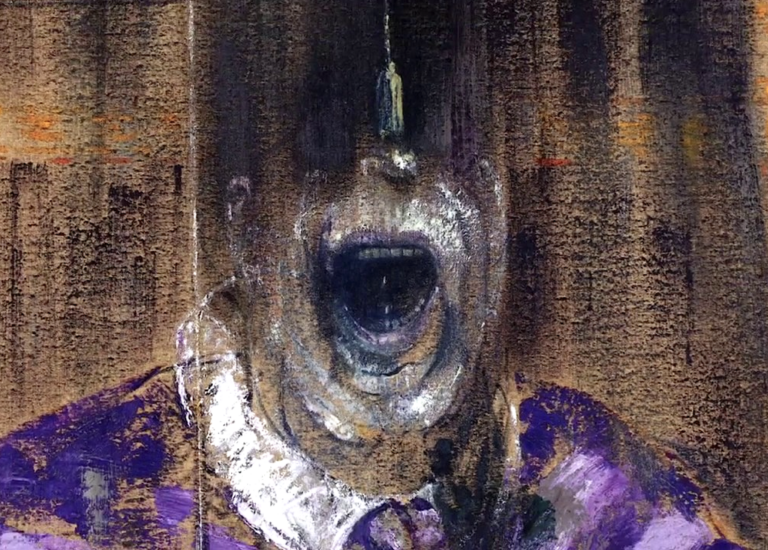
The paintings of Francis Bacon continue to trouble their viewers, not least those viewers who try to slot his work into a particular genre or movement. Bacon rose to prominence painting the human body, hardly an uncommon subject, but he did so in the middle of the twentieth century, just when abstraction had achieved near-complete domination of Western art. Though his work may not have been deliberately fashionable, it wasn’t straightforwardly realistic either. Even as they incorporated humanity, his artistic visions twisted it out of shape, often in complicatedly grotesque or bloody ways. What could have inspired such enduringly nightmarish work?
That question underlies Francis Bacon: A Brush with Violence, the 2017 BBC Two documentary above. Some answers are to be found in the painter’s life, whose fragile and asthmatic early years were shadowed by the formidable presence of the elder Bacon, a Boer War veteran and racehorse trainer. As Bacon’s friend and dealer Lord Gowrie says, “His father got his stable boys to whip him, and I think that started one or two things off.” Like many studies, […]
|
|
|
|
|
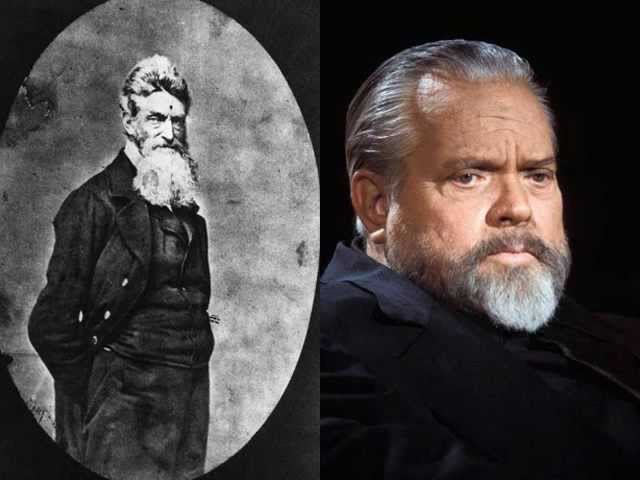
Orson Welles was only 25 years old when he directed and starred in Citizen Kane, a film still widely considered the best ever made. Even then, he’d already been a household name for at least three years, since his controversially realistic radio adaptation of H. G. Wells’ The War of the Worlds. But Welles’ high profile at a young age came as a result of serious work at an even younger one. His earlier efforts include Marching Song, a never-produced stage play about the abolitionist John Brown, which he co-wrote with his former schoolmaster Roger Hill when he was just seventeen years old.
Published only in 2019, Marching Song proves that Welles had been working in the fragmented-biography narrative form well before Citizen Kane. It also shows the depth of his fascination with the figure of John Brown. As research, Welles and Hill visited historical sites including Harper’s Ferry, the Virginia town in which Brown, in October of 1859, led the raid on a federal armory meant as the first blow in a large-scale slave-liberation movement. As every American learns in school, […]
|
|
|
|
|
Throughout history, determined artists have worked on available surfaces – scrap wood, cardboard, walls…
Ben Wilson has created thousands of works using chewing gum as his canvas.
Specifically, chewing gum spat out by careless strangers.
His work has become a defining featuring of London’s Millennium Bridge, a modern structure spanning the Thames, and connecting such South Bank attractions as Tate Modern and the Shakespeare’s Globe with St. Paul’s Cathedral to the north.



A 2021 profile in The Guardian documents the creation process:
The technique is very precise. He first softens the oval of flattened gum a little with a blowtorch, sprays it with lacquer and then applies three coats of acrylic enamel, usually to a design from his latest book of requests that come from people who stop and crouch and talk. He uses tiny modelers’ brushes, quick-drying his work […]
|
|
|
|