|
Digest of new articles at openculture.com, your source for the best cultural and educational resources on the web ͏ ͏ ͏ ͏ ͏ ͏ ͏ ͏ ͏ ͏ ͏ ͏ ͏ ͏ ͏ ͏ ͏ ͏ ͏ ͏ ͏ ͏ ͏ ͏ ͏ ͏ ͏ ͏ ͏ ͏ ͏ ͏ ͏ ͏ ͏ ͏ ͏ ͏ ͏ ͏ ͏ ͏ ͏ ͏ ͏ ͏ ͏ ͏ ͏ ͏ ͏ ͏ ͏ ͏ ͏ ͏ ͏ ͏ ͏ ͏ ͏ ͏ ͏ ͏ ͏ ͏ ͏ ͏ ͏ ͏ ͏ ͏ ͏ ͏ ͏ ͏ ͏ ͏ ͏ ͏ ͏ ͏ ͏ ͏ ͏ ͏ ͏
|
|
You can slide up, pull off and hammer like a beast, but be forewarned. It’s unlikely you’ll be able to keep pace with Heart’s Nancy Wilson, as she demonstrates how to play the introduction to 1975’s “Crazy On You,” one of the greatest – and trickiest – opening guitar solos in rock history.
“I really wanted people to know right up front what I could do,” Wilson revealed in a 1999 interview with Acoustic Guitar:
It was the same thing as sitting in the Bandwagon music store and playing (Paul Simon’s) Anji. It was like, “Check me out, I know some stuff.”
As hard rocking female musicians in the 70s and 80s, Wilson and her bandmate/sister, lead vocalist- and songwriter, Ann found themselves having to prove themselves constantly.
As Ann recently explained to The Guardian:
Back then, especially in the 70s, there was no filter on how women were sexualized – hyper-sexualized – in order to sell their images. Now at least it looks like women have […]
|
|
|
|
|
Before becoming a filmmaker, Jean-Pierre Grumbach participated in the French Resistance during World War II. It was then that he took the nom de guerre of Jean-Pierre Melville, under which he would later inspire the French New Wave. Just as he never made a film under another name, his work never quite abandoned the themes provided by his wartime experience in Nazi-occupied France, which comes through most clearly in his feature debut Le Silence de la mer. Released just four years after V-E Day, it tells the story of a German lieutenant billeted in a French household, an admirer of French culture who holds forth nightly of his anticipation of the “marriage” of the German and French civilizations.
The day comes for the German to make a much-anticipated trip to Paris. After worshipfully taking in the sights of the capital — the Arc de Triomphe, Notre-Dame de Paris, the Monument à Jeanne d’Arc — he meets with his Nazi superiors. And so he discovers, to his great shock, that what the occupiers […]
|
|
|
|
|
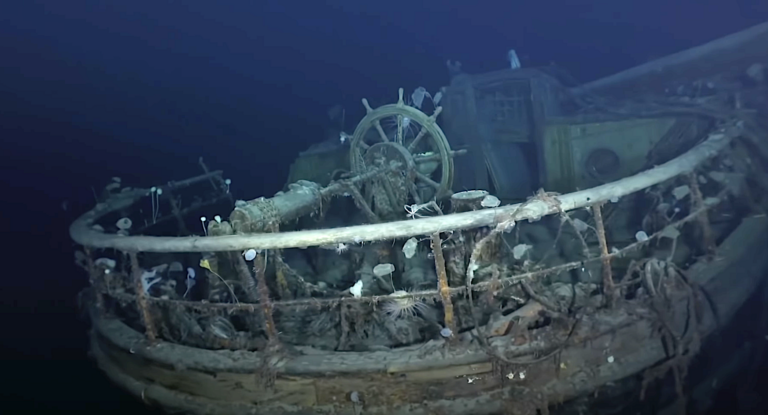
110 years after its first and last voyage, we remember the RMS Titanic and its touted “unsinkability” as one of the resounding ironies of maritime history. But 1912 also saw the launch of another newly built yet ill-fated ship whose name proved all too apt: Endurance, as it was rechristened by Sir Ernest Shackleton when he purchased it to use on his Imperial Trans-Antarctic Expedition of 1914. In January of the following year, Endurance got stuck in the ice of the Weddell Sea off Antarctica, and over the following ten months that ice slowly crushed and ultimately sank the ship. But her whole crew survived, thanks to Shackleton’s leading them more than 800 miles over the open ocean to safety.
Shackleton and his men have been celebrated for their endurance; as for Endurance herself, it has spent more than a century unseen at the bottom of the ocean — unseen, that is, until now. “A team of adventurers, marine archaeologists and technicians located the wreck at the bottom of the Weddell Sea, east of the Antarctic Peninsula, using undersea drones,” […]
|
|
|
|
|
Creative Commons image via Wikimedia Commons
Artist and music producer Brian Eno wrote one of my very favorite books: A Year with Swollen Appendices, which takes the form of his personal diary of the year 1995 with essayistic chapters (the “swollen appendices”) on topics like “edge culture,” generative music, new ways of , pretension, CD-ROMs (a relevant topic back then), and payment structures for recording artists (a relevant topic again today). It also includes a fair bit of Eno’s correspondence with Stewart Brand, once editor of the Whole Earth Catalog and now president of the Long Now Foundation, “a counterpoint to today’s accelerating culture” meant to “help make long-term thinking more common” and “creatively foster responsibility in the framework of the next 10,000 years.”
It so happens that Eno now sits on the Long Now Foundation’s board and has had a hand in some of its projects. Naturally, he contributed suggested reading material to the foundation’s Manual of Civilization, a collection of books humanity could use to rebuild civilization, should it need […]
|
|
|
|
|
If there’s a small silver lining in Putin’s assault on Ukraine, it’s that we’ve discovered the mediocrity of the Russian military. Russia expected a short and decisive war. Two weeks later, the invasion grinds on.
Already, Russia has lost 4,000 soldiers (the US lost 2,400 during its 20-year campaign in Afghanistan), while Ukraine still retains control of its major cities. Above, Wendover Productions breaks down a major factor behind Russia’s stumble–the failure of its logistics.
For more on this question, it’s worth listening to this interview with Retired Lt. General Mark Hertling, the former commanding general of U.S. Army Europe and 7th Army. Drawing on his own military experience, he elaborates on the major gaps in Russia’s strategic planning.
Related Content
Russian Invasion of Ukraine Teach-Out: A Free Course from the University of Michigan
West Point Expert Gives Ukrainians Advice on Conducting Effective Urban Warfare Against […]
|
|
|
|