|
Digest of new articles at openculture.com, your source for the best cultural and educational resources on the web ͏ ͏ ͏ ͏ ͏ ͏ ͏ ͏ ͏ ͏ ͏ ͏ ͏ ͏ ͏ ͏ ͏ ͏ ͏ ͏ ͏ ͏ ͏ ͏ ͏ ͏ ͏ ͏ ͏ ͏ ͏ ͏ ͏ ͏ ͏ ͏ ͏ ͏ ͏ ͏ ͏ ͏ ͏ ͏ ͏ ͏ ͏ ͏ ͏ ͏ ͏ ͏ ͏ ͏ ͏ ͏ ͏ ͏ ͏ ͏ ͏ ͏ ͏ ͏ ͏ ͏ ͏ ͏ ͏ ͏ ͏ ͏ ͏ ͏ ͏ ͏ ͏ ͏ ͏ ͏ ͏ ͏ ͏ ͏ ͏ ͏ ͏
|
|
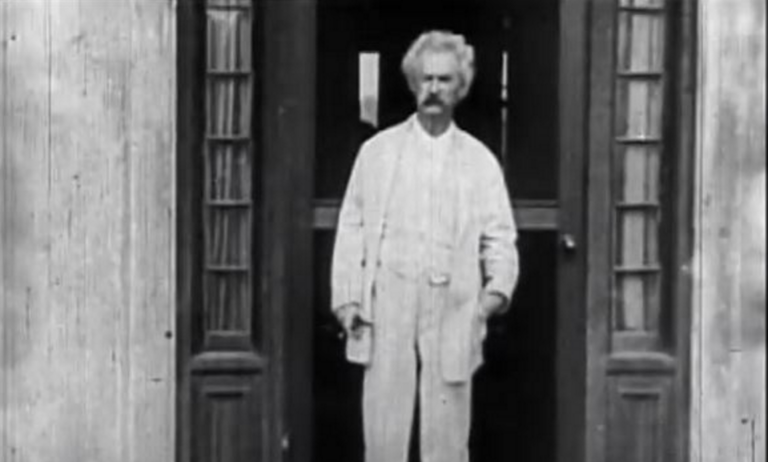
We know what Mark Twain looked like, and we think we know what he sounded like. Just above see what he looked like in motion, strolling around Stormfield, his house in Redding, Connecticut—signature white suit draped loosely around his frame, signature cigar puffing white smoke between his fingers. After Twain’s leisurely walk along the house’s façade, we see him with his daughters, Clara and Jean, seated indoors. Below you can see the original murky version, featured on our site way back in 2010. A digital restoration (top) does wonders for the watchability of this priceless silent artifact, so vividly capturing the writer/contrarian/raconteur’s essence that you’ll find yourself reaching to turn the volume up, expecting to hear that familiar curmudgeonly drawl.
Shot by Thomas Edison in 1909, the short film is most likely the only moving image of Twain in existence. We might assume that Edison also recorded Twain’s voice, since we seem to know it so well, from portrayals of the great American humorist in pop cultural touchstones like Star Trek: The Next Generation and parodies […]
|
|
|
|
|
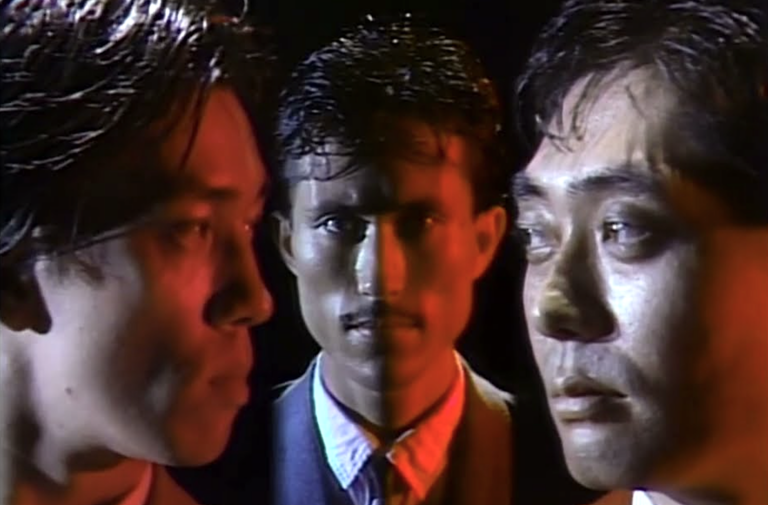
Music changes when technology changes. Few musicians have demonstrated as keen an awareness of that fact as Haruomi Hosono, Yukihiro Takahashi, and Ryuichi Sakamoto, who together as Yellow Magic Orchestra (YMO) burst onto the scene making sounds that most listeners of the late nineteen-seventies had never heard before — never heard in a musical context, at least. They’d never seen a band employ a computer programmer, nor bring onstage a device like Roland’s MC-8 Microcomposer, an early musical sequencer designed strictly for studio use. That YMO didn’t hesitate to make these unconventional choices, and many others besides, won them years as the most popular band in their native Japan.
It would be unimaginable for YMO to have emerged in any other place or time. “Japan had long since remade itself as a postwar economic engine, but by the late 1970s it was becoming something else: a global emblem of techno-utopianism and futuristic cool,” writes the New York Times‘ Clay Risen. “Sony released the Walkman in 1979, just as Kenzo Takada and Issey Miyake were taking over Paris fashion […]
|
|
|
|
|
Image by Benjaminec, via Wikimedia Commons
Rome may not have been built in a day, but it was built to last — or at least its concrete was, given that the pieces of the Roman Empire that have stood to our time, in one form or another, tend to have been built with it. That material has proven not just durable but enduringly fascinating, holding a great deal of not just historical interest but technical interest as well. For ancient Roman concrete appears to outlast its much more technically advanced modern descendants, and the complex question of why is one we’ve featured more than once here on Open Culture. Just this year, researchers at MIT, Harvard, and laboratories in Italy and Switzerland have found what seems to be the final piece of the puzzle.
“For many years, researchers have assumed that the key to the ancient concrete’s durability was based on one ingredient: pozzolanic material such as volcanic ash from the area of Pozzuoli, on the Bay of Naples,” […]
|
|
|
|
|
We recognize that Open Culture readers are a creative bunch.
As proof, we point to your Getty Museum Challenge entries and the fact that one of your number won Yale University Press’s Kafka Caption Contest.
We’ve identified another opportunity to show off your creative streak, compliments of All Of It with Alison Stewart, a daily live culture program on WNYC, New York City’s public radio station.
You have until February 13 to write and record an original song inspired by a work in the public domain, and submit it to The All Of It Public Song Project.
Amateurs are welcome to take a crack at it and any genre is cricket, including rap, spoken word, and instrumentals.
Even if you limit yourself to the works that entered the public domain on January 1 of this year, the possibilities are almost endless.
Should you be inclined toward a faithful cover, we encourage you to consider one of 1927’s deep cuts, like Fats Waller’s “Soothin’ Syrup Stomp” or Jelly Roll Morton’s […]
|
|
|
|
|
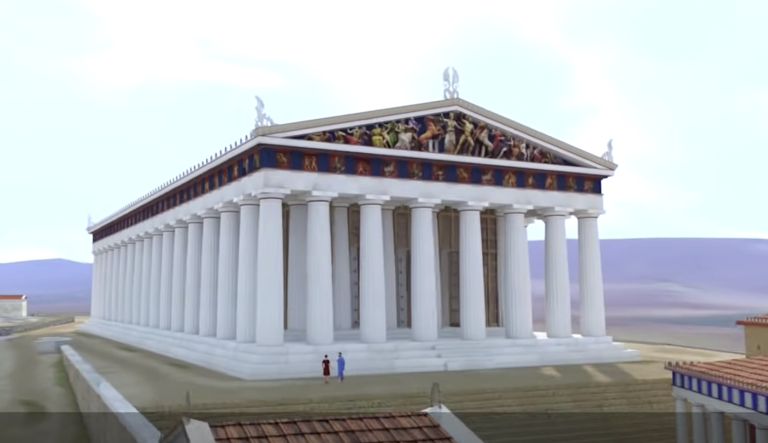
If we seek to understand Western civilization, we must look back not just to Rome, but also to Athens. And today, thanks to computer-generated imagery informed by historical research, we can look not just to those cities, but at them — or at least at convincing digital reconstructions, but from angles their actual inhabitants could scarcely have imagined. A few years ago, we featured here on Open Culture the Youtube channel Ancient Athens 3D for its reconstructions of individual structures like the Temples of Ilissos and Hephaestus. Its more recent video above offers a twelve-minute virtual tour of all classical Athens in the fifth century BC, the height of ancient Greek civilization.
In that period, according to the video, Athens “was the center of the arts, theater, philosophy, and democracy.” In the city “great monuments of architecture were built and were largely associated with the Athenian general Pericles.”
It was Pericles who led the city-state during the first two years of the Peloponnesian War, the conflict in which Athens would eventually fall to Sparta in 404 BC — a defeat […]
|
|
|
|