|
Digest of new articles at openculture.com, your source for the best cultural and educational resources on the web ͏ ͏ ͏ ͏ ͏ ͏ ͏ ͏ ͏ ͏ ͏ ͏ ͏ ͏ ͏ ͏ ͏ ͏ ͏ ͏ ͏ ͏ ͏ ͏ ͏ ͏ ͏ ͏ ͏ ͏ ͏ ͏ ͏ ͏ ͏ ͏ ͏ ͏ ͏ ͏ ͏ ͏ ͏ ͏ ͏ ͏ ͏ ͏ ͏ ͏ ͏ ͏ ͏ ͏ ͏ ͏ ͏ ͏ ͏ ͏ ͏ ͏ ͏ ͏ ͏ ͏ ͏ ͏ ͏ ͏ ͏ ͏ ͏ ͏ ͏ ͏ ͏ ͏ ͏ ͏ ͏ ͏ ͏ ͏ ͏ ͏ ͏
|
|
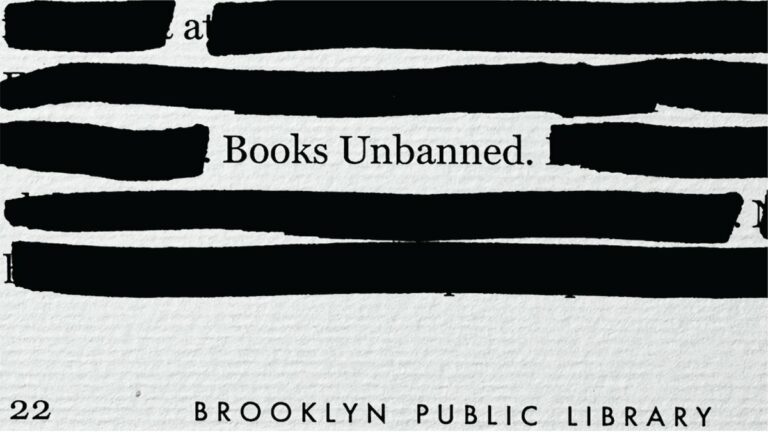
We have covered it before: school districts across the United States are increasingly censoring books that don’t align with conservative, white-washed visions of the world. Art Spiegelman’s Maus, The Illustrated Diary of Anne Frank, Alice Walker’s The Color Purple, Toni Morrison’s The Bluest Eye, and Harper Lee’s To Kill a Mockingbird–these are some of the many books getting pulled from library shelves in American schools. In response to this concerning trend, the Brooklyn Public Library has made a bold move: For a limited time, the library will offer a free eCard to any person aged 13 to 21 across the United States, allowing them free access to 500,000 digital books, including many censored books. The Chief Librarian for the Brooklyn Public Library, Nick Higgins said:
A public library represents all of us in a pluralistic society we exist with other people, with other ideas, other viewpoints and perspectives and that’s what makes a healthy democracy — not shutting down access to those points of view or silencing […]
|
|
|
|
|
We live in an age of subtitles. On some level this is a vindication of the cinephiles who spent so much of the twentieth century complaining about shoddy dubbing of foreign films and public unwillingness to “read movies.” Today we think nothing of reading not just movies but television shows as well, even those performed in our native language. For an increasing proportion of at-home viewers — including on-computer, on-tablet, and on-phone viewers — subtitles have come to feel like a necessity, even in the absence of any hearing difficulties. Vox’s Edward Vega investigates why this has happened in the video above.
The chief irony of the story is that the intelligibility of film and television dialogue seems to have degraded as a result of sound recording and editing technology having improved. Back in the early days of sound film, actors had practically to shout into bulky microphones concealed on-set or placed just off it. Today, a production can keep a couple of boom mics suspended overhead at all times, but also rig each actor up with a few hidden […]
|
|
|
|
|
Welcome to Medieval Mixed-Gender Fight Club.
The first rule of Medieval Mixed-Gender Fight Club is: you do not talk about Medieval Mixed-Gender Fight Club.
The second rule of Medieval Mixed-Gender Fight Club is: you DO NOT talk about Medieval Mixed-Gender Fight Club!
Why?
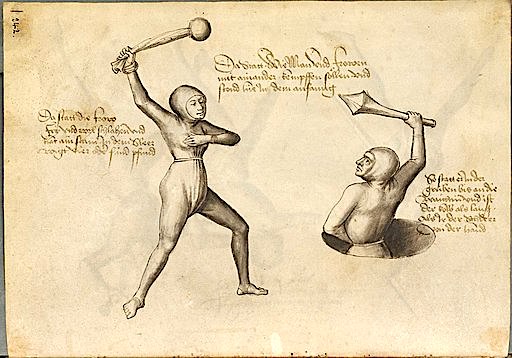
The Public Domain Review’s managing editor, Hunter Dukes, wisely argues that it’s because we have so little to go on, beyond these startling images of “judicial duels” between men and women in German fencing master Hans Talhoffer‘s illustrated 15th-century “fight books.”
The male combatant, armed with a wooden mace, starts out in a waist-deep hole.
The female, armed with a rock wrapped in a length of cloth, stands above, feet planted to the ground.
Their matching unisex garments wouldn’t look out of place at the Met Gala, and provide for maximum movement as evidenced by the acrobatic, and seriously painful-looking paces Talhoffer puts them through.
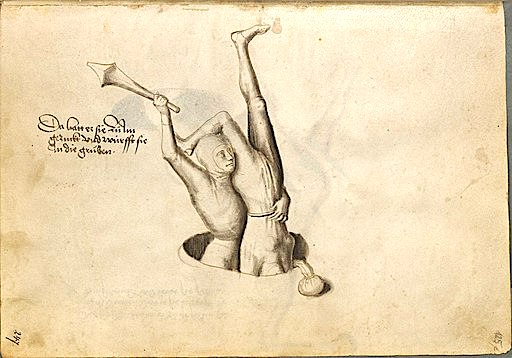
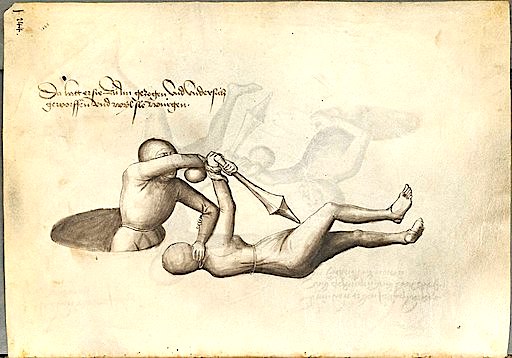
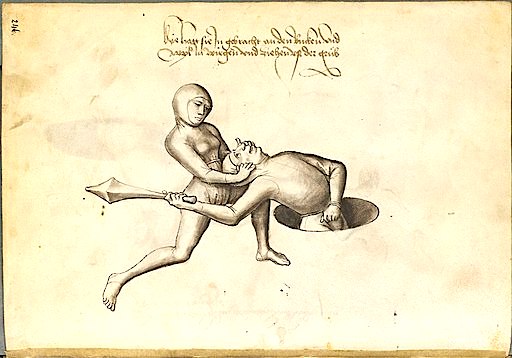
Dukes is not alone […]
|
|
|
|
|
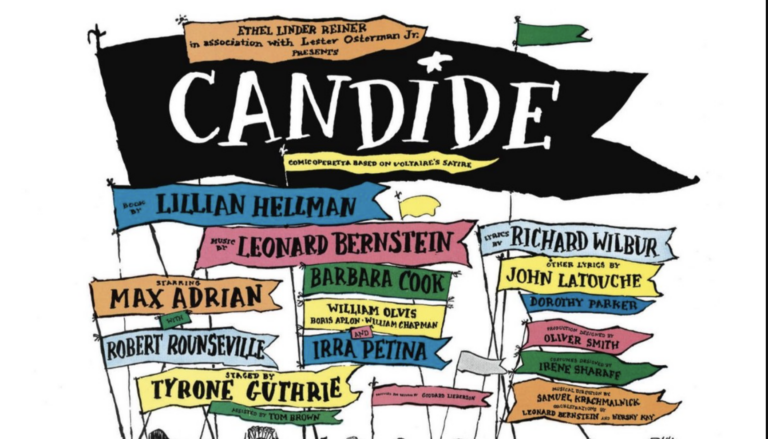
The seventeen-fifties found Western civilization in the middle of its Age of Enlightenment. That long era introduced on a large scale the notion that, through the use of rationality and scientific knowledge, humanity could make progress. For the Enlightenment’s true believers, it would have eventually become quite easy indeed to assume that we had nowhere to go but up, and would sooner or later attain a state of perfection. No such fantasies, of course, for Jean-Marie Arouet, better known as Voltaire. Despite being an Enlightenment icon, he pulled no punches in attacking what he saw as its delusions, most lastingly in his 1759 satirical novel Candide, ou l’Optimisme.
Two centuries later, Western civilization, and especially the freshly formed civilization of the United States of America, had entered a new age of reason. Or rather, it had entered an age of technical, industrial, and organizational “know-how.”
The conviction that America could be perfected through engineered systems played its part in generating a degree of prosperity the world had never known (and would have scarcely been imaginable in Voltaire’s day). But […]
|
|
|
|