|
Digest of new articles at openculture.com, your source for the best cultural and educational resources on the web ͏ ͏ ͏ ͏ ͏ ͏ ͏ ͏ ͏ ͏ ͏ ͏ ͏ ͏ ͏ ͏ ͏ ͏ ͏ ͏ ͏ ͏ ͏ ͏ ͏ ͏ ͏ ͏ ͏ ͏ ͏ ͏ ͏ ͏ ͏ ͏ ͏ ͏ ͏ ͏ ͏ ͏ ͏ ͏ ͏ ͏ ͏ ͏ ͏ ͏ ͏ ͏ ͏ ͏ ͏ ͏ ͏ ͏ ͏ ͏ ͏ ͏ ͏ ͏ ͏ ͏ ͏ ͏ ͏ ͏ ͏ ͏ ͏ ͏ ͏ ͏ ͏ ͏ ͏ ͏ ͏ ͏ ͏ ͏ ͏ ͏ ͏
|
|
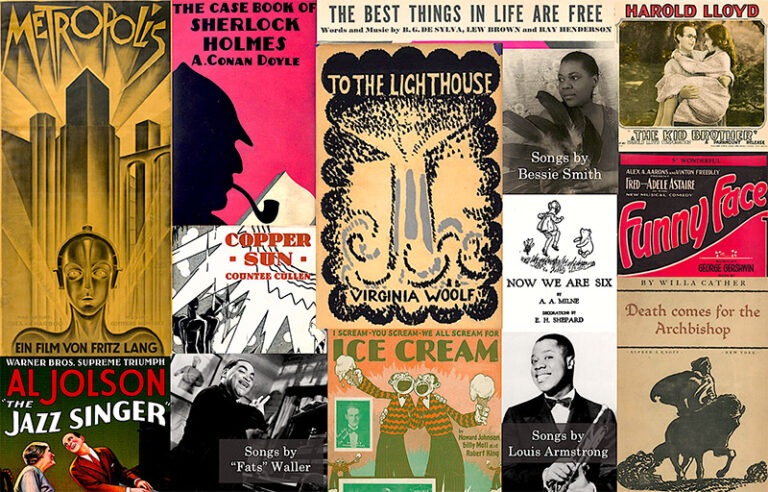
It’s safe to say that few, if any, of us alive today were doing any movie-going in 1927. But that shouldn’t stop us from recognizing the importance of that year to cinema itself. It saw the release of, among other pictures, The Lodger, with which the young Alfred Hitchcock first fully assembled his signature mechanics of suspense; Metropolis, Fritz Lang’s still-influential vision of Art Deco dystopia; F. W. Murnau’s Sunrise, a lavish romantic drama complete with sound effects; and even the very first feature-length “talkie,” The Jazz Singer starring Al Jolson. And don’t even get us started on what a year 1927 was for literature.
Rather, take it from Hyperallergic’s Rhea Nayyar, who highlights Franz Kafka’s posthumously published first novel Amerika, which is now “considered one of his more realistic and humorous works.” Nayyar also mentions Virginia Woolf’s much better-known To the Lighthouse, which, like Amerika as well as all the aforementioned films, has just entered the public domain in the United States in 2023 for anyone to enjoy and use […]
|
|
|
|
|
2022 – another difficult year for so many – has drawn to a close.
While not a remedy for all the hardships and privations we’ve been privy to, Joni Mitchell’s music remains good medicine. Listening to her always makes us feel more connected, reflective and calm for at least an hour or two.
Lucky us. The beloved singer-songwriter has given us a New Year’s gift – all her albums posted to her official Youtube channel.
What a lovely way to usher the old year offstage, and quietly welcome the new.
We all have our allegiances, though many who identify as fans may discover they’ve missed a couple releases along the way.
She has, to date, released 19 studio albums, 5 live albums, and an EP, as well as inspiring 2 tribute albums. A recent remark on Elton John’s Rocket Hour left us hopeful that more may be in the offing.
Sir Elton is but one of many well known musicians who are unabashed Mitchell fans. Artists as diverse as Harry Styles, k.d. […]
|
|
|
|
|
Few things could have been more amusing to a twelve-year-old in 1996 than an Amish-themed parody of the late Coolio’s portentously grim life-in-the-hood anthem “Gangsta’s Paradise.” As luck would have it, “Weird Al” Yankovic released just such a song in 1996, when I happened to be twelve years old myself. Like everyone who’s been a kid at some point in the past 40 years, I grew up hearing and appreciating Yankovic’s prolific output of parodies, pastiches, and even original songs. From “Eat It” to “Smells like Nirvana” to “White and Nerdy,” there was hardly a pop-music phase of my childhood, adolescence, and early adulthood that he didn’t make funny.
That’s to make funny, as distinct from to make fun of: unlike that of a predecessor in comedy songwriting like Tom Lehrer, Yankovic’s body of work evidences not the least tendency toward harshness or ridicule.
Hence his appeal from his very first recording “My Bologona,” an accordion-based parody of “My Sharona” recorded in the bathroom of his college radio station, to no less an advocate of silliness […]
|
|
|
|
|
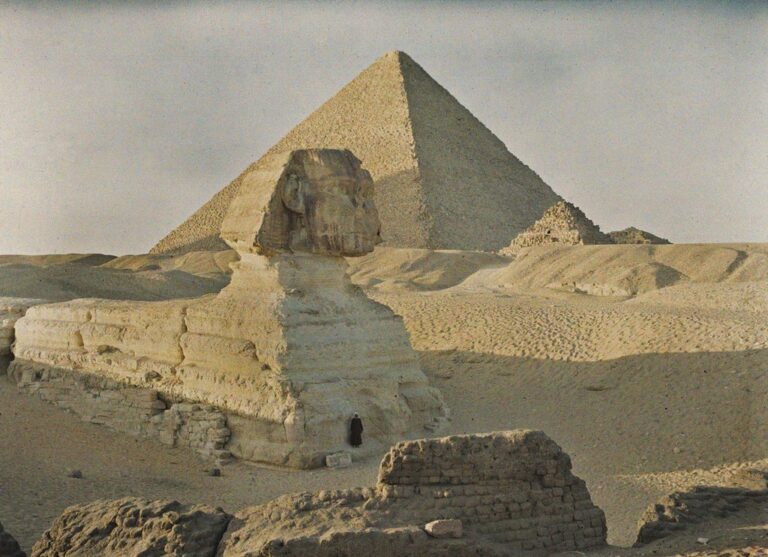
The world, we often hear, used to be bigger. Today, if you feel the faintest twinge of curiosity about a distant place — Beijing, Paris, Cambodia, Egypt — you can near-instantaneously call up countless hours of high-quality video footage shot there, and with only a little more effort even communicate in real-time with people actually living there. This may be the case in the early twenty-first century, but it certainly wasn’t in the early twentieth. If you’d wanted to see the world back then, you either had to travel it yourself, an expensive and even dangerous proposition, or else hire a team of expert photographers to go forth and capture it for you.

Albert Kahn, a successful French banker and speculator, did both. A few years after making his own trip around the world, taking stereographic photos and even motion-picture footage along the way, he came up with the idea for a project called Les archives de la planète, or The Archives […]
|
|
|
|
|
At its peak in the second century, the Roman Empire dominated nearly two million square miles of the world. As with most such grand achievements, it couldn’t have happened without the development of certain technologies. The long reach of the Eternal City was made possible in large part by the humble technology of the road — or at least it looks like a humble technology here in the twenty-first century. Roads existed before the Roman Empire, of course, but the Romans built them to new standards of length, capacity, and durability. How they did it so gets explained in the short video above.
On a representative stretch of Roman-road-to be, says the narrator, a “wide area would be deforested.” Then “the topsoil would be removed until a solid base was found.” Atop that base, workers laid down curbs at the width determined by the road plan, then filled the gap between them with a foundation of large stones.
Atop the large stones went a layer of smaller stones mixed with fine aggregates, and finally the gravel, sand, and clay that made […]
|
|
|
|