 Cinema as we’ve almost always known it — “Edison, the Lumière brothers, Méliès, Porter, all the way through Griffith and on to Kubrick” — has “really almost gone.” So writes Martin Scorsese in his recent essay for the New York Review of Books, “The Persisting Vision: Reading the Language of Cinema.” He argues that traditional film forms have “been overwhelmed by moving images coming at us all the time and absolutely everywhere, even faster than the visions coming at the astronaut” in Kubrick’s 2001: A Space Odyssey. “We have no choice but to treat all these moving images coming at us as a language. We need to be able to understand what we’re seeing and find the tools to sort it all out.” Only natural that Scorsese, as one of the best-known, highest-profile auteurs alive, would reference Kubrick, his generational predecessor in the untiring furtherance of cinematic vision and craft.
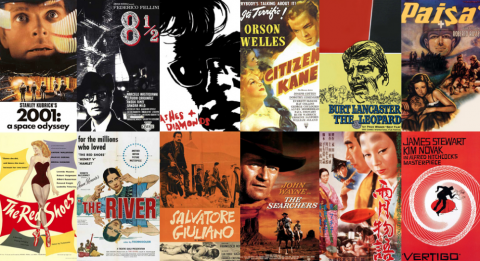
We just yesterday featured a post about Kubrick’s 1963 list of ten favorite films. Scorsese, for his part, has impressed many as one of the most enthusiastically cinephilic directors working in America today: his essays about and appearances on the DVDs of his favorite movies stand as evidence for the surprising breadth of his appreciation. Today, why not have a look at Scorsese’s list, which he put together for Sight and Sound magazine, and which begins with the Kubrick selection you might expect:
- 2001: A Space Odyssey (1968) – Stanley Kubrick
- 8½ (1963) – Federico Fellini
- Ashes and Diamonds (1958) – Andrzej Wajda
- Citizen Kane (1941) – Orson Welles
- The Leopard (1963) – Luchino Visconti
- Paisan (1946) – Roberto Rossellini
- The Red Shoes (1948) – Michael Powell/Emeric Pressburger
- The River (1951) – Jean Renoir
- Salvatore Giuliano (1962) – Francesco Rosi
- The Searchers (1956) – John Ford
- Ugetsu Monogatari (1953) – Mizoguchi Kenji
- Vertigo (1958) – Alfred Hitchcock
In “The Persisting Vision,” he champions comprehensive film preservation, citing the case of Hitchcock’s Vertigo, the final entry on his list, now named the greatest film of all time by Sight and Sound’s critics poll. “When the film came out some people liked it, some didn’t, and then it just went away.” When, after decades of obscurity, Vertigo came back into circulation, the color was completely wrong,” and “the elements — the original picture and sound negatives — needed serious attention.” A restoration of the “decaying and severely damaged” film eventually happened, and “more and more people saw Vertigo and came to appreciate its hypnotic beauty and very strange, obsessive focus.” I, personally, couldn’t imagine the world of cinema without it — nor without any of the other pictures Scorsese calls his favorites.
Related Content:
Martin Scorsese Makes a List of 85 Films Every Aspiring Filmmaker Needs to See
Martin Scorsese Creates a List of 39 Essential Foreign Films for a Young Filmmaker
Revisit Martin Scorsese’s Hand-Drawn Storyboards for Taxi Driver
Martin Scorsese’s Very First Films: Three Imaginative Short Works
Martin Scorsese Brings “Lost” Hitchcock Film to Screen in Short Faux Documentary
Colin Marshall hosts and produces Notebook on Cities and Culture and writes essays on literature, film, cities, Asia, and aesthetics. He’s at work on a book about Los Angeles, A Los Angeles Primer. Follow him on Twitter at @colinmarshall.




nice to see the John Wayne movie on his list.
Now I’ll be damned but this “list of 10 favorite movies” really looks like a “list of 12 favorite movies”.
It’s a bit disappointing that his last selected movie is dated in 1968. So film language and the fact of making top brilliant movies has stopped in 1968, 45 years ago…
Amazing list. Nothing modern. No Bergman. Seems very arbitrary list for such an intellect. No comedy. Happy guy!
12, right?
“Ashes and Diamonds” are legally available at Youtube http://www.youtube.com/watch?v=V3ys_NeM6wA , among 30 other significant Polish movies at the chanel of its producer Studio Filmowe KADR. Some of the movies already have English subs, Ashes are unluckily only in Polish, but the channel is quite new, so I hope that an English version is a question of a near future!
nothing beyond 1970. this is sad .
Lives of Others, Godfather 2, Man on the Flying Trapeze. Thin Red Line, trasure of Sierra Madre.n
sine the early 80s filmmaking in Hollywood has gone down the toilet that’s a fact!!I would say 65 percent of what holly wood puts out now is flat out garbage movies!!
Looks like mr. Scorsese and I have somewhat different tastes. I’m very glad to see The River included, however. Jean Renoir was a true master — “the greatest of all directors”, in the words of no one other than Orson Welles — and he was one of the few directors who could use color to achieve truly beautiful aesthetic effects, which is no accident, since his father was one of the greatest modern painters.
The most recent movie in the list dates back to 1968. I think he should have added more recent ones. Some good candidates, in my opinion, would be Kurosawa’s Ran and something by Bela Tarr. And maybe Aguirre. I also find it disappointing that there are no movies by Tarkovsky and Bresson, as well as no silent movies, but then again, our tastes seem to be somewhat different.
Great collection of movies !
i agree that these are great films. I have to include thoughts of some that I have enjoyed watching several times for a variety of reasons. Fargo, Godfather 2, The Shawshank Tedemption and The Departed.
that’s what i thought.
Good to the The Searchers in there. Terrific movie.
The youtube shows this video is private.
Great list, by my favourite director, here is mine :)
alphabetical order-
Apocalypse Now (Copolla, 1979)
Bicycle Thief, The (Di Sica, 1948)
Breathless (Godard, 1960)
Chinatown (1974, Polanski)
Dekalog (Kielowski, 1989)
Dr. Strangelove (Kubrick, 1964)
Network (Lumit, 1976)
Peeping Tom (Powell, 1960)
Gangs Of Wasseypur (Kashyap, 2012)
Godfather,The (Copolla, 1972)
Taxi Driver (Scorsese, 1976)
Wild Strawberries (Bergman, 1957)
With regards to there being nothing later than 1968 — in A Personal Journey with Martin Scorsese through American Movies, a documentary he made with the BFI, Scorsese said that that was when he started making movies, and that he wasn’t as able to critique that work. He doesn’t really give a reason, other than when he offers this list he’s really telling us the movies that made him want to be a filmmaker — by 1970 he was one.
Gosh, your replies are so stupid.
The Searchers is to American cinema what Huckleberry Finn is to American literature.
you are stupid.
What’s with the people saying the replies and/or commenters are “stupid?” There are some interesting, substantive responses.