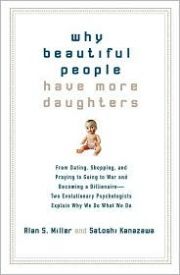
 Human behavior is notoriously complex, and there’s been no shortage of psychologists and psychological theories venturing to explain what makes us tick. Why do we get irrationally jealous? Or have midlife crises? Why do we overeat to our own detriment? Why do we find ourselves often strongly attracted to certain physical traits? Numerous theories abound, but few are perhaps as novel and thought-provoking as those suggested by a new book with a long title: Why Beautiful People Have More Daughters: From Dating, Shopping, and Praying to Going to War and Becoming a Billionaire — Two Evolutionary Psychologists Explain Why We Do What We Do. Written by Satoshi Kanazawa and Alan S. Miller, the book finds answers not in ids, egos and superegos, but in the evolution of the human brain. Written in snappy prose, their argument is essentially that our behavior — our wants, desires and impulses — are overwhelmingly shaped by the way our brain evolved 10,000+ years ago, and one consequence is that our ancestral brain is often responding to a world long ago disappeared, not the modern, fast-changing world in which we live. This disconnect can lead us to be out of sync, to act in ways that seem inexplicable or counter-productive, even to ourselves. These arguments belong to new field called “evolutionary psychology,” and we were fortunate to interview Satoshi Kanazawa (London School of Economics) and delve further into evolutionary psychology and the (sometimes dispiriting) issues it raises. Have a read, check out the book, and also see the related piece that the Freakonomics folks recently did on this book. Please note that the full interview continues after the jump.
DC: In a nutshell, what is “evolutionary psychology”? (e.g. when did the field emerge? what are the basic tenets/principles of this school of thinking?)
SK: Evolutionary psychology is the application of evolutionary biology to human cognition and behavior. For more than a century, zoologists have successfully used the unifying principles of evolution to explain the body and behavior of all animal species in nature, except for humans. Scientists held a special place for humans and made an exception for them.
In 1992, a group of psychologists and anthropologists simply asked, “Why not? Why can’t we use the principles of evolution to explain human behavior as well?” And the new science of evolutionary psychology was born. It is premised on two grand generalizations. First, all the laws of evolution by natural and sexual selection hold for humans as much as they do for all species in nature. Second, the contents of the human brain have been shaped by the forces of evolution just as much as every other part of human body. In other words, humans are animals, and as such they have been shaped by evolutionary forces just as other animals have been.
DC: Evolutionary psychology portrays us as having impulses that took form long ago, in a very pre-modern context (say, 10,000 years ago), and now these impulses are sometimes rather ill-adapted to our contemporary world. For example, in a food-scarce environment, we became programmed to eat whenever we can; now, with food abounding in many parts of the world, this impulse creates the conditions for an obesity epidemic. Given that our world will likely continue changing at a rapid pace, are we doomed to have our impulses constantly playing catch up with our environment, and does that potentially doom us as a species?
SK: In fact, we’re not playing catch up; we’re stuck. For any evolutionary change to take place, the environment has to remain more or less constant for many generations, so that evolution can select the traits that are adaptive and eliminate those that are not. When the environment undergoes rapid change within the space of a generation or two, as it has been for the last couple of millennia, if not more, then evolution can’t happen because nature can’t determine which traits to select and which to eliminate. So they remain at a standstill. Our brain (and the rest of our body) are essentially frozen in time — stuck in the Stone Age.
One example of this is that when we watch a scary movie, we get scared, and when we watch porn we get turned on. We cry when someone dies in a movie. Our brain cannot tell the difference between what’s simulated and what’s real, because this distinction didn’t exist in the Stone Age.
DC: One conclusion from your book is that we’re something of a prisoner to our hard-wiring. Yes, there is some room for us to maneuver. But, in the end, our evolved nature takes over. If all of this holds true, is there room in our world for utopian (or even mildly optimistic) political movements that look to refashion how humans behave and interact with one another? Or does this science suggest that Edmund Burke was on to something?
SK: Steven Pinker, in his 2002 book The Blank Slate, makes a very convincing argument that all Utopian visions, whether they be motivated by left-wing ideology or right-wing ideology, are doomed to failure, because they all assume that human nature is malleable. Evolutionary psychologists have discovered that the human mind is not a blank slate, a tabula rasa; humans have innate biological nature as much as any other species does, and it is not malleable. Paul H. Rubin’s 2002 book Darwinian Politics: The Evolutionary Origin of Freedom gives an evolutionary psychological account of why Burke and classical liberals (who are today called libertarians) may have been right.
As a scientist, I am not interested in Utopian visions (or any other visions for society). But it seems to me that, if you want to change the world successfully, you cannot start from false premises. Any such attempt is bound to fail. If you build a house on top of a lake on the assumption that water is solid, it will inevitably collapse and sink to the bottom of the lake, but if you recognize the fluid nature of water, you can build a successful houseboat. A houseboat may not be as good as a genuine house built on ground, but it’s better than a collapsed house on the bottom of the lake. A vision for society based on an evolutionary psychological understanding of human nature at least has a fighting chance, which is a much better than any Utopian vision based on the assumption that human nature is infinitely malleable.
DC: So give us a hint. Why do beautiful people actually have more daughters?
SK: The basic idea is this: Whenever parents have genetic traits they can pass on to their children that are more valuable for boys than for girls, then they have more sons than daughters. Conversely, whenever parents have genetic traits they can pass on to their children that are more valuable for girls than for boys, then they have more daughters than sons. Physical attractiveness — being beautiful — is good for both boys and girls, but it’s much more advantageous for girls. Physical attractiveness of a woman is one of the most important considerations for men when they select both long-term and short-term mates, but a man’s physical attractiveness is important for women only when she’s looking for short-term mates. Women like to have affairs with good-looking men, but they don’t necessarily want to marry them, unless of course they are also rich and powerful.
So beautiful daughters will be more likely to take full advantage of their physical attractiveness than beautiful sons. Beautiful daughters are more likely to pass on their genes successfully to the next generation than beautiful sons, because they are more likely to find themselves in stable marriages to desirable spouses. In a representative sample of 3,000 young Americans, those who are “very attractive” had 36% greater odds of having a daughter compared to everyone else. Similarly, studies have found that big and tall parents are more likely to have sons, and short and thin parents are more likely to have daughters, because body size is more of an advantage to men than to women. Women are attracted to big and tall men much more than men are attracted to big and tall women.
DC: In the book you debunk the notion of “midlife crisis.” Why?
SK: We don’t debunk its existence; we believe it exists. But we suggest that it might exist for different reasons than people think. Midlife crisis is a mystery for evolutionary psychology, because there is really no reason for middle-aged men to change their behavior suddenly when they reach middle age. So we speculate in the book that middle-aged men may engage in a constellation of behavior which we associate with the phrase “midlife crisis,” not because they are middle-aged, but because their wives are. When their wives reach menopause, it means that, not only is the wife’s reproductive career over, but so is the husband’s, unless, of course, he can find a younger mate to replace (or, as often happened throughout evolutionary history, add to, since humans are naturally polygynous) the menopausal wife. We believe that “midlife crisis” might be a reflection of middle-aged men’s attempt to attract younger women because their wives are no longer reproductive. So we hypothesize that a 50-year-old man married to a 25-year-old wife will not undergo midlife crisis, whereas a (very rare) 25-year-old man married to a 50-year-old wife will. And, of course, evolutionary psychology can explain why there are very few young men married to middle-aged women. If you want to know, you have to read the book!
DC: Finally, what are some of the remaining mysteries in evolutionary psychology? Are there things that you still don’t know, questions for which you still don’t have answers?
SK: There are many questions for which we don’t yet have answers. We devote our last chapter to discussing some of these questions. For example, why do most middle-class people in western industrial nations have so few children? Most middle-class Americans can easily raise five or six children, and feed, clothe, and shelter them all very well. Yet most couples only want (and have) two children. This is a mystery for evolutionary psychology.
A related mystery is the fact that there seems to be a genetic transmission of fertility from parents to children, so that parents who have many siblings tend also to have many children themselves. This makes absolutely no sense from an evolutionary psychological perspective. If your parents had many children, that means you have many brothers and sisters who carry some of your genes, so you can afford not to have many children yourself. Conversely, if you are an only child, nobody else besides you carries half of your genes, so you have to have many children to spread your genes, to compensate for your parents’ lack of reproductive success. So there should really be a negative correlation between your parents’ fertility and your own, but all the demographic studies show that the correlation is positive. Only children tend to beget only children. This is a mystery.




“Most middle-class Americans can easily raise five or six children, and feed, clothe, and shelter them all very well. Yet most couples only want (and have) two children. This is a mystery for evolutionary psychology.”
This is hardly a mystery, at least to my mind.
It seems obvious to me that the reason to have many kids is to ensure that at least a few of them survive to pass on genes, like a dandelion. But this strategy is only actually viable in a high-stress environment, because kids take lots of resources to raise to reproductive maturity and so having tons of kids is expensive and only really works when most of them are likely to die before they reach sexual maturity anyway. Also, in a stressful environment, resources are scarce and closer to borderline in terms of ROI in producing them. Ergo, it is in the family’s best interest to have lots of workers around to ensure subsistence levels of resources are achieved.
OTOH, the advanced civilizations of Westerners all but guarantees that a high ratio of kids born will live, so they can genetically afford to have fewer and invest their surplus resources into ensuring the kids live a long and healthy life, rather than going for the dandelion approach. Plus, resource acquisition is relatively easy and therefore Westerners do not have to resort to breeding their own labor pool to ensure adequate resource accumulation.
Your mileage may vary, but it makes sense to me. Why strain your resources unnecessarily with a lot of kids if you don’t have to?
because their parent want more kid if the first kid beautiful and have a good chance to increase their income because a lot of people like beautiful, that can used in media such as tv, film,advertising
“When the environment undergoes rapid change within the space of a generation or two, as it has been for the last couple of millennia, if not more, then evolution can’t happen because nature can’t determine which traits to select and which to eliminate.”
Perhaps this explains why cultures in general place high importance on conservative values and long held traditions because they are trying to stabilize environmental condition to allow evolution to occur.
One flaw in this storyline is that the environment has actually remained sufficiently constant for most people for long periods over the last 10,000 years to be capable of driving evolution. Starting about 10,000 years ago in the Middle East, and spreading gradually around the world, the neolithic revolution turned most of the world’s population into farmers, living a lifestyle that changed very slowly between its introduction and maybe 150 years ago. This has had evolutionary effects, such as the lactose tolerance of northern Europeans whose farming systems relied (and rely) to a significant extent on milk production. My guess is that there are two main reasons for the evolutionary hang-overs in behaviour described here. One is that they have not resulted in significant disadvantages over the last 10,000 years. The other is that the evolutionary roots of much of our behaviour are very deep, shared in essence with chimpanzees and bonobos, and it would take significant evolutionary pressure to eradicate them, as opposed to driving the minimum behavioural changes required for efficient survival and reproduction.
i hate to be a troll here, but this sounds like total bullshit.
i’m sorry :(
Criticism is fine, indeed welcomed here, but how about a little substance (or else it looks like trolling).…
DC
This is nothing new from a philosophical point of view. Olaf Stapledon broke down the species and behavior patterns from an evolutionary perspective in 1930 when he wrote ‘Last and First Men’. 2 billion years of evolution for our species, breaking them into 18 variations due to their genetic differences and behavior patterns. We, the first men, don’t fare very well.
Give it a wiki to get a better idea.
I’m not sure that I necessarily agree with either the premise, or the way they are explaining the concept. The quote you sent infers that the parents are some how able to purposefully have more of one gender or the other, which I don’t think is possible.
I can sort of see how it makes sense if they are talking about populations of parents instead of individuals: a population of parents who have a trait that is more valuable to girls will quite likely have their female descendants survive/thrive better than their male descendants. However, the more I read it the more I think they are talking about individuals, in which case I think they are BSing:
“In a representative sample of 3,000 young Americans, those who are “very attractive” had 36% greater odds of having a daughter compared to everyone else.”
That makes no sense at all. There is no way that genes that will one day in the future determine how beautiful a baby is will affect the likelihood of an X‑sperm fertilizing the egg over a Y‑sperm… I call shenanigans.
More that I disagree with:
“… and when we watch porn we get turned on. We cry when someone dies in a movie. Our brain cannot tell the difference between what’s simulated and what’s real, because this distinction didn’t exist in the Stone Age.”
It’s called empathy. I suppose that the fact that it may be a fictional story may come in to play, but I think that part is only a tiny part in why we react this way. I’m sure that neolithic hunters cried when someone told them a sad story…
“For example, why do most middle-class people in western industrial nations have so few children? Most middle-class Americans can easily raise five or six children, and feed, clothe, and shelter them all very well. Yet most couples only want (and have) two children. This is a mystery for evolutionary psychology.”
It’s not a mystery. Well, it’s true in the same sense that it’s a mystery why some people like chocolate and some people don’t… It has far more to do with the fact that unlike previous generations/societies, we don’t need to have many children to help us provide for ourselves. Thus, the negatives associated by some with having many children VASTLY outweigh the positives, and so we don’t have as many children. This is also very much a cultural issue, but I don’t think it has a god damn thing to do with evolutionary psychology; or rather, it has no more to do with it than it does with a myriad of other issues. Obviously evolutionary psychology is important, very important in particular issues, but I think these guys are out to lunch with what they’ve said in this interview.
There is no science-substance-behind this book: pure fantasy. Read Kanazawa, Satoshi. 2007. “Beautiful Parents Have More Daughters: A Further Implication of the Generalized Trivers-Willard Hypothesis (gTWH)”, Journal of Theoretical Biology. 244: 133–140. Nada, zilch. We should select for better editors.…
Alright, it’s finally sunk in; it was what I said in the first post; they aren’t explaining it very well. It took me this long to realize that they were talking implicitly about a gender-having genes but explicitly about the beautiful-having genes.
That is, genes that increase the tendency to have a particular gender will become tied to the genes that benefit a particular gender:
This link would happen when the two genes “met in the wild”: there was a bigger advantage for the beautiful+girl-having combo than any of the other combos (beautiful+boy-having, ugly+boy-having, ugly+girl-having), and so that combo proliferated more effectively. In fact, it proliferated more effectively than the other beautiful+? combos, and thus, created the correlation between being beautiful and having girl-having genes.
This is another example of extremely shoddy thinking being passed off as cutting edge science. They don’t even know the basics of when EP originated: they say it began in 1992, which is totally wrong. E.O. Wilson published SOCIOBIOLOGY in 1975. This was the origins of applying evolutionary theory to human behavior. The authors’ apparent ignorance of the fact that evolutionary psychology is simply another name for sociobiology is shameful.
As previous comments have noted, the premise that evolutionary processes are “stuck” and that significant change cannot have happened in 10,000 years is simply false. Not just false, but embarrassingly so.
EP could be a useful, important discipline, but it is dominated by people like these (and Pinker) who are peddling sloppy thinking in lieu of serious science.
You should note that Mr. Kanazawa has never actually shown that beautiful people have more daughters. The original piece was shown to be faulty by professor Mark Gelman. Links to Gelman’s work:
a href=“http://www.stat.columbia.edu/~gelman/research/published/kanazawa.pdf
a href=“http://www.stat.columbia.edu/~gelman/research/unpublished/power.pdf
Also check out his blog post on the same topic:
http://www.stat.columbia.edu/~cook/movabletype/archives/2007/08/the_most_beauti.html
I have a series of posts on Mr. Kanazawa’s arguments. This link takes you to the last post which gives the links to earlier ones:
http://echidneofthesnakes.blogspot.com/2007_07_01_archive.html#2846602295158944466
A final post on the question is here:
http://echidneofthesnakes.blogspot.com/2007_09_01_archive.html#2386730832932158479
[…] read a great interview with Satoshi Kanazawa, one of the authors of Why Beautiful People Have More Daughters, a new book […]
Evolutionary psychology is a cobbled together collection of just-so stories that are nothing but a sinking life raft desperately clung to by those those who long for the glory days of patriarchy. We will one day soon look back at books like this and laugh and laugh.
And the premise that “beautiful” people have more daughters has been debunked.
More and more women are dating younger men. Within the past 50 years. Less than an evolutionary time span. Only an evolutionary psychologist could believe that it’s just a coincidence this has happened at exactly the same time as women have become more financially independent.
As our last good president said — it’s the economy, stupid!
[…] Our Ancestral Mind in the Modern World: An Interview with Satoshi Kanazawa | Open Culture: DC: Evolutionary psychology portrays us as having impulses that took form long ago, in a very pre-modern context (say, 10,000 years ago), and now these impulses are sometimes rather ill-adapted to our contemporary world. For example, in a food-scarce environment, we became programmed to eat whenever we can; now, with food abounding in many parts of the world, this impulse creates the conditions for an obesity epidemic. Given that our world will likely continue changing at a rapid pace, are we doomed to have our impulses constantly playing catch up with our environment, and does that potentially doom us as a species? […]
[…] One example of this is that when we watch a scary movie, we get scared, and when we watch porn we get turned on. We cry when someone dies in a movie. Our brain cannot tell the difference between what’s simulated and what’s real, because this distinction didn’t exist in the Stone Age. ^ […]
There are better explanations for why people have more girls than boys or vis a versa. I read somewhere that there was a strong correlation between the sex of a child and that of previous generations, something to do with balancing the generations and explaining the pretty constant sex ratios. Sorry for not having a link or explaining it very well.
36% chance isn’t really much at all, and isn’t beauty in the eye of the beholder so how exactly is it satisfactorily defined for this sample?
Nice site look =) I love it
Really good post…I was searching for something like this. thanks…
[…]Our Ancestral Mind in the Modern World: An Interview with Satoshi Kanazawa | Open Culture[…]…
“Evolutionary psychology is a cobbled together collection of just so stories that are nothing but a sinking life raft desperately clung to by those who long for the glory days of patriarchy.”
Spoken like a true ideologue. Care to say anything of substance, as opposed to just buzz words?