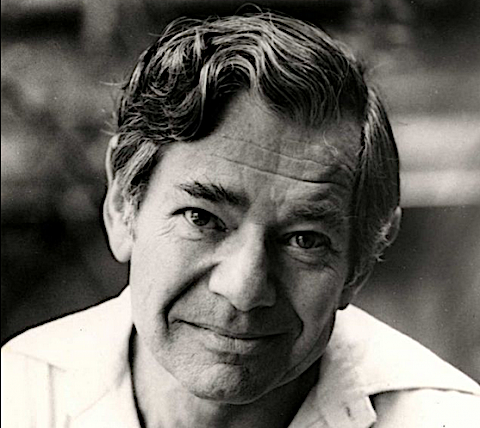
Image via Wikimedia Commons
Walter Kaufmann spent 33 years (1947–1980) teaching philosophy at Princeton. And more than anyone else, Kaufmann introduced Nietzsche’s philosophy to the English-speaking world and made it possible to take Nietzsche seriously as a thinker – something there wasn’t always room to do in American intellectual circles.
Without simplifying things too much, Kaufmann saw Nietzsche as something of an early existentialist, which brings us to these vintage lectures recorded in 1960 (right around the time that Kaufmann, a German-born convert to Judaism, also became a naturalized American citizen). The three lectures offer a short primer on existentialism and the modern crises philosophers grappled with. Kierkegaard and the Crisis in Religion begins the series, followed by Nietzsche and the Crisis in Philosophy and Sartre and the Crisis in Morality. You can hear them right below:
Kierkegaard and the Crisis in Religion
Nietzsche and the Crisis in Philosophy
Sartre and the Crisis in Morality
Kaufmann’s talks are now listed in the Philosophy section of our collection of 1100 Free Online Courses. There you will also find courses presented by other major figures, including John Searle, Hubert Dreyfus, and Michael Sandel.
If you would like to sign up for Open Culture’s free email newsletter, please find it here. It’s a great way to see our new posts, all bundled in one email, each day.
If you would like to support the mission of Open Culture, consider making a donation to our site. It’s hard to rely 100% on ads, and your contributions will help us continue providing the best free cultural and educational materials to learners everywhere. You can contribute through PayPal, Patreon, and Venmo (@openculture). Thanks!
Related Content:
Free Online Philosophy Courses, part of our collection, 1,700 Free Online Courses from Top Universities
Lovers and Philosophers — Jean-Paul Sartre & Simone de Beauvoir Together in 1967
The Philosophy of Nietzsche: An Introduction by Alain de Botton




#/media/File:Walter_Kauffman.jpg)
Thanks, I enjoyed his talks so much!
Is Walter still alive? I have dire need to speak with him about nietzche. It’s an Apollonian and dionysian problem put together and made real. Cough. Hint. I most definitely need guidance on this path someone dreamed up for me. And I’m tired of taking walks alone and debating nietzche to myself cuz my wife’s too busy taking care of the kid.. So Walter! Do you wanna help nietzches little monster lol. Anyway what does the moonlight have to be like to see the symbol on the birth of tragedy?
Damn… He isn’t around. Um.… Beep blupe borp
What a treat! It was Kaufmann’s Nietzsche that got my world spinning faster as a late teen. Around ten years later, I came out with my first book (aphorisms) and nearly ten years after that my book of essays, ‘From Nietzsche to Belly Dancing’. Still meditating on Nietzsche, and the artist as mystic (in current issue of Agni magazine: http://www.bu.edu/agni/toc/74/index.html)
Nietzsche spent most of his intellectual life reacting against the final part of Schopenhauer’s Die Welt als Wille und Vorstellung. Kaufmann minimized this and tried to make it seem that Nietzsche was mostly concerned with Hegel’s concept of development.
Respectfully, Kaufmann was non-religious, even though as a child and adolescent he briefly was religiously involved first as a Protestant, then a Catholic, and finally a Jew. But he quickly put aside all religion…as he writes about in no uncertain terms in his book “Faith of a Heretic.”
To describe him as “a German-born convert to Judaism” is, therefore, inaccurate.
It’s not inaccurate. It’s just superficially accurate.
Nietzsche seems to be widely misunderstood. Brian Leitner highlights some common myths about Nietzsche at philosophybites.com
http://cdn1.libsyn.com/philosophybites/Brian_Leiter_on_Nietzsche_Myths.mp3?nvb=20091219100347&nva=20091220101347&t=06ac16fa21d83d8f3389b
I’ve found that the best data subject, thank you http://www.autocadkursu.co/ http://www.autocadkursu.co/autocad-ozel-ders.html
Yeah! This is tip top! Thanks for posting!
Does this statement belong to Sartre.If it does do you have any proof ? Here is the statement,
“When we speak of forlornness, we mean only that God does not exist and that we have to face all the consequences of this.…The existentialist thinks it very distressing that God does not exist, because all possibility of finding values in a heaven.…
This is an interesting talk. The only thing is that I think if someone knows who Nietzsche is they know he wasn’t an anti-Semite. Although, that may only be my own experience.
Interested in philosophy but not have access for it
Started in philosophy at University of Minnesota, them transferred to Kid Anges City College, got my Bachelirs at California State, Dominguez Hills, transferred to Cal State Los Angeles for a Masters, dropped out for 20 years to raise family then got accepted for PHD at International College Westwood, in tutotship under Mr Kiley, dropped lack of finances, and spent next 20 yeare working , and now the only thing going for me is contributing to a web-sight by the name of I love philosophy. My thirst for philosophy has gone on un ceasing.
Yes. Which is why the modern roots — from ‘philosophia’ [L] fr. ‘philosophos’ [Gk] — speak of love of wisdom. Now, you may have set aside formal academic pursuits, even on a few occasions. But it sounds to me like you didn’t ever really drop out. And my guess would also be that the framework was still very much with you throughout — and occasionally, quite helpful.
Recall also that Socrates didn’t write anything, let alone some formal thesis! Dialogue was the method. And yet, it was he who was forced to take the hemlock for his supposed impiety and corruption of the youth.
It was Plato recorded the bulk of the dialogues. I’d also wager that whatever books you have in your home, at least the bulk of the ones that have lasted through the years, are philosophy-related.
A philosophy teacher I had back in college would, every once in a while, mention something like, “La possibilité de la possibilité de connaissance,” which was maddening to most in the class, especially those who believed everything has to have an answer.
It is Sartre’s experience in wartime, particularly during the German occupation, that leaves the biggest stamp on his philosophy, and one could even argue, on something we might risk calling the French Outlook, a disposition shared by both Sartre and Camus : one is responsible for one’s own decisions and involvement. Sartre’s essay, Existentialism is a Humanism, may indeed reconfigure the French Christian outlook but it is hardly a failure in depicting the Existentialist outlook. As for ethos, or a programmatic Ethics, no, Sartre did not produce that in his lieftime. It is a matter for the individual, much as the young man in the essay must decide between his mother and joining the resistance. To quote from The Plague (Camus) : “What on earth prompted you to take a hand in this, doctor?” “I don’t know. My… my code of morals, perhaps.” “Your code of morals. What code, if I may ask?” “Comprehension.”
A rather brutal comment. Forgive me, I was just wiping the sleep from my eyes after spending a good part of the night with Sartre’s essay, Existentialism is a Humanism from ’47, which Kaufman both praises and dismisses. No ethos! No programmatic program of what to do. Here is a relevant quote which may give you some sense of Sartre’s approach to philosophy-in-action : “The other is indispensable to my existence, and equally so to any knowledge I can have of myself. Under these conditions, the intimate discovery of myself is at the same time the revelation of the other as a freedom which confronts mine, and which cannot think or will without doing so either for or against me. Thus, at once, we find ourselves in a world which is, let us say, that of “inter-subjectivity”. It is in this world that man has to decide what he is and what others are.”
“The existentialist, on the contrary, finds it extremely embarrassing that God does not exist, for there disappears with Him all possibility of finding values in an intelligible heaven. There can no longer be any good a priori, since there is no infinite and perfect consciousness to think it. It is nowhere written that “the good” exists, that one must be honest or must not lie, since we are now upon the plane where there are only men.” Existentialism is a Humanism”
NOTE: Freud’s Viennese proteges met Thursday evenings to appreciate NIETZSCHE, whom Freud described as one of few writers who had anything to teach him.
NIETZSCHE WRITES IN tHE ZARATHUSTRA …THAT HE WOULD ENLIGHTEN THE “HIGHER MEN” …those who take themselves for highly refined men of virtue.
The Philosopher, according to Marcuse, is attempting to root the values of the Enlightenment not in the consciousness —but in the instincts.
WELCOME TO THE TIGHTROPE