One of the 19th century’s most intriguing figures, the Scottish explorer David Livingstone may be best known for words uttered by a reporter when the two men met on the shores of Lake Tanganyika: “Dr. Livingstone, I presume?”
David Livingstone disappeared in Africa for six years before meeting the famously quoted Henry Morton Stanley. He was a hero in Victorian England for his rags-to-riches story of an impoverished boy who went on to become a scientific investigator and anti-slavery crusader. Livingstone became impassioned about the potential of Christianity to eradicate the slave trade in Africa and took his missionary work into the African interior.
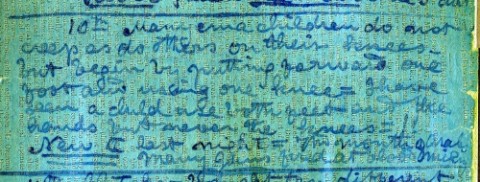
An avid chronicler of his adventures, Livingstone left behind a number of journals, but one of his most vivid accounts—of a massacre hit witnessed in 1871—has been inaccessible until now. Livingstone’s 1871 Field Diary captures a five-month period when the explorer was stranded in a village in the Congo. He had run out of paper and ink to maintain his usual journal, so he improvised by writing over an old copy of The Standard newspaper using ink made from the seeds of a local berry.
In collaboration with British and American archivists, the UCLA Digital Library Program used spectral imaging technology to digitize the delicate material. Overall the site offers an interesting presentation of Livingstone’s work, though the diary pages themselves aren’t too legible. Critical notes are abundant and intriguing, and diary pages appear side-by-side with transcriptions. Viewers can zoom in to study Livingstone’s spidery script written perpendicular to the newspaper copy. The spectral imaging process itself is worth a look. Without this technique, the diaries appear as nothing more than ghostly scribbles.
Previous to keeping this field diary, Livingstone embarked on a mission to find the source of the Nile River, which he misidentified. But his theories about central African water systems are fascinating. Livingstone was the first European to see Mosi-oa-Tunya, “the smoke that thunders,” waterfall, which he renamed Victoria Falls after his monarch. His diaries provide a peek into a time when exploration was dangerous, difficult and even deadly. Livingstone died of Malaria in present-day Zambia, where his heart is buried under a tree. The rest of his remains were interred at Westminster Abbey.
Kate Rix is an Oakland based freelance writer. See more of her work at .





A correction: it was not “the UCLA digital library program” that used “spectral imaging technology” — UCLA is the repository for the data collected by the imaging team for the project, which included Ken Boydston (then of Megavision Inc., now with Transcendent Imaging), William A. Christens-Barry (Equipoise Imaging, LLC), Keith Knox (Eureka Imaging), and myself (from the Rochester Institute of Technology). This is the same team responsible for imaging of the Archimedes Palimpsest.
In later years, a tree grew over the site where Livingston’s heart was buried. Eventually cut down, small fragments of the tree were distributed in European and North American Evangelical circles. One such Protestant “relic” is on deposit at the Canadian Baptist Archives. The Archives are housed in McMaster Divinity College, on the campus of McMaster University, Hamilton, Ontario, Canada. (I catalogued the item while working as the Acting Director of the Archives.)
H.M. Stanley was credited with the infamous line:
“His meeting with H. M. Stanley on 10 November 1871 gave rise to the popular quotation “Dr. Livingstone, I presume?”
– en.wikipedia.org/wiki/David_Livingstone
I have in my possession 3 leaves on a letter written by reverend Wright whom was given them by Codingtion would love to be able to submit pictures of the item I have