According to Freud, neurotics never know what they want, and so never know when they’ve got it. So it is with the seeker after fluent cultural literacy, who must always play catch-up to an impossible ideal. William Grimes points this out in his New York Times review of Peter Boxall’s obnoxious 1001 Books You Must Read Before You Die, which “plays on every reader’s lingering sense of inadequacy. Page after page reveals a writer or a novel unread, and therefore a demerit on the great report card of one’s cultural life.” Then there are the less-ambitious periodical reminders of one’s literary insufficiency, such as The Telegraph’s “100 novels everyone should read,” The Guardian’s “The 100 greatest novels of all time: The list,” the Modern Library’s “Top 100,” and the occasional, pretentious Facebook quiz etc. based on the above.
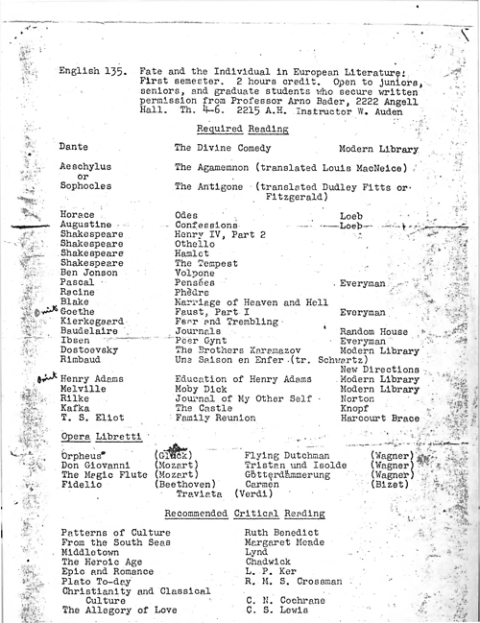
Grimes’ reference to a report card is relevant, since what we’re discussing today is the instruction in grand themes and “great books” represented by W.H. Auden’s syllabus above for his English 135, “Fate and the Individual in European Literature.” Granted, this is not an intro lit class (although I imagine that his intro class may have been punishing as well), but a course for juniors, seniors, and graduate students. Taught during the 1941–42 school year when Auden was a professor at the University of Michigan, his syllabus required over 6,000 pages of reading in just a single semester (and for only two credits!). Find all of the books at the bottom of this post.
While a few days ago we posted a syllabus David Foster Wallace created around several seeming easy reads—mass market paperbacks and such—Auden asks his students to read in a semester the literary equivalent of what many undergraduate majors cover in all four years. Four Shakespeare plays and one Ben Jonson? That was my first college Shakespeare class. All of Moby Dick? I spent over half a semester with the whale in a Melville class. And then there’s all of Dante’s Divine Comedy, a text so dense with obscure fourteenth century Italian allusions that in some editions, footnotes can take up half a page. And that’s barely a quarter of the list, not to mention the opera libretti and recommended criticism.
Was Auden a sadistic teacher or so completely out of touch with his students that he asked of them the impossible? I do not know. But Professor Lisa Goldfarb of NYU, who is writing a series of essays on Auden, thinks the syllabus reflects as much on the poet’s own preoccupations as on his students’ needs. Goldfarb writes:
“What I find fascinating about the syllabus is how much it reflects Auden’s own overlapping interests in literature across genres — drama, lyric poetry, fiction — philosophy, and music.… He also includes so many of the figures he wrote about in his own prose and those to whom he refers in his poetry…
“By including such texts across disciplines — classical and modern literature, philosophy, music, anthropology, criticism — Auden seems to have aimed to educate his students deeply and broadly.”
Such a broad education seems out of reach for many people in a lifetime, much less a single semester. Now whether or not Auden actually expected students to read everything is another matter entirely. Part of being a serious student of literature also involves learning what to read, what to skim, and what to totally BS. Maybe another way to see this class is that since Auden knew these texts so well, his course gave students the chance to hear him lecture on his own journey through European literature, to hear a poet from a privileged class and bygone age when “reading English Literature at University” meant, well, reading all of it, and nearly everything else as well (usually in original languages).
If that’s the kind of erudition certain anxious readers aspire to, then they’re sunk. Increasingly few have the leisure, and the claims on our attention are too manifold. At one time in history being fully literate meant that one read both languages—Latin and Greek. Now it no longer even means mastering only “European literature,” but all the world’s cultural productions, an impossible task even for a reader like W.H. Auden. Who could retain it all? Instead of chasing vanishing cultural ideals, I console myself with a paraphrase from the dim memory of my last reading of Moby Dick: why read widely when you can read deeply?
Find all of the books on Auden’s syllabus listed below:
Required Reading
Dante — The Divine Comedy
Aeschylus — The Agamemnon (tr. Louis MacNeice)
Sophocles — Antigone (tr. Dudley Fitts or Fitzgerald)
Horace — Odes
Augustine — Confessions
Shakespeare — Henry IV, Pt 2
Shakespeare — Othello
Shakespeare — Hamlet
Shakespeare — The Tempest
Ben Jonson — Volpone
Pascal — Pensees
Racine — Phedre
Blake — Marriage of Heaven and Hell
Goethe — Faust, Part I
Kierkegaard — Fear and Trembling
Baudelaire — Journals
Ibsen — Peer Gynt
Dostoevsky — The Brothers Karamazov
Rimbaud — A Season in Hell
Henry Adams — Education of Henry Adams
Melville — Moby Dick
Rilke — The Journal of My Other Self
Kafka — The Castle
TS Eliot — Family Reunion
OPERA LIBRETTI:
Orpheus (Gluck)
Don Giovanni (Mozart)
The Magic Flute (Mozart)
Fidelio (Beethoven)
Flying Dutchman (Wagner)
Tristan und Isolde (Wagner)
Götterdämmerung (Wagner)
Carmen (Bizet)
Traviata (Verdi)
RECOMMENDED CRITICAL READING:
Patterns of Culture — Ruth Benedict
From the South Seas — Margaret Mead
Middletown — Robert Lynd
The Heroic Age — Hector Chadwick
Epic and Romance — W.P. Ker
Plato Today — R.H.S. Crossman
Christianity and Classical Culture — C.N. Cochrane
The Allegory of Love — C.S. Lewis
Related Content:
W.H. Auden Recites His 1937 Poem, ‘As I Walked Out One Evening’
David Foster Wallace’s 1994 Syllabus: How to Teach Serious Literature with Lightweight Books
Nabokov Reads Lolita, Names the Great Books of the 20th Century
The Harvard Classics: A Free, Digital Collection
Josh Jones is a writer, editor, musician, and literary neurotic based in Washington, DC. Follow him @jdmagness





Each of my literature classes required roughly 200 pages of reading per week, a little more than half of Auden’s 6,000 pages. Nearly killed me!
As an engineering student in the 1970s my literature classes were pretty easy. I’m guessing I read about 2500 pages per semester and maybe only a couple of Shakespere and Moby Dick is all I can remember reading.
Most of those books one would have already read as a literature major or graduate student, or even in high school. One would only have to round out what hasn’t been read yet.
The opera libretti could be easily consumed with audio recordings at night.
Compared to graduate course reading lists I’ve had in the past consisting of long obscure works in impenetrable foreign tongues, this seems like a fairly easy and enjoyable class.
Well. as a current high-school teacher. I sort of agree but only in principle and not in reality. In fact, many high-school teachers are now told to dispense with the whole notion of teaching a great book, Instead, we all are prompted by our bosses to teach a reading-writing skill set or a common-core standard. and throw away the idea that we can “teach a book,” let alone a classic.nnYeah, if I could teach “Agamemnon” or “Antigone” as a classic skill set that would be a great idea or a beginning. Woops here we go again.
I loved Medea in high school. Euripedes is better than that Revenge show for sure.
Morris: Yes, I think you’re right. At this time in history, when higher education was still the preserve of a relative elite, this reading list may have been routine. After WWII, with the GI Bill and in successive generations with the further democratization of higher ed, students were much less likely to have had good preparatory education or the leisure time to do this amount of reading and/or listening to opera, which is why, I imagine, this shocks us today. It more resembles the reading list for my comprehensive Masters’ exams in English lit in 2005 more than any undergraduate syllabus I ever encountered as an English major in the late 90s.
Well, I just came across another Open Culture post about how W.H. Auden liked to take Benzedrine, i.e., speed. Maybe he expected his students to do the same?
Surely the title of Peter Boxall’s guide (who is as far removed from obnoxious as any human has a right to be) give you an indication that there is time to do some of the reading he suggests. Auden’s list doesn’t seem heavy for an advanced course, but heavily weighted to classics. He also includes three anthropology monographs for reasons which are not terribly clear.
Mozart didn’t write the libretto. Emanuel Schickaneder did magic Flute and Da Ponte was librettist of Don Giovanni. Credit where it’s due.
I noted the same thing. I didn’t see your comment. Kudos. You got there before me.
Interestingly, he asks students to read opera libretti, but names the composers as the authors. The composers, Mozart among them, did not write their libretti. They composed to them, or with them. Lorenzo da Ponte, an Italian Jew, wrote the libretto for many of Mozart’s operas. Auden apparently didn’t know that. So now I feel better.
Why Opera libretto? It is usually filled with clichu00e9 and very dramatic but artificial scenes, kind of like Indian movies… nnNever understood complains about number of pages. Yes, I am used to CEOs of billion dollar companies proud that they did not read squat and all their grandparents were thiefs and farmers — but are we really better off from that egalitarianism? P.S. I did not read half of these books. Not my taste, or just plain have not. No pride or excuses on that.
This is why they invented Cliff Notes.
Any guesses about how much it would cost to buy all these books?
The required reading books can be had, 95% on Kindle, the rest on paperback, for less than $43 on Amazon :-) See my list: http://amzn.com/w/23E5MSRC8Q2L1 only a couple could not be found on Kindle, and I think one (The Schwartz translation) is now a collectors’ item and can only be had for a ransom
Not to forget the really inexpensive editions of classics published by Barnes and Noble; or, better yet, the weekly public library purge where you can find all kinds of lit for 25u00a2 or 50u00a2 a book. (Sad, isn’t it?)
I had a class in college where I read somewhere in the neighborhood of 10 of Mark Twain’s books, not to mention writing the papers for that class and all the others.
All great works but not THE great works (though some of them are). Not meant to be comprehensive or to scale all the big peaks. Actually it’s a pretty idiosyncratic take on the class title: “Fate and the Individual in European Literature.” Not only is is interesting for what Auden includes from his own preoccupations (Pascal) but for what he leaves out of that same set of obsessions (Freud). It’s a great take considering where Auden was at in ’41-’42, what he was writing, and his own self-exilic anxieties. Like it!
Sorry to hear that our dear author lacks the dedication or reading aptitude to achieve reasonable literacy. For those of us who haven’t given up, lovely to see Auden’s syllabus. Thanks for posting at least one thing of value.
Reading widely is more important than reading deeply. That is, until you have to assemble that desk from IKEA.
I was hoping a student of this era had written something about their experience of taking this ENGL 135 course with Auden. Here’s a substantial account by Robert Chapman, who sent out questionnaires to former students in 1978 and compiled their views into an article in the Michigan Quarterly Review. Interestingly, the amount of reading is scarcely mentioned (really), though it is discussed by Chapman briefly (he is the only former student who does.) Rather, what the students recount are their experiences of Auden as a person (demanding, but at the same time unusually casual and free-associational in class; affable and social outside). What strikes me is that several of the students said (in 1978, nearly forty years beyond the class) that they are still processing what they learned from Auden in ways they find tricky to explain. One says he “isn’t ready yet” to describe the effect of the class. That note hints at a quality of thought and being that often gets paved over with black asphalt-practicality in many shallow, transient-goaled discussions of “learning outcomes” now. Not all humanities learning is of short term cash value.
“Auden in Ann Arbor” [MQR, Volume XVII, Issue: 4, Fall 1978, pp. 507–520] is here:
http://hdl.handle.net/2027/spo.act2080.0017.004:14
I think most upper level survey classes would be near this range (page-wise), since they are trying to cover a lot of material, instead of in depth material. Also, all of my Victorian Lit classes (upper level grad and grad school) required more pages than that during the semester. It was generally one novel per week plus criticism, and Victorian Lit novels are quite wordy and usually over 500 pages (some closer to 1000). I had some semesters that between two (graduate) classes I was reading 1500+ pages per week (I did, however, develop eye strain that semester). So, I don’t think this is particularly impossible, but perhaps all lit classes are a bit sadistic?
This is a shorter reading list than I was given before starting university (English Literature and Language) in 1994, so it’s not that reflective of a “bygone age”. I agree the libretti are a slightly eccentric choice, but you can’t talk about “Fate and the individual in European Literature” without having read a chunk of that literature — otherwise you’d just have to take the lecturer’s opinion as gospel. No-one now can hope to have read everything important, but there are still survey courses that hope to give you some idea of the breadth of European (or at least English) literature over the last few centuries.
this is before the days of technology and external distractions though. people read for fun back then, and this probably wouldn’t have seemed like such a chore if you were probably reading works like these for pleasure anyways.
How unfortunate that movie making and recording was so much more expensive back then. It’d be marvelous to take that course today as if we were among his students.
I’m a little shocked that you are so shocked. Aside from its idiosyncrasies (opera libretti?), this much reading was not beyond the bounds of a upper-level and graduate course as late as the 1970s. There are some long books here; there are also a number of plays, every one of which can be read in an afternoon. Of course, even at the elite schools, students didn’t genuinely read everything on the list; you picked what you thought was more important or more to your liking and faked others with notes or skimming. You can be sure this was also the case in 1941, when the “elite” were predominantly social elite, not SAT-screened scholars. Prep schools can only help so much; most preppies were happy to take their “gentleman’s Cs.”
Actually, Auden’s syllabus isn’t very different from the 1989 European Literary Tradition course I took as a Freshman *science* major at Yale.
Reminds me of the speech Bob Dylan gave at the Musicares awards. The Daily Beast offered this:
“These songs didn’t come out of thin air. I didn’t just make them up out of whole cloth—there was a precedent. For three or four years all I listened to were folk songs. I went to sleep singing folk songs. If you sang ‘John Henry’ as many times as me,” he said, and then quoted a stanza from the traditional folk song, “If you’d have sung that song as many times as I did—you’d have written ‘How many roads must a man walk down?’ too.”
Dylan’s muse was what he listened to. Auden’s muse was what he read.
I am a little distressed at the reaction this post is getting. People are worried about how much all these books would cost, and so on. You should use a list like this to inspire you, or “bum” you out if you have not read many of these books and it bothers you. Again, perhaps it could inspire you, and, of course, you probably have read items he did not include on the list. But “dig in” and enjoy. You better get going!!!
Three operas by Wagner as literature? The music is great but the writing is pretty lame. A good writer doesn’t need magic potions.
The sheer amount of reading isn’t overwhelming for a good reader. At a minute a page, that’s 100 hours of reading, or about 1 hour a day for a semester. As the article mentions, though, these aren’t throwaway pulp fiction and deserve attention and analysis. I wonder what Auden taught in the classroom and how he could pick what to cover in that limited time with such an enormous amount of excellent and usually very deep material.
“Three operas by Wagner as literature? The music is great but the writing is pretty lame. A good writer doesn’t need magic potions.”
I hope this is a subtle joke. If not, my palm is going to permanently attached to my face because the magic potion plot is part of the source story by Gottfried von Straßburg. It’s like complaining that the Ring Cycle is too indebted to Norse mythology.
Ken Millar took this course from Auden when he was a graduate student at the University of Michigan. A few years later, Ken Millar began using the pseudonym Ross Macdonald and started writing the Lew Archer detective novels joining Dashiell Hammett and Raymond Chandler as one of the masters of the hard-boiled genre. According to his biographer, Tom Nolan, Ken Millar would judge meeting W.H. Auden as one of the four or five crucial events in his life.
No cellphones, TV, Netflix, facebook (social media of any kind)…sure this list is dense, but without the modern distractions doable.
A follow up comment. I had a Women in Victorian Lit class in college. We had to read a classic Victorian novel for each week (Jane Eyre, etc.). I had no problem doing this, however, I had not kept up with reading Thackeray’s Vanity Fair an 800 page trade paperback so I sat down and read it straight through the day before class. My roommate brought dinner to me from the cafeteria that night.
Since Auden (with Chester Kallman) did excellent singing translations of (at very least) “Don Giovanni” (for the old NBC Opera, back in the 1950’s) you can certainly bet that Auden knew precisely who Da Ponte was (he also talks about in various occasional essays). His use of the composers’ names was for the students’ aid (he had no reason to assume that it’d be helpful to list the librettists’ names, since, for the most part, they’re very much NOT the main guys), and in no way demonstrates his “ignorance” at all. Be serious. Really. It’s very nice you’ve read a little bit though. And you know the name of at least one of the two really great opera librettists, so one should be grateful. I suppose. But hey.…a little more respect where it is due.
And oh yeah, except for the Divine Comedy (which I hardly think was intended in this context to be parsed line-by-line), this is not that imposing a list for a good semester’s work. Challenging, yes. But impossible? Hardly. It just means a little less time on the climbing wall; several fewer occasions to be fiddled with by the wrestling coach.m And my last quibble is a big one: no “King Lear???” Well, it WAS the forties (early fifties?), when “Lear” had not yet achieved its central place in the canon.
If this was at the University of Michigan, you can’t really be talking about “social elites.” Intellectual, yes. Interested in learning a lot, yes. But this is, after all, a public university. One of the great ones, yes. But lacking the pretentious snootiness and unthinking racism of the “ivy league” schools of the same era.