Freudianism may no longer be in vogue. But, even so, Sigmund Freud remains one of the most envelope-pushing thinkers of the past century, someone still worth getting to know. In this lecture, Yale psychology professor Paul Bloom offers a primer on Freud and Freudian thought. The lecture is part of a larger free course (20 lectures in total) called “Introduction to Psychology.” You can access the course via the Yale Open Course web site, YouTube and iTunesU.
“I’m not sure how much outward details or accomplishments ever really make us happy deep down. The millionaires I know seem desperate to become multimillionaires, and spend more time with their lawyers and their bankers than with their friends (whose motivations they are no longer sure of). And I remember how, in the corporate world, I always knew there was some higher position I could attain, which meant that, like Zeno’s arrow, I was guaranteed never to arrive and always to remain dissatisfied…”
“…my two-room apartment in nowhere Japan seems more abundant than the big house that burned down [in Santa Barbara, CA]. I have time to read the new John le Carre, while nibbling at sweet tangerines in the sun. When a Sigur Ros album comes out, it fills my days and nights, resplendent. And then it seems that happiness, like peace or passion, comes most freely when it isn’t pursued.”
On a related note, you might want to check out this piece in the The Atlantic, What Makes Us Happy?, which takes a look at Harvard’s long effort to answer that question.
Speaking at the TED conference in 2007, Malcolm Gladwell (author of The Tipping Point, Blink, and now Outliers: The Story of Success) introduces you to the food industry’s pursuit of the perfect spaghetti sauce, which ultimately tells you something essential about human choice and happiness.
The Time Paradox, a new book by Philip Zimbardo & John Boyd, puts forth an intriguing argument — our attitudes toward time, often unconscious ones, can strongly shape our personalities and the kind of lives we lead. They can contribute to our happiness and success, or our unhappiness and depression.
The argument goes something like this: Not entirely knowingly, we all focus on the past, present or future. And, in moderation, each focus can have some net good. Future-oriented people tend to be ambitious and successful; present-oriented people tend to have friends and fun; and past-oriented people often have close family relationships. But when we associate too strongly with one of these “time zones” (again often without realizing it), we run into problems. When we’re too strongly focused on the future, we sacrifice friends, family and fun. When we’re too present-oriented, we leave ourselves open to hedonism and addictions. And when we cling to the past, we simply get stuck in the past, and depression usually follows. The upshot then is that we need to find a “temporal balance,” and this applies not just to individuals, but to nations, religious groups and social classes as well. According to Zimbardo and Boyd, larger social groups can tend toward distorted senses of time. The American financial crisis boils down to an extreme focus on the present, or a lack of concern for future consequences. That’s essentially what the big credit giveaway was all about.
You may recognize Philip Zimbardo’s name. He’s a widely recognized psychology professor who was behind the famous Stanford Prison Experiment (1971). He has served as the president of the American Psychological Association. And, last year, he published The Lucifer Effect, a New York Times bestseller.
To delve a bit more deeply into The Time Paradox, you should watch (below) the engrossing presentation that Zimbardo gave at Google’s HQ last month. Or you can listen to this radio interview that aired recently in New York City (iTunesFeedMP3). Lastly, you can take a survey on The Time Paradox web site and learn more about your temporal balance.
Speaking at the TED Conference, famed psychologist Mihaly Czikszentmihalyi asks what’s the source of happiness? And his answer comes down to this: Beyond a certain point (and it’s not very far), money doesn’t affect happiness too much. Rather, as his research shows, we tend to be most happy when we get immersed, almost lost in, being creative and performing at our best. It’s an ecstatic state that he calls “flow.” The video runs about 19 minutes, and is well worth your time. Some book titles worth checking out include: Flow: The Psychology of Optimal Experience or Finding Flow: The Psychology of Engagement with Everyday Life.
If you would like to support the mission of Open Culture, consider making a donation to our site. It’s hard to rely 100% on ads, and your contributions will help us continue providing the best free cultural and educational materials to learners everywhere. You can contribute through PayPal, Patreon, and Venmo (@openculture). Thanks!
PsychCentral has posted its list of the ten best psychology videos available on the web. Below, we have posted links to the videos themselves. But if you want a quick description of each clip, then definitely read through the original post. Thanks to Kottke.org for bringing this to light.
Back in 1971, Philip Zimbardo, a Stanford psychology professor, set up an experiment that quickly and now famously went awry. Here, Zimbardo had undergraduates play the role of prisoners and prison guards in a mock prison environment. Meant to last two weeks, the experiment was cut short after only six days when, as The Stanford Prison Experiment web site puts it, the guards “became sadistic and [the] prisoners became depressed and showed signs of extreme stress.” For Zimbardo, the way things played out says a lot about what happens when good, average people are put in bad situations. And it speaks to how torture scenarios, like those at Abu Ghraib, become possible. (For more on the parallels between the prison experiment and the torture in Iraq, you may want to check out Zimbardo’s recent video-captured talk at Googleplex.
Below, we’ve posted a video that offers a quick version, with original footage, of how the prison experiment went down. If you’re interested in understanding what he calls the “Lucifer Effect,” the title of his new book (which, by the way, was just reviewed by Martha Nussbaum in the Times Online), then it’s worth your time.
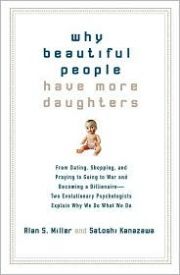
Human behavior is notoriously complex, and there’s been no shortage of psychologists and psychological theories venturing to explain what makes us tick. Why do we get irrationally jealous? Or have midlife crises? Why do we overeat to our own detriment? Why do we find ourselves often strongly attracted to certain physical traits? Numerous theories abound, but few are perhaps as novel and thought-provoking as those suggested by a new book with a long title: Why Beautiful People Have More Daughters: From Dating, Shopping, and Praying to Going to War and Becoming a Billionaire — Two Evolutionary Psychologists Explain Why We Do What We Do. Written by Satoshi Kanazawa and Alan S. Miller, the book finds answers not in ids, egos and superegos, but in the evolution of the human brain. Written in snappy prose, their argument is essentially that our behavior — our wants, desires and impulses — are overwhelmingly shaped by the way our brain evolved 10,000+ years ago, and one consequence is that our ancestral brain is often responding to a world long ago disappeared, not the modern, fast-changing world in which we live. This disconnect can lead us to be out of sync, to act in ways that seem inexplicable or counter-productive, even to ourselves. These arguments belong to new field called “evolutionary psychology,” and we were fortunate to interview Satoshi Kanazawa (London School of Economics) and delve further into evolutionary psychology and the (sometimes dispiriting) issues it raises. Have a read, check out the book, and also see the related piece that the Freakonomics folks recently did on this book. Please note that the full interview continues after the jump.
DC: In a nutshell, what is “evolutionary psychology”? (e.g. when did the field emerge? what are the basic tenets/principles of this school of thinking?)
SK: Evolutionary psychology is the application of evolutionary biology to human cognition and behavior. For more than a century, zoologists have successfully used the unifying principles of evolution to explain the body and behavior of all animal species in nature, except for humans. Scientists held a special place for humans and made an exception for them.
In 1992, a group of psychologists and anthropologists simply asked, “Why not? Why can’t we use the principles of evolution to explain human behavior as well?” And the new science of evolutionary psychology was born. It is premised on two grand generalizations. First, all the laws of evolution by natural and sexual selection hold for humans as much as they do for all species in nature. Second, the contents of the human brain have been shaped by the forces of evolution just as much as every other part of human body. In other words, humans are animals, and as such they have been shaped by evolutionary forces just as other animals have been.
DC: Evolutionary psychology portrays us as having impulses that took form long ago, in a very pre-modern context (say, 10,000 years ago), and now these impulses are sometimes rather ill-adapted to our contemporary world. For example, in a food-scarce environment, we became programmed to eat whenever we can; now, with food abounding in many parts of the world, this impulse creates the conditions for an obesity epidemic. Given that our world will likely continue changing at a rapid pace, are we doomed to have our impulses constantly playing catch up with our environment, and does that potentially doom us as a species?
SK: In fact, we’re not playing catch up; we’re stuck. For any evolutionary change to take place, the environment has to remain more or less constant for many generations, so that evolution can select the traits that are adaptive and eliminate those that are not. When the environment undergoes rapid change within the space of a generation or two, as it has been for the last couple of millennia, if not more, then evolution can’t happen because nature can’t determine which traits to select and which to eliminate. So they remain at a standstill. Our brain (and the rest of our body) are essentially frozen in time — stuck in the Stone Age.
One example of this is that when we watch a scary movie, we get scared, and when we watch porn we get turned on. We cry when someone dies in a movie. Our brain cannot tell the difference between what’s simulated and what’s real, because this distinction didn’t exist in the Stone Age.
DC: One conclusion from your book is that we’re something of a prisoner to our hard-wiring. Yes, there is some room for us to maneuver. But, in the end, our evolved nature takes over. If all of this holds true, is there room in our world for utopian (or even mildly optimistic) political movements that look to refashion how humans behave and interact with one another? Or does this science suggest that Edmund Burke was on to something?
SK: Steven Pinker, in his 2002 book The Blank Slate, makes a very convincing argument that all Utopian visions, whether they be motivated by left-wing ideology or right-wing ideology, are doomed to failure, because they all assume that human nature is malleable. Evolutionary psychologists have discovered that the human mind is not a blank slate, a tabula rasa; humans have innate biological nature as much as any other species does, and it is not malleable. Paul H. Rubin’s 2002 book Darwinian Politics: The Evolutionary Origin of Freedom gives an evolutionary psychological account of why Burke and classical liberals (who are today called libertarians) may have been right.
As a scientist, I am not interested in Utopian visions (or any other visions for society). But it seems to me that, if you want to change the world successfully, you cannot start from false premises. Any such attempt is bound to fail. If you build a house on top of a lake on the assumption that water is solid, it will inevitably collapse and sink to the bottom of the lake, but if you recognize the fluid nature of water, you can build a successful houseboat. A houseboat may not be as good as a genuine house built on ground, but it’s better than a collapsed house on the bottom of the lake. A vision for society based on an evolutionary psychological understanding of human nature at least has a fighting chance, which is a much better than any Utopian vision based on the assumption that human nature is infinitely malleable.
We're hoping to rely on loyal readers, rather than erratic ads. Please click the Donate button and support Open Culture. You can use Paypal, Venmo, Patreon, even Crypto! We thank you!
Open Culture scours the web for the best educational media. We find the free courses and audio books you need, the language lessons & educational videos you want, and plenty of enlightenment in between.