You’ve likely heard the reason people never smile in very old photographs. Early photography could be an excruciatingly slow process. With exposure times of up to 15 minutes, portrait subjects found it impossible to hold a grin, which could easily slip into a pained grimace and ruin the picture. A few minutes represented a marked improvement on the time it took to make the very first photograph, Nicéphore Niépce’s 1826 “heliograph.” Capturing the shapes of light and shadow outside his window, Niépce’s image “required an eight-hour exposure,” notes the Christian Science Monitor, “long enough that the sunlight reflects off both sides of the buildings.”
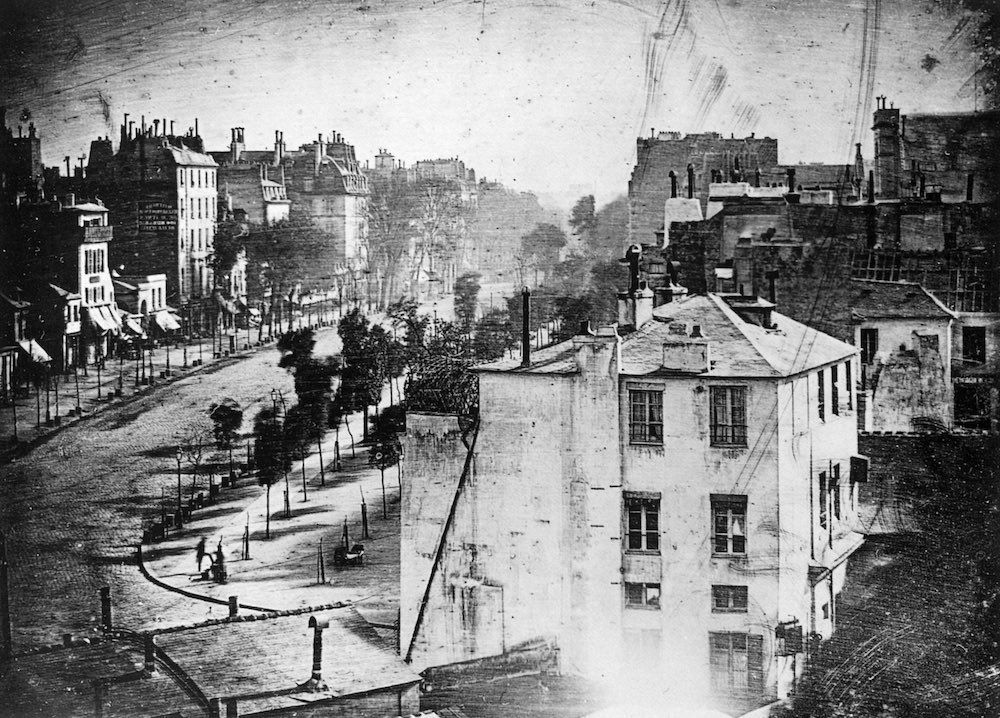
Niépce’s business and inventing partner is much more well-known: Louis Jacques Mandé Daguerre, who went on after Niépce’s death in 1833 to develop the Daguerreotype process, patenting it in 1839. That same year, the first selfie was born. And the year prior Daguerre himself took what most believe to be the very first photograph of a human, in a street scene of the Boulevard du Temple in Paris. The image shows us one of Daguerre’s early successful attempts at image-making, in which, writes NPR’s Robert Krulwich, “he exposed a chemically treated metal plate for ten minutes. Others were walking or riding in carriages down that busy street that day, but because they moved, they didn’t show up.”
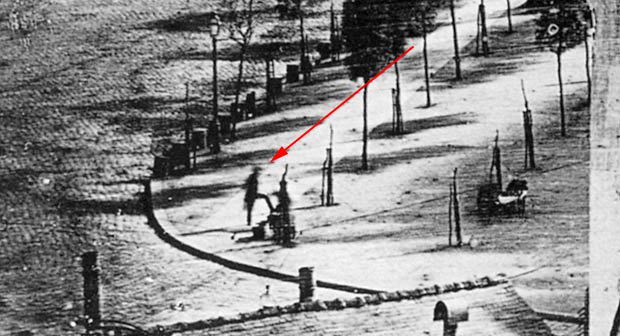
Visible, however, in the lower left quadrant is a man standing with his hands behind his back, one leg perched on a platform. A closer look reveals the fuzzy outline of the person shining his boots. A much finer-grained analysis of the photograph shows what may be other, less distinct figures, including what looks like two women with a cart or pram, a child’s face in a window, and various other passersby. The photograph marks a historically important period in the development of the medium, one in which photography passed from curiosity to revolutionary technology for both artists and scientists.
Although Daguerre had been working on a reliable method since the 1820s, it wasn’t until 1838, the Metropolitan Museum of Art explains, that his “continued experiments progressed to the point where he felt comfortable showing examples of the new medium to selected artists and scientists in the hope of lining up investors.” Photography’s most popular 19th century use—perhaps then as now—was as a means of capturing faces. But Daguerre’s earliest plates “were still life compositions of plaster casts after antique sculpture,” lending “the ‘aura’ of art to pictures made by mechanical means.” He also took photographs of shells and fossils, demonstrating the medium’s utility for scientific purposes.
If portraits were perhaps less interesting to Daguerre’s investors, they were essential to his successors and admirers. Candid shots of people moving about their daily lives as in this Paris street scene, however, proved next to impossible for several more decades. What was formerly believed to be the oldest such photograph, an 1848 image from Cincinnati, shows what appears to be two men standing at the edge of the Ohio River. It seems as though they’ve come to fetch water, but they must have been standing very still to have appeared so clearly. Photography seemed to stop time, freezing a static moment forever in physical form. Blurred images of people moving through the frame expose the illusion. Even in the stillest, stiffest of images, there is movement, an insight Eadweard Muybridge would make central to his experiments in motion photography just a few decades after Daguerre debuted his world-famous method.
Note: An earlier version of this post appeared on our site in 2017.
Related Content:
The First Photograph Ever Taken (1826)
The First “Selfie” In History Taken by Robert Cornelius, a Philadelphia Chemist, in 1839
Josh Jones is a writer and musician based in Durham, NC.




So the guy shining his shoes is not human? By your arrow, you imply there is only one human in the photo. Seems rather classist to me.
Interesting to note the daguerre woodcut prints. It seems to be a lost art nowadays. How can we bring this form of expression back into vogue… This is London calling 347 848 4665
Why dose nobody know what he was make g the female I. Picture grab and why
My very first picture was taken using a tall round oatmeal container,the feelings that he must have experienced could only be surreal, magic is real.
I take Daguerreotypes on my phone all the time.
I see your point!!!
Your post is obnoxiously covered in ads blocking my ability to read the story.
Therefore I will block any future posts from you greedy weasels
I don’t understand why anyone is picking apart those two picture’s I don’t think the ad’s were purposely put there to annoy anyone either can’t you just enjoy the magic of photography back then and the genius of the person who made it happen ?
FUCK THESE CON ARTIST.
Correction. Those are two humans in the photo. If the photo in question is the one with a man standing and a shoe shine boy sitting.
Oh shut up bedwetting socialist. Did you even read the article? They referenced ALL of the humans in this photo. But only the man standing allegedly getting his shoes shined is a definitive recognized human form in a photo. Any other human forms are open only to pure speculation. Especially the supposed two women and a cart.
Rufus, take a long walk off a short pier
Thats fake, look at the shadows od different things, theyre all going in different directions.