Sometimes it’s hard for the untrained eye to figure out what exactly is going on in a Picasso.
Fortunately, the artist leaned toward informative, workmanlike titles.
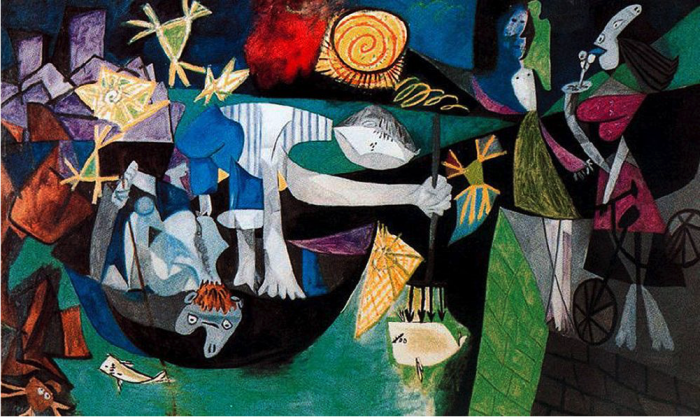
Had he titled “Night Fishing at Antibes,” below, something a bit more opaque—“Untitled No. 2,” say—the uneducated eye might well perceive the narrative as something closer to “Drunken Night in a Conveyer Belt Sushi Joint.”
Even knowing the correct title, my gut still argues that the boomerang-headed lady with boobs like lips is singing karaoke…
But after watching the above video by Evan Puschak, aka The Nerdwriter, I’m willing to concede that she’s standing on a jetty, a likely amalgamation of two of Picasso’s lovers.
(The less voluptuous creature standing next to her is his wife, and my gut is eager to know why it looks like she’s topless, a point on which Pushak is frustratingly mum.)
His process for understanding a Picasso takes the gut response into account, but then fleshes things out with four additional steps. You can apply them to many other artists’ work too.
- First reaction
- Content
- Form
- Historical context
- Personal context
It’s certainly helpful to know that the painting was made in 1939.
You probably don’t need the Internet to guess what world events were likely a source of preoccupation for the artist, whose “Guernica” was completed just two years earlier.
Content-wise, Puschak truffles up some interesting geographical references that elude most online analysis of the work. For instance, those purple blocks in the upper left corner now house the Musée Picasso.
There may well be a sixth step. Earlier, when a fan of the Nerdwriter’s weekly video essay series asked Puschak how to understand art, he responded:
All good art is trying to tell you something about your life. Your life… specifically. So understanding art is a process of understanding yourself, and vice versa. In both cases, you only learn by engaging. Watching isn’t enough, neither is reading or listening or thinking for that matter. From my perspective, engagement means writing. An idea that’s been snaking around in my videos for a long time is that we learn by saying, not thinking. You know something when you can articulate it, and for that you need words and sentences and paragraphs. So introspect, write down what your mind is doing. And when you watch a movie or look at a painting, write down how you feel about it. You’ll be amazed how one informs the other, and before long you’ll see some beautiful sparks.
Below are some of the resources Puschak credits with informing this Nerdwriter episode:
Rudolf Arnheim, “Picasso’s Night Fishing at Antibes” The Journal of Aesthetics and Art Criticism — Vol. 22, No. 2 (Winter, 1963), pp. 165–167
Douglas N. Morgan, “Picasso’s People: A Lesson in Making Sense” The Journal of Aesthetics and Art Criticism Vol. 22, No. 2 (Winter, 1963), pp. 167–171
Nina Corazzo, “Picasso’s ‘Night Fishing at Antibes’: A New Source” The Burlington Magazine Vol. 132, No. 1043 (Feb., 1990), pp. 99–101
Mark Rosenthal, “Picasso’s Night Fishing at Antibes: A Meditation on Death” The Art Bulletin Vol. 65, No. 4 (Dec., 1983), pp. 649–658
Albert Boime, “Picasso’s “Night Fishing at Antibes”: One More Try” The Journal of Aesthetics and Art Criticism Vol. 29, No. 2 (Winter, 1970), pp. 223–226
Timothy Anglin Burgard, “Picasso’s Night Fishing at Antibes: Autobiography, Apocalypse, and the Spanish Civil War” The Art Bulletin Vol. 68, No. 4 (Dec., 1986), pp. 657–672
Lawrence D. Steefel, Jr., “Body Imagery in Picasso’s “Night Fishing at Antibes” Art Journal Vol. 25, No. 4 (Summer, 1966), pp. 356–363+376
You can view the Nerdwriter’s other videos on his website or subscribe to his YouTube channel where a new video is published every Wednesday.
Related Content:
Watch Picasso Create Entire Paintings in Magnificent Time-Lapse Film (1956)
The Mystery of Picasso: Landmark Film of a Legendary Artist at Work, by Henri-Georges Clouzot
How to Look at Art: A Short Visual Guide by Cartoonist Lynda Barry
Ayun Halliday is an author, illustrator, theater maker and Chief Primatologist of the East Village Inky zine. Her play Zamboni Godot is opening in New York City in March 2017. Follow her @AyunHalliday.