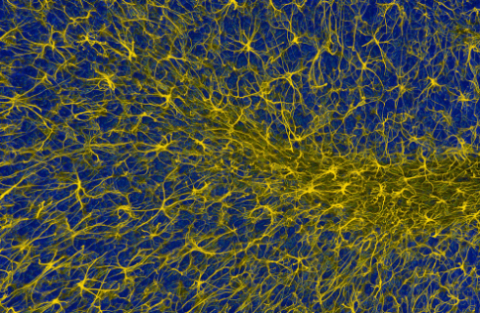
The Nikon International Small World Competition first began in 1974 as a “means to recognize and applaud the efforts of those involved with photography through the light microscope.” A good 36 years later, Nikon named the winners of the 2010 competition, which means we can take another artistic look inside the world of small things, getting down to the very micro level of animals, plants and minerals. Above, you’re looking at an image of glial cells in the cerebellum magnified 400 times. This image and 28 others appear in the always excellent The Big Picture section of the Boston Globe. Also visit a gallery of images on the Nikon site. Thanks to @wesalwan for sending our way.
On Thursday night, the Guggenheim Museum and YouTube unveiled the winners of a highly publicized video contest, YouTube Play: A Biennial of Creative Video. The contest originally generated 23,000 submissions from 91 countries, and, from there, Guggenheim curators culled a shortlist of 125 videos. Then the big moment: 20 winners were selected during an awards ceremony held last night at the museum.
The ceremony itself featured performances by artists who have made YouTube integral to their art – above we have Kutiman, the Israeli artist known for his mother of all funk remix, giving the audience something rather different: a live mashup of Brahms’ “Hungarian Dance,” accompanied by the Noname ensemble from the Julliard School and YouTube Symphony Orcherstra players. And to wrap things up OK Go, the unofficial kings of YouTube, performed ‘White Knuckles’ and ‘This too Shall Pass.’ Keep a close eye on the YouTube channel dedicated to the Biennial of Creative Video. The winning videos will almost certainly be coming online soon.
Out of Print Clothing “celebrates the world’s great stories through fashion,” working with artists to design t‑shirts that feature iconic book covers. The catalog lets you choose from Orwell’s Animal Farm, Salinger’s Catcher in the Rye, William S. Burroughs’ Naked Lunch, Bulgakov’s Russian classic Master and Margarita or 29 other vintage shirts, each of which costs a fairly reasonable $28. See the full list of shirts here.
Last week, the Dalai Lama spent several days at Stanford University, where he made compassion his focus. He laid the foundation with a large public address before an audience of 7,000. (Watch an excerpt above or the full talk below.) Then things got more focused when the spiritual leader of Tibet participated in a daylong conference about the neurobiological underpinnings of compassion. Hosted by Stanford’s Center for Compassion and Altruism Research and Education, the conference brought together important scientists from many disciplines – psychology, neuroscience, medicine, and economics. You can watch a recording of the conference here. It’s all in video and ready to go.
If you would like to support the mission of Open Culture, consider making a donation to our site. It’s hard to rely 100% on ads, and your contributions will help us continue providing the best free cultural and educational materials to learners everywhere. You can contribute through PayPal, Patreon, and Venmo (@openculture). Thanks!
In North Korea, the propaganda machine is kicking into gear, laying the foundation for Kim Jong-un to replace his father Kim Jong-il. Earlier this month, father and son attended a massive military parade together. Ostensibly meant to commemorate the 65th anniversary of the founding of the Workers’ Party, the parade was really about giving the son a big coming-out party – a first introduction to domestic and foreign audiences. And departing from the usual script, the North Korean regime allowed Western journalists to cover the event live and on-site. Hence the video above. Using Canon 60D and 1DmkIV cameras, the Guardian brilliantly captured the propagandistic essence of the moment.
Related note: It hasn’t been updated in a while, but the blog North Korean Economy Watch uses Google Earth to provide the most extensive mapping of North Korea’s economic, cultural, political, and military infrastructures. It’s a great way to further demystify the secretive state. Thanks to Ed for the tip.
Do schools kill creativity? Sir Ken Robinson asked that question at the 2006 TED conference. And the talk resonated widely. His short presentation remains one of the most watched and “favorited” videos in TED’s large catalogue of inspiring videos. Quite an accomplishment.
Now, with the latest RSA video, Sir Ken returns to delve deeper into this basic question. He asks, Why do schools kill creativity? And why is this problem built into the modern educational system? And how can we bring a “paradigm” shift – one that will let schools foster creativity at long last?
Running 11 minutes, the creatively-animated video above (how fitting!) gives you some answers. But realize that the clip is an excerpt from a longer 52 minute lecture available in its entirety here.
A quick PS: Wired UK recently asked the big question: “What innovation would most improve education in the next decade?” You will find succinct answers by Ken Robinson, Chris Anderson (head of TED), yours truly and several others here.
David Lynch has been practicing Transcendental Meditation for decades, and, last year, he interviewed another longtime TM practitioner – Sir Paul McCartney. The interview (find Part 1 above and Part 2 here) turned quickly to The Beatles, their involvement with the Maharishi Mahesh Yogi (guru of the TM movement), and their famous trip to his ashram in Rishikesh (India) in February 1968. There, among other things, they wrote 48 songs – many of which contributed to The White Album – before having a falling out with the guru and leaving town.
If you would like to support the mission of Open Culture, consider making a donation to our site. It’s hard to rely 100% on ads, and your contributions will help us continue providing the best free cultural and educational materials to learners everywhere. You can contribute through PayPal, Patreon, and Venmo (@openculture). Thanks!
Readers of Open Culture will appreciate how video has become, in many ways, our newest vernacular—growing in popularity every day, and estimated to reach 90 percent of worldwide web traffic by 2013. Yet so little of our moving image heritage is actually online. As of October 2010, just single percentage points of the great collections at the BBC Archive, ITN Source, Library of Congress, National Archives, etc., are actually digitized and available over the Internet! A new short film out this week from the UK’s JISC Film & Sound Think Tank makes the point with clarity. (Watch here or above.)
What if it were possible to enjoy the world’s largest and most popular information commons and enable it with downloadable video–video of great quality, whose originators, owners, and rightholders opened to reuse and remix by anyone for free?
Intelligent Television and iCommons have produced a report–just out now–to help cultural and educational institutions understand and appreciate the possibilities presented by openly licensed assets for Wikipedia and the open web. Video for Wikipedia: A Guide to Best Practices for Cultural and Educational Institutions describes how Wikipedia is now opening its doors to video, and how leading institutions can participate in what is, in effect, the newest knowledge revolution.
The issues are situated, of course, within the larger context of building a free and informed society. For universities, museums, archives, and others, bringing video online from our cultural heritage (and equipping students to use it) has become a new cultural imperative. Open video on Wikipedia is not simply a call for free media fragments to be stored online. It augurs a new vision of teaching and learning, and a new creative and political discourse. Everyone is invited to participate in this conversation just getting underway…
We're hoping to rely on loyal readers, rather than erratic ads. Please click the Donate button and support Open Culture. You can use Paypal, Venmo, Patreon, even Crypto! We thank you!
Open Culture scours the web for the best educational media. We find the free courses and audio books you need, the language lessons & educational videos you want, and plenty of enlightenment in between.