No one who travels to Florence can help seeing the dome of the Cathedral of Saint Mary of the Flower. That’s true not just because of its sheer looming physical presence over the rest of the city, but also because of its importance as an achievement in various kinds of history, from that of engineering to architecture to religion. Its story is told by art historians Beth Harris and Steven Zucker in their new Smarthistory video above, which begins in the year 1417. At the time, Zucker explains, Florence had a “huge” problem: the groundwork for its ambitiously large cathedral had been laid a century before, but nobody knew how to build the dome for which its plans called.
The assumption, says Harris, was that “by the time they had to build it, they would figure out how to do it,” a reflection of both the more relaxed speed of construction in the fifteenth century, as well as a pace of innovation that must have felt rapidly on the increase.
Such a structure hadn’t been built since the Pantheon in antiquity, the outdoing of which would, at least in theory, confirm Florence’s reception of the torch of civilization from Rome. But none of the traditional techniques could support a dome of this size, atop so high a tower, during construction. Salvation eventually came in the unpromising form of Filippo Brunelleschi, an architect, sculptor, and goldsmith without much of a résumé — but, crucially, with a deep understanding of the Pantheon.
“Brunelleschi realized that hemispherical domes function in a self-supporting manner if they’re constructed out of self-supporting concentric circles,” Zucker says, and his challenge was to use that knowledge to build an octagonal dome. This involved designing two domes, a thick inner one covered by a thin outer one. Drop €30 on a ticket, and you can ascend the stairs through the inter-dome gap yourself. There the walls reveal the herringbone brick pattern that kept the structure stable; at a larger scale, those bricks form structural elements, much like oversized versions of the stones used to build arches since time immemorial. Regarding almost any picture of Florence, your eye may go straight to the cathedral, drawn both to the dome and to the splendor of its other era-mixing architectural features. But only from the inside can you understand how it all works.
Based in Seoul, Colin Marshall writes and broadcasts on cities, language, and culture. He’s the author of the newsletterBooks on Cities as well as the books 한국 요약 금지 (No Summarizing Korea) and Korean Newtro.Follow him on the social network formerly known as Twitter at @colinmarshall.
Jack Kerouac wants you to turn writing into “free deviation (association) of mind into limitless blow-on-subject seas of thought, swimming in sea of English with no discipline, other than rhythms of rhetorical exhalation and expostulated statement….” Think you can do that? Find out by following Kerouac’s “Essentials of Spontaneous Prose.” He published this document in Black Mountain Review in 1957 and wrote it in response to a request from Allen Ginsberg and William S. Burroughs that he explain his method for writing The Subterraneansin three days time.
And for a theory of Kerouac’s not quite theory, visit the site of Marissa M. Juarez, formerly a professor of Rhetoric, Composition, and the Teaching of English at the University of Arizona. Juarez raises some salient points about why Kerouac’s “Essentials” bemuse the English teacher: His method “discourages revision… chastises grammatical correctness, and encourages writerly flexibility.” Read Kerouac’s full “Essentials of Spontaneous Prose” here or below. [Note: If you see what looks like typos, they are not errors. They are part of Kerouac’s original, spontaneous text.]
SET-UP: The object is set before the mind, either in reality. as in sketching (before a landscape or teacup or old face) or is set in the memory wherein it becomes the sketching from memory of a definite image-object.
PROCEDURE: Time being of the essence in the purity of speech, sketching language is undisturbed flow from the mind of personal secret idea-words, blowing (as per jazz musician) on subject of image.
METHOD: No periods separating sentence-structures already arbitrarily riddled by false colons and timid usually needless commas-but the vigorous space dash separating rhetorical breathing (as jazz musician drawing breath between outblown phrases)– “measured pauses which are the essentials of
our speech”– “divisions of the sounds we hear”- “time and how to note it down.” (William Carlos Williams)
SCOPING: Not “selectivity” of expression but following free deviation (association) of mind into limitless blow-on-subject seas of thought,
swimming in sea of English with no discipline other than rhythms of rhetorical exhalation and expostulated statement, like a fist coming down on a table with each complete utterance, bang! (the space dash)- Blow as deep as you want-write as deeply, fish as far down as you want, satisfy yourself first, then reader cannot fail to receive telepathic shock and meaning-excitement by same laws operating in his own human mind.
LAG IN PROCEDURE: No pause to think of proper word but the infantile pileup of scatological buildup words till satisfaction is gained, which will turn out to be a great appending rhythm to a thought and be in accordance with Great Law of timing.
TIMING: Nothing is muddy that runs in time and to laws of time-Shakespearian stress of dramatic need to speak now in own unalterable way or forever hold tongue-no revisions (except obvious rational mistakes, such as names or calculated insertions in act of not writing but inserting).
CENTER OF INTEREST: Begin not from preconceived idea of what to say about image but from jewel center of interest in subject of image at moment of writing, and write outwards swimming in sea of language to peripheral release and exhaustion-Do not afterthink except for poetic or P. S. reasons. Never afterthink to “improve” or defray impressions, as, the best writing is always the most painful personal wrung-out tossed from cradle warm protective mind-tap from yourself the song of yourself, blow!-now!-your way is your only way- “good”-or “bad”-always honest (“ludi- crous”), spontaneous, “confessionals’ interesting, because not “crafted.” Craft is craft.
STRUCTURE OF WORK: Modern bizarre structures (science fiction, etc.) arise from language being dead, “different” themes give illusion of “new” life. Follow roughly outlines in outfanning movement over subject, as river rock, so mindflow over jewel-center need (run your mind over it, once) arriving at pivot, where what was dim-formed “beginning” becomes sharp-necessitating “ending” and language shortens in race to wire of time-race of work, following laws of Deep Form, to conclusion, last words, last trickle-Night is The End.
MENTAL STATE: If possible write “without consciousness” in semi-trance (as Yeats’ later “trance writing”) allowing subconscious to admit in own uninhibited interesting necessary and so “modern” language what conscious art would censor, and write excitedly, swiftly, with writing-or-typingcramps, in accordance (as from center to periphery) with laws of orgasm, Reich’s “beclouding of consciousness.” Come from within, out-to relaxed and said.
Oh, and for authenticity’s sake, you should try Kerouac’s “Essentials” on a typewriter. It’s all he had when he wrote The Subterraneans. No grammar robots to distract him.
Note: An earlier version of this post appeared on our site in 2013.
If you would like to sign up for Open Culture’s free email newsletter, please find it here. It’s a great way to see our new posts, all bundled in one email, each day.
If you would like to support the mission of Open Culture, consider making a donation to our site. It’s hard to rely 100% on ads, and your contributions will help us continue providing the best free cultural and educational materials to learners everywhere. You can contribute through PayPal, Patreon, and Venmo (@openculture). Thanks!
We know more or less everything we could possibly know about ancient Egyptian civilization. That owes in large part to the advanced state of record-keeping it achieved, and how many of its writings have survived, up to and including — as previously featured here on Open Culture — a homework assignment and a list of excuses given by builders who missed work. There just happens to be one especially glaring gap in our knowledge: exactly how the ancient Egyptians built the Pyramids of Giza. This intersection of relative ignorance and extreme fascination has, as architecture YouTuber Dami Lee acknowledges in the video above, inspired no end of crackpot-ism. Nothing could be as unpromising as unsolicited contact from someone claiming to have discovered the secret of the pyramids.
The case of a Korean independent researcher called Huni Choi proved to be different, for reasons Lee uses the video to lay out. Conventional assumptions about how the pyramids were built hold that workers would have had to drag the stones up one or more ramps, though the dimensions of the structures dictate that the project would necessitate huge, complex, or huge and complex ramp systems — whose own construction has somehow left behind not a trace of evidence.
According to Choi, “the Great Pyramid wasn’t built on its own, but through a chain of ‘sacrificial’ structures” designed to be “cannibalized.” The idea is that the pyramids were “overbuilt,” starting with a gigantic “trapezoidal mass” with an integrated ramp system, which, after being topped out, was then carved down into the pyramid shape we still find so familiar and compelling.
If true, Choi’s theory would solve the long-intractable problem of the pointed tops, which posed such a thorny engineering problem that even other pyramid-building civilizations seemingly avoided even attempting them. It also accounts for how the Egyptian designers and builders could have kept an eye on the angles all the while, in order to make sure the things were going up straight. And what of the leftover stone cut away from each pyramid? Why, it would simply have been re-used for the construction of the next one. This all squares not just with the estimated mass of the Giza complex, but also with apparent ancient Egyptian attitudes toward the natural and built environment. Alas, unlike in, say, physics, an archaeological theory like this one remains difficult to prove dispositively, barring another technological breakthrough that enables a new form of analysis of the pyramids themselves. Still, it’s a lot more satisfying than just assuming some ancient aliens did it.
Based in Seoul, Colin Marshall writes and broadcasts on cities, language, and culture. He’s the author of the newsletterBooks on Cities as well as the books 한국 요약 금지 (No Summarizing Korea) and Korean Newtro.Follow him on the social network formerly known as Twitter at @colinmarshall.
In 1964—a year before the release of A Charlie Brown Christmas—Vince Guaraldi gave the first televised performance of “Linus and Lucy.” Filmed for public television, the performance featured Guaraldi on piano, Tom Beeson on bass, and John Rae on drums. Long unseen, this 1964 performance captures the piece in its earliest televised form, well before A Charlie Brown Christmas became the second-best-selling jazz album in history. Sit back, take a deep breath, and enjoy this groovy, historic performance.
If you would like to sign up for Open Culture’s free email newsletter, please find it here. It’s a great way to see our new posts, all bundled in one email, each day.
If you would like to support the mission of Open Culture, consider making a donation to our site. It’s hard to rely 100% on ads, and your contributions will help us continue providing the best free cultural and educational materials to learners everywhere. You can contribute through PayPal, Patreon, and Venmo (@openculture). Thanks!
The age of social media has shown humanity a fair few truths about itself, not all of them flattering. But once in a while, one of the waves of discourse that roll through the internet really does help us better understand one another. Take the surprise some have expressed in recent years upon finding out that the expression to “picture” something in one’s head isn’t just a figure of speech. You mean that people “picturing an apple,” say, haven’t been just thinking about an apple, but actually seeing one in their heads? The inability to do that has a name: aphantasia, from the Greek word phantasia, “image,” and prefix -a, “without.”
That same template has lately been used to create another term, anendophasia, whose roots endo and phasia mean “inner” and “speech.” As you might expect, the word refers to the lack of an internal monologue. That sounds bizarre to many who hear it for the first time: some because they can’t imagine thinking in words, and others because they can’t imagine thinking in anything else.
These, as explained in the Voided Thoughts video above, are just some of the ways the experiences inside our heads differ. Some 40 percent of us hear and even have conversations with “internal voices,” about 50 percent of us see things in our mind’s eye instead, and some 20 percent report thinking exclusively in feelings. Those who belong to one of those groups will have trouble imagining what life is like for anyone in the others.
This owes to the inherent inaccessibility of one human being’s subjective experience to another, a condition that has bedeviled philosophers practically since the emergence of their profession. But scientific researchers have also been looking into it, and their studies have suggested that the capacity for internal monologues and mental pictures makes more than a trivial difference in one’s life. Visual thinkers, the video notes, tend to be better at memorization; verbal thinkers “usually have an edge when it comes to planning, problem-solving, and rehearsing,” but they’re also “more prone to looping thoughts.” In practice, most of us use both forms of thinking in different proportions depending on the situation, and thus, to an extent, enjoy both sets of advantages — and should watch out for both sets of disadvantages.
Based in Seoul, Colin Marshall writes and broadcasts on cities, language, and culture. He’s the author of the newsletterBooks on Cities as well as the books 한국 요약 금지 (No Summarizing Korea) and Korean Newtro.Follow him on the social network formerly known as Twitter at @colinmarshall.
Few professionals tend to live as long, or mature as slowly, as architects. Frank Gehry died late last year at the formidable age of 96, with several projects still under construction. But he’d only really been Frank Gehry for the past half-century or so: not in the sense of having changed his name from Frank Goldberg (a choice he made in his twenties and later came to regret), but in having planted his first recognizable flag in the built environment. The environment was a quiet middle-class residential neighborhood in Santa Monica; the flag was his own home, a modest Dutch Colonial fixer-upper originally built in 1920, and transformed by Gehry into what resembled a highly controlled industrial disaster.
“He fortified parts of the pastel-painted, shingled exterior with corrugated steel, wrapped layers of chain-link fencing over other portions in angular planes not seen since Russian Constructivism, and slammed a tilted cubic skylight, which looked as if it had fallen from outer space, into the kitchen,” writes New York Review of Books architecture critic Martin Filler in his remembrance of the architect.
“In the interior he exposed walls down to the wooden studs and treated vestigial white plaster patches as though they were Robert Ryman paintings. Paradoxically, this messy mash-up also exuded a cozy domesticity,” a quality on display in Beyond Utopia: Changing Attitudes in American Architecture, a 1983 documentary co-written by Filler that includes an interview with Gehry in the house’s kitchen.
About fifteen years before the Guggenheim Bilbao, and two decades before Disney Concert Hall, the starchitect-to-be sits in the kitchen of his radically renovated home with his two young sons. “I like that when you look through the top you can see down here in the kitchen,” says one of them. Now, here to speak more expansively on the project’s virtues, and how they fit into the longer arc of Gehry’s career, is architect and star of Architectural Design’s Youtube channel star Michael Wyetzner, with a new video called “What Frank Gehry’s Personal Home Teaches Us About Creative Risk.” And indeed, such risk-taking stood out in his own generation, most of whose major architects adhered one way or another to modernist or postmodernist trends. As his home renovation signaled, Gehry decided to go his own way.
At a glance, the jagged, almost aggressive look of the Gehry residence may hardly bring to mind the gleaming metallic curves, almost invariably described as “undulating,” of the Guggenheim Bilbao and Disney Hall. But Wyetzner finds deeper resonances with various elements of the aesthetic sensibility that Gehry cultivated in his work from his middle-age self-reinvention through his nonagenarian eminence, not least emphasizing the impression of movement and the “noisy versus quiet” visual dynamic. Contrast is power, as all artists understand on one level or another — and, perhaps, as Frank Gehry came to understand that while hanging out with Los Angeles artists before he made his name. Though he never exactly joined their ranks, it is as an “artist-architect,” in Wyetzner’s words, that he will be remembered.
Based in Seoul, Colin Marshall writes and broadcasts on cities, language, and culture. He’s the author of the newsletterBooks on Cities as well as the books 한국 요약 금지 (No Summarizing Korea) and Korean Newtro.Follow him on the social network formerly known as Twitter at @colinmarshall.
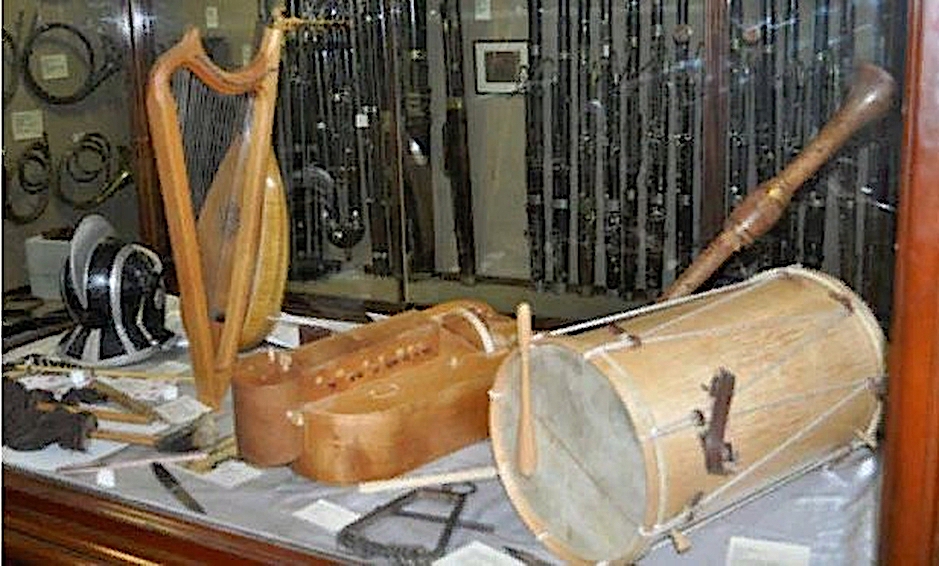
Khipus, the portable information archives created by the Inca, may stir up memories of 1970s macrame with their long strands of intricately knotted, earth-toned fibers, but their function more closely resembled that of a densely plotted computerized spreadsheet.
As Cecilia Pardo-Grau, lead curator of the British Museum’s current exhibitionPeru: a journey in time explains in the above Curators Corner episode, khipus were used to keep track of everything from inventories and censuses to historical narratives, using a system that assigned meaning to the type and position of knot, spaces between knots, cord length, fiber color, etc.
Much of the information preserved within khipus has yet to be deciphered by modern scholars, though the Open Khipu Repository — computational anthropologist Jon Clindaniel’s open-source database — makes it possible to compare the patterns of hundreds of khipus residing in museum and university collections.
Even in the Incan Empire, few were equipped to make sense of a khipu. This task fell to quipucamayocs, highborn administrative officials trained since childhood in the creation and interpretation of these organic spreadsheets.
Fleet messengers known as chaskis transported khipus on foot between administrative centers, creating an information superhighway that predates the Internet by some five centuries. Khipus’ sturdy organic cotton or native camelid fibers were well suited to withstanding both the rigors of time and the road.
A 500-year-old composite khipu that found its way to the British Museum organics conservator Nicole Rode prior to the exhibition was intact, but severely tangled, with a brittleness that betrayed its age. Below, she describes falling under the khipu’s spell, during the painstaking process of restoring it to a condition whereby researchers could attempt to glean some of its secrets.
Visit Museo Chileno de Arte Precolombino’s website to learn more about khipu in a series of fascinating short articles that accompanied their groundbreaking 2003 exhibit QUIPU: counting with knots in the Inka Empire.
Note: An earlier version of this post appeared on our site in 2022.
“The three volumes of Green’s Dictionary of Slang demonstrate the sheer scope of a lifetime of research by Jonathon Green, the leading slang lexicographer of our time. A remarkable collection of this often reviled but endlessly fascinating area of the English language, it covers slang from the past five centuries right up to the present day, from all the different English-speaking countries and regions. Totaling 10.3 million words and over 53,000 entries, the collection provides the definitions of 100,000 words and over 413,000 citations. Every word and phrase is authenticated by genuine and fully-referenced citations of its use, giving the work a level of authority and scholarship unmatched by any other publication in this field.”
Now comes the good news. Green’s Dictionary of Slanghas become available as a free website, giving you access to an even more updated version of the dictionary. Collectively, the website lets you trace the development of slang over the past 500 years. And, as Mental Floss notes, the site “allows lookups of word definitions and etymologies for free, and, for a well-worth-it subscription fee, it offers citations and more extensive search options.” If you’ve ever wondered about the meaning of words like kidlywink, gollier, and linthead, you now know where to begin.
If you would like to sign up for Open Culture’s free email newsletter, please find it here. It’s a great way to see our new posts, all bundled in one email, each day.
If you would like to support the mission of Open Culture, consider making a donation to our site. It’s hard to rely 100% on ads, and your contributions will help us continue providing the best free cultural and educational materials to learners everywhere. You can contribute through PayPal, Patreon, and Venmo (@openculture). Thanks!
We're hoping to rely on loyal readers, rather than erratic ads. Please click the Donate button and support Open Culture. You can use Paypal, Venmo, Patreon, even Crypto! We thank you!
Open Culture scours the web for the best educational media. We find the free courses and audio books you need, the language lessons & educational videos you want, and plenty of enlightenment in between.