FYI: Apple officially released iOS7, the latest operating system for the iPhone and iPad, on September 18. Almost simultaneously, Stanford began offering a course teaching students how to design apps in the new environment. Although the course is still in progress, the initial video lectures are now available online, you guessed it, on iTunesU.
The Smithsonian’s 19 museums, 9 research centers, and 140-plus affiliates boast the world’s largest collection—137 million items, in addition to a staggering array of photos, documents, films, and recordings. Choosing which to include in The Smithsonian’s History of America in 101 Objects (published on October 29)from such a wealth of options was no easy task. (On the other hand, the Director of the British Museum Neil MacGregor did manage to encapsulate two million years of world history in one object less…)
Anthropologist Richard Kurin, the Smithsonian Institution’s Under Secretary for History, Art, and Culture, prioritized objects with vivid biographies. There may be no way for a museum to recreate the Civil War, as he notes, but a “hand-drawn battle map of the time, a bullet or gunnery shelf, a uniform bearing evidence of wounds, and broken metal shackles are all objects that, having been present at the event depicted, can speak to the larger story. The parts stand for the whole.”
Celebrity may have factored into the selection process, too. Not every entry is bespangled with a famous name, but one can’t overlook the vicarious thrill inherent in Cesar Chavez’s union jacket, Abraham Lincoln’s top hat, Helen Keller’s watch, or Marian Anderson’s mink coat. Who can say whether these resonances will lose their luster in the future. In his introduction, Kurin uses the steering wheel of the U.S.S. Maine, once an object of keen national interest due to its role in the Spanish-American War, to exemplify the descent into obscurity.
To celebrate the publication of The Smithsonian’s History of America in 101 Objects, the Smithsonian Channel will be profiling some of the items in a four-part series, Seriously Amazing™ Objects (love the trademark, guys).
Or enjoy these three samples, selected by yours truly for their unifying roundness. (I could never accomplish anything on the order of Kurin’s feat, but encourage the Smithsonian to get in touch whenever they’re in the market for someone who could repackage their collection as board books for infants…)
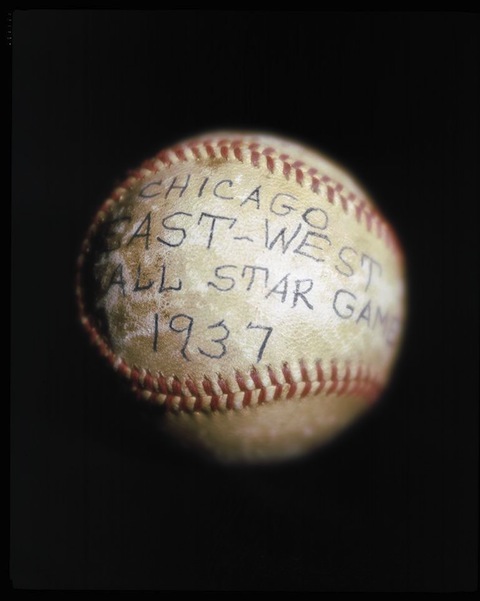
Negro League Baseball
1937, American History Museum
Sportswriter Frank Deford fulfills Kurin’s biographic requirements with an essay on the larger social implications behind this artifact, which scored a home run for Buck Leonard and the East lineup in the ’37 Comiskey All-Star game.
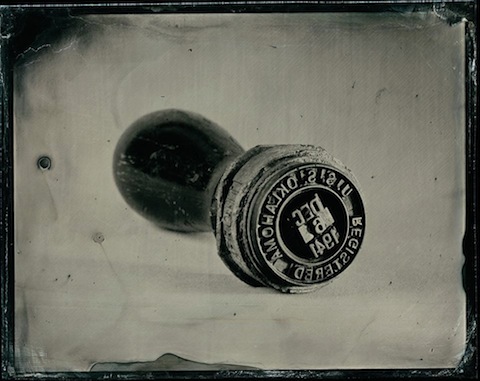
USS Oklahoma Stamp
1941, Postal Museum
“To record when a piece of mail was processed aboard ship, the Navy used wooden postmark stamps. This one bears an ominous date: Dec 6, 1941 PM. It was recovered from the battleship Oklahoma after it was hit by several torpedoes, listed to a 45-degree angle, capsized and sank in the attack on Pearl Harbor on December 7, 1941. The Oklahoma lost 429 sailors and Marines, a third of its crew.”
Wow.
The Pill
c. 1965 American History Museum
As Natalie Angier, author of Woman: An Intimate Geography pointed out in a recent article in Smithsonian magazine, “when people speak of the Pill, you know they don’t mean aspirin or Prozac but rather that mother of all blockbuster drugs, the birth control pill.” A pinnacle of both medical and feminist history, its significance extends well beyond the national borders.
How about you, readers? What item from a museum collection would you include in a book on American History?
Definitely worth a quick mention. For a limited time, PBS is making available its latest film from its great American Masters documentary series. My Train A Comin’traces Jimi Hendrix’s “remarkable journey from his hardscrabble beginnings in Seattle, through his stint as a US Army paratrooper and as an unknown sideman, to R&B stars until his discovery and ultimate international stardom.” It features “previously unseen footage of the 1968 Miami Pop Festival, home movies, and interviews with those closest to Jimi Hendrix.” From what we can tell, PBS will keep this film online for only a matter of days. So watch it while you can.
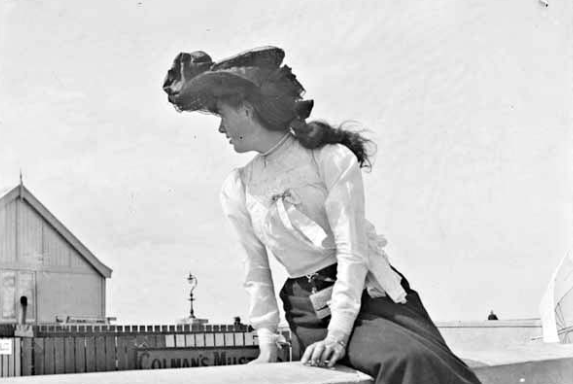
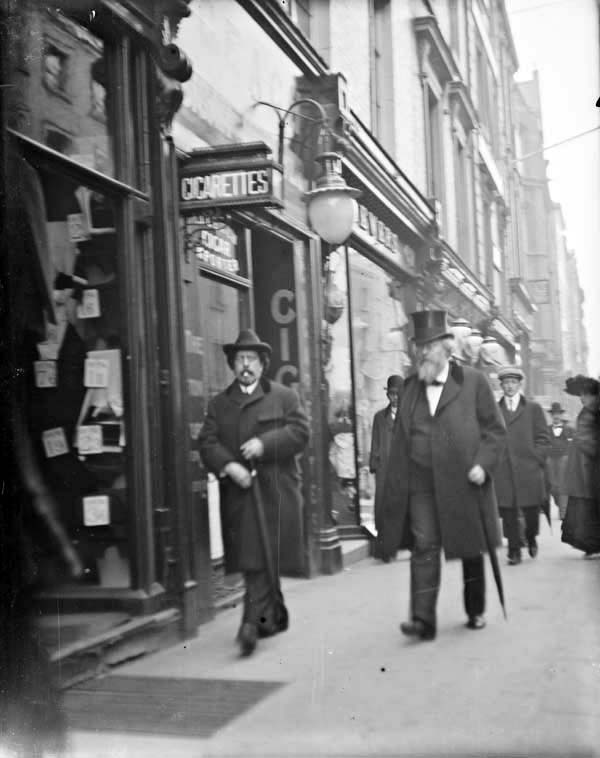
The Google Cultural Institute has drawn our attention before, with its virtual exhibitions on the rise of the Eiffel Tower, the fall of the Iron Curtain, and many other notable chapters of human history. Today, take a look at a Google Cultural Institute gallery that has a foot in literature as well as in history, Dubliners: the Photographs of J.J. Clarke from the National Library of Ireland. Subtitled “a glimpse of James Joyce’s Dublin,” the online show presents pictures taken by this fellow Clarke at the turn of the 20th century, when he came to the Irish capital to study medicine. His “photojournalistic approach to his subjects allowed him to capture vivid scenes from the daily lives of Dublin’s men, women and children.”
This made Clarke a contemporary of Joyce, and so his “images also show us how the city looked” to the writer “whose best known works — the short story collection Dubliners, and the novels A Portrait of the Artist as a Young Man and Ulysses — are all set around that time, when Joyce too was a young student fascinated by the world around him.”
Both the photographer and the novelist, in their separate forms, set about capturing the city, the era, and the culture around them, and the pictures of Clarke’s featured at the Google Cultural Institute could easily illustrate any of Joyce’s books.
I’ve long enjoyed repeating the observation that, had the real Dublin crumbled, we could rebuild it from the details given in Ulysses — or at least we could rebuild the Dublin of 1904. But I now accept that having on hand Clarke’s photographs, about which you can learn much more at the National Library of Ireland’s site, they would greatly speed the reconstruction process as well. All of the Joycean texts mentioned above can be found in our collection of Free Audio Books and Free eBooks.
Before the Grateful Dead recorded their classic eponymous country psych album, before they were the Grateful Dead, they were the Warlocks, “playing the divorcees bars up and down the peninsula,” Jerry Garcia tells us above. Their booking agent “used to book strippers and dog acts and magicians and everybody else.” Their first few gigs “sounded like hell,” says Garcia, “very awful.” In this Blank-on-Blank-animated 1988 interview with former Capital-EMI record executive Joe Smith, Garcia gets into the origin of their name (a story involving the East Coast Warlocks, who might have sued. What he doesn’t mention is that the Velvet Underground—inventors of East Coast psych—also played at that time as the Warlocks.)
Smith was with Warner Bros. when the Dead were signed in 1967. His relationship with the band then was frustrated, and he went so far as to call the recording of their second album “the most unreasonable project with which we have ever involved ourselves.” But this conversation is a funny, cordial exchange between two very affable people with surprisingly good memories of the time (Smith also once said the Dead “could have put me in the hospital for the rest of my life”). Jerry tells the story of their invitation to Merry Prankster and psychedelic genius Ken Kesey’s acid test parties in La Honda, California. It’s more or less the history of the West Coast acid rock scene and its apotheosis at Haight-Ashbury, so kind of essential watching, I’d say, but at less than six minutes, you can afford to be the judge.
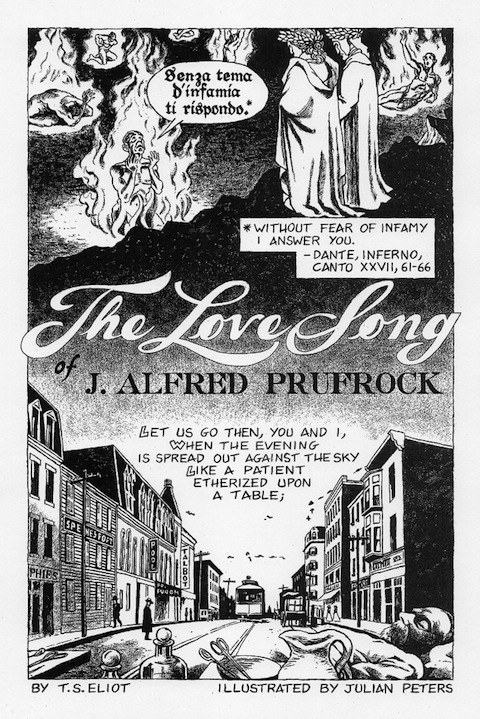
Poetry is as close as written language comes to the visual arts but, aside from narrative poems, it is not a medium easily adapted to visual forms. Perhaps some of the least adaptable, I would think, are the high modernists, whose obsessive focus on technique renders much of their work opaque to all but the most careful readers. The major poems of T.S. Eliot perhaps best represent this tendency. And yet comic artist Julian Peters is up to the challenge. Peters, who has previously adapted Poe, Keats, and Rimbaud, now takes on Eliot’s “The Love Song of J. Alfred Prufrock,” and you can see the first nine pages at his site.
Written in 1910 and published five years later, “Prufrock” has become a standard reference for Eliot’s doctrine of the “objective correlative,” a concept he defines in his critical essay, “Hamlet and His Problems,” as “a set of objects, a situation, a chain of events which shall be the formula of that particular emotion.” It’s a theory he elaborates in “Tradition and the Individual Talent” in his discussion of Dante. And Dante is where “Prufrock” begins, with an epigraph from the Inferno. Peters’ first page illustrates the agonized speaker of Dante’s lines, Guido da Montefeltro, a soul confined to the eighth circle, whom you can see at the top of the title page shown above. Peters’ visual choices place us firmly in the hellish emotional realm of “Prufrock,” a seeming catalogue of the mundane that harbors a darker import. Peters gives us no hint of when we might expect new pages, but I for one am eager to see more.
Click image once to enlarge, and yet again to enlarge further.
The assignment was impossible: a subject that refused to be interviewed, research that took over three months, and expenses that reached nearly $5,000 (in mid 1960s money). The result: one of the greatest celebrity profiles ever written.
Recently hired by Esquire after spending the first ten years of his career at TheNew York Times, Gay Talese’s first assignment from editor Harold Hayes was to write a profile of the already iconic Frank Sinatra.
The legendary singer was approaching fifty, under the weather, out of sorts, and unwilling to be interviewed. So Talese remained in L.A., hoping Sinatra might recover and reconsider, and he began talking to many of the people around Sinatra — his friends, his associates, his family, his countless hangers-on — and observing the man himself wherever he could.
In an interview last month with Nieman Storyboard, Talese explained that he didn’t want to write the story in the first place. “Life magazine just did a piece on Sinatra,” he recalls. “What can you say about Sinatra that hasn’t already been said?” However, for a writer who has written many brilliant pieces, the resulting profile, “Frank Sinatra Has a Cold,” is his most indelible.
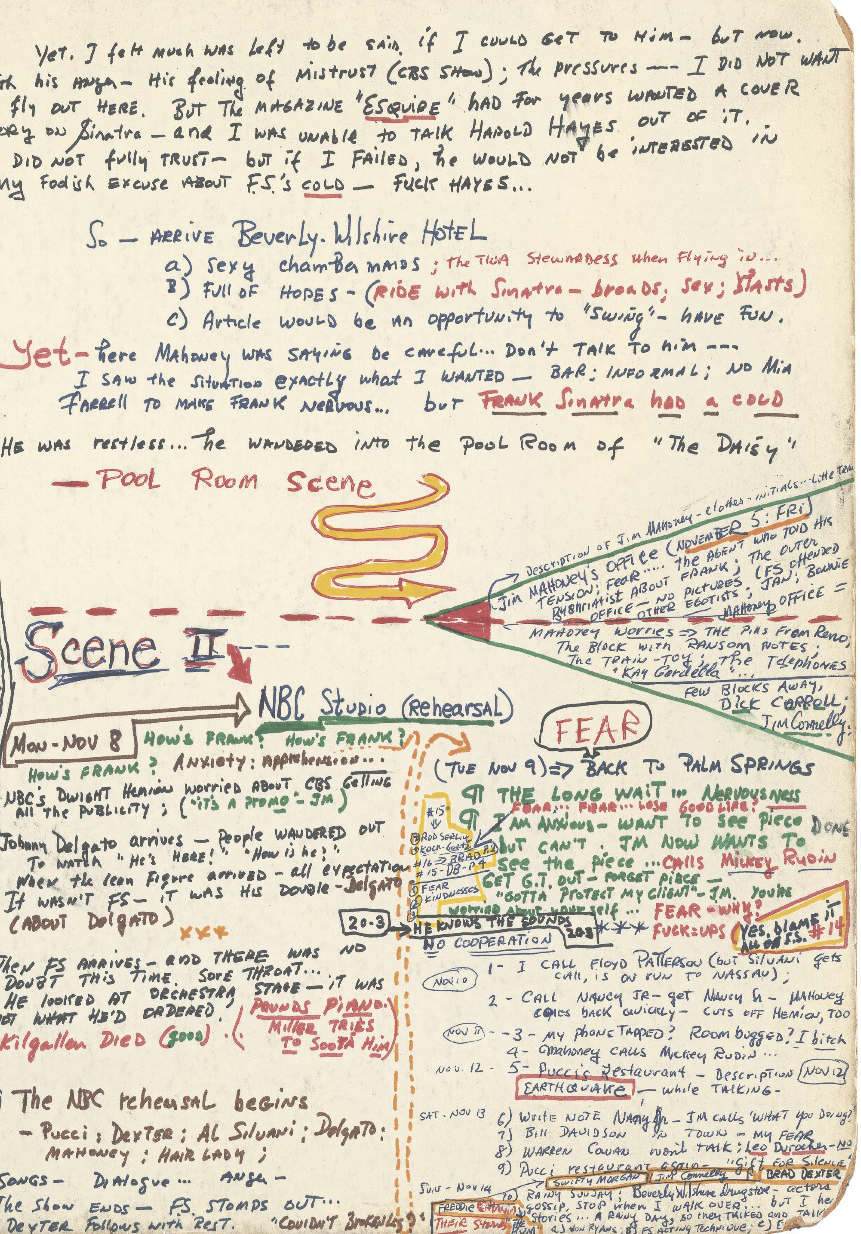
Above is Talese’s outline for the profile. Instead of notebooks, Talese used shirt boards to write down his observations. As he told The Paris Review in 2009, “I cut the shirt board into four parts and I cut the corners into round edges, so that they [could] fit in my pocket. I also use full shirt boards when I’m writing my outlines.”
What is also vital to Talese’s process is his personal observation. If you read Talese’s outline (click on the image above to enlarge), you will uncover more of what Talese thought and felt during that day than facts about Sinatra. “What I’m doing as a researching writer is always mixed up with what I’m feeling while doing it,” Talese notes, “and I keep a record of this. I’m always part of the assignment.”
This style goes to the heart of what became known as New Journalism, which, among other things, established the right for a writer to use his or her imagination to make a scene come alive. While the style was adopted by Talese, along with Tom Wolfe, Joan Didion, and others, it was first born out of necessity to complete the Sinatra profile. “The creativity in journalism is in what you do with what you have,” Talese says.
Club owner Hillel Kristal’s legendary CBGB died a slow death. A long, drawn-out affair that, when it came on October 15, 2006, seemed inevitable. The old venue’s state then was perfectly described by Ben Sisario in the New York Times as “the famously crumbling rock club that has been in continuous, loud operation since December 1973, serving as the casual headquarters and dank incubator for some of New York’s most revered groups.”
But CBGB’s still had some life in it, as did all of the old New York haunts that folded under Giuliani and Bloomberg. CBGB outlasted so much of old New York that it seemed indestructible, and thus slightly annoying until it was gone. Yet it needed to be seen into the next world in real style, and so it was, all thanks to Patti Smith.
On the club’s closing night, Smith and band convened to pay tribute to that “dank incubator” by playing not only the bands it birthed but those who came before. At the top, see their live take on the Stones’ “Gimme Shelter.” It lacks the strange delicacy of the original, but once Smith takes off her glasses and Flea, who sat in for a few tunes, cuts loose, it’s a serious rocker. Smith’s ad-lib at the end is as captivating as her announcement—“Rolling Stones!”—is unnecessary.
Smith’s band also played a Ramones medley (above) more than worthy of the formidable Queens foursome. Sure, anyone could play these songs—that was the point. But not many could so well capture the Ramones’ tuneful enthusiasm in the New York band’s ancestral home.
Lastly we bring you Smith and band’s “Pale Blue Eyes.” Although this footage predates Reed’s passing by seven years, it’s still a poignant tribute to the man who perhaps more than any other musician and writer inspired the ethos of the old CBGB. Without Lou Reed, we would have no… better not to finish that sentence. Enjoy the CBGB tribute above and see more of the final night’s celebration here.
We're hoping to rely on loyal readers, rather than erratic ads. Please click the Donate button and support Open Culture. You can use Paypal, Venmo, Patreon, even Crypto! We thank you!
Open Culture scours the web for the best educational media. We find the free courses and audio books you need, the language lessons & educational videos you want, and plenty of enlightenment in between.