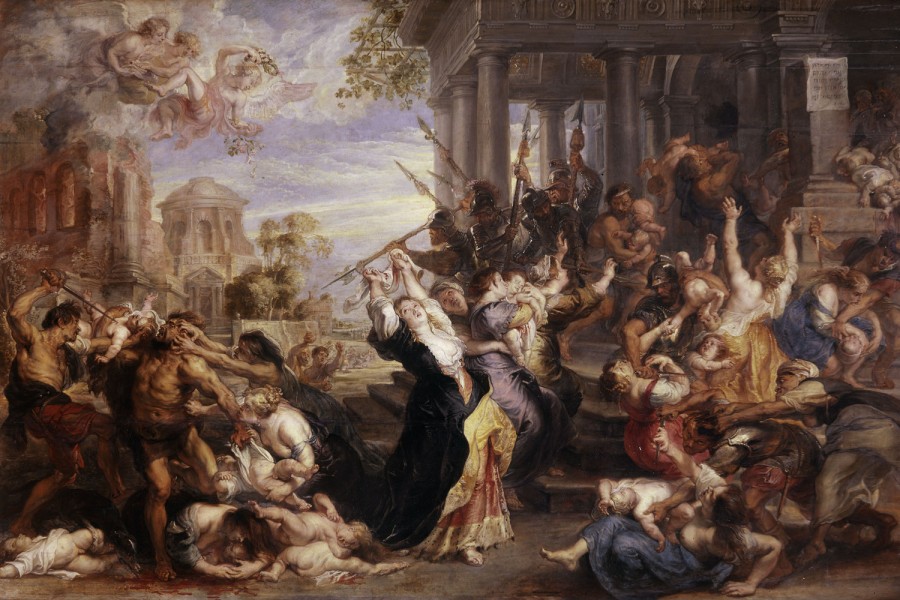
3D Printed Zoetrope Animates Rubens’ Famous Painting, “The Massacre of the Innocents”

In the 17th cen­tu­ry, the Flem­ish Baroque painter Peter Paul Rubens paint­ed “The Mas­sacre of the Inno­cents” (see below), an artis­tic depic­tion of a very brief Bib­li­cal pas­sage in The Gospel of Matthew. The pas­sage recounts the sto­ry of how Herod the Great, a Roman client king of Judea, ordered the exe­cu­tion of young male chil­dren in Beth­le­hem, hop­ing to avoid los­ing his throne to a new­ly-born King of the Jews. And it reads like this:

Then Herod, when he saw that he was deceived by the wise men, was exceed­ing­ly angry; and he sent forth and put to death all the male chil­dren who were in Beth­le­hem and in all its dis­tricts, from two years old and under, accord­ing to the time which he had deter­mined from the wise men. Then was ful­filled what was spo­ken by Jere­mi­ah the prophet, say­ing:

“A voice was heard in Ramah,
Lamen­ta­tion, weep­ing, and great mourn­ing,
Rachel weep­ing for her chil­dren,
Refus­ing to be com­fort­ed,
Because they are no more.”

In the 21st cen­tu­ry, Sebas­t­ian Bur­don and Mat Coll­ishaw have now come along and cre­at­ed “All Things Fall,” a 3d zoetrope that brings the “Mas­sacre of the Inno­cents” to life. Using a 19th cen­tu­ry opti­cal tech­nique that pro­duces the illu­sion of motion, the zoetrope vir­tu­al­ly ani­mates the grue­some Bib­li­cal scene. You can watch it play out, eeri­ly, above.

Accord­ing to Bur­don, it took “6 months to do all the 3d mod­el­ing and ani­ma­tions” and involved “cre­at­ing over 350 char­ac­ter fig­ures, envi­ron­ment ele­ments and archi­tec­ture. A pret­ty stun­ning effort.

Peter_Paul_Rubens_-_Massacre_of_the_Innocents_-_WGA20259

Relat­ed Con­tent:

Down­load Over 250 Free Art Books From the Get­ty Muse­um

Watch Art on Ancient Greek Vas­es Come to Life with 21st Cen­tu­ry Ani­ma­tion

5‑Minute Ani­ma­tion Maps 2,600 Years of West­ern Cul­tur­al His­to­ry

by | Permalink | Make a Comment ( 1 ) |

The Music of Avant-Garde Composer John Cage Now Available in a Free Online Archive

JohnCageArchive

You don’t know avant-garde music unless you know John Cage. And now we have anoth­er rich, eas­i­ly acces­si­ble online resource that can help us get to know John Cage bet­ter. The new site is called Mak­ing the Right Choic­es: A John Cage Cel­e­bra­tion, and it has its ori­gins in the cel­e­bra­tion of Cage’s 100th birth­day put on by con­duc­tor Michael Tilson Thomas and the New World Sym­pho­ny in Feb­ru­ary 2013.

This Cage-devot­ed, Knight Foun­da­tion-fund­ed site, in the words of Hyper­al­ler­gic’s Alli­son Meier, “presents a com­pre­hen­sive overview of his career, from a water­ing can poured on nation­al tele­vi­sion to a rhyth­mic solo piano per­for­mance inspired by lost love,” mate­r­i­al from Cage’s life and career as well as mate­r­i­al inspired by it, and of course “video and audio from the 2013 per­for­mances in Mia­mi Beach, includ­ing some famil­iar and some obscure pieces from [Cage’s] influ­en­tial and exper­i­men­tal career of both music and staged silence.”

You may remem­ber when we fea­tured Cage’s 1960 per­for­mance of Water Walk on I’ve Got a Secret. The site does­n’t fail to include that clas­sic tele­vi­sion clip, but it also offers videos on the stag­ing of Water Walk today, from its direc­tion and back­ground to its rehearsal to the the­atri­cal­i­ty of its per­for­mance to the place­ment of the cam­eras film­ing it. You can find these and many oth­er audio­vi­su­al explo­rations of the nuts and bolts of Cage’s work at Mak­ing the Right Choic­es’ cat­a­log of videos.

“John Cage gen­uine­ly want­ed to open up the beau­teous expe­ri­ence of sound for every­one,” writes Tilson Thomas in a piece on the com­pos­er. “Much of his work could be described as kits to be used in the cre­ation of a per­for­mance that relies on the per­cep­tions, imag­i­na­tions and choic­es of the musi­cians. It was a spir­i­tu­al mis­sion for him to cre­ate the oppor­tu­ni­ty for the per­for­mance to exist while at the same time to inter­fere with it as lit­tle or as sub­tly as pos­si­ble.” That chal­lenge Cage set for him­self keeps his work fas­ci­nat­ing to us to this day — and as Tilson Thomas and the New World Sym­pho­ny sure­ly found out, it remains as much of a chal­lenge as ever for those who pick it up today.

Vis­it Mak­ing the Right Choic­es: A John Cage Cel­e­bra­tion .

via Hyper­al­ler­gic

Relat­ed Con­tent:

John Cage Per­forms Water Walk on US Game Show I’ve Got a Secret (1960)

10 Rules for Stu­dents and Teach­ers Pop­u­lar­ized by John Cage

Lis­ten to John Cage’s 5 Hour Art Piece: Diary: How To Improve The World (You Will Only Make Mat­ters Worse)

Hear Joey Ramone Sing a Piece by John Cage Adapt­ed from James Joyce’s Finnegans Wake

Watch a Sur­pris­ing­ly Mov­ing Per­for­mance of John Cage’s 1948 “Suite for Toy Piano”

Col­in Mar­shall writes on cities, lan­guage, Asia, and men’s style. He’s at work on a book about Los Ange­les, A Los Ange­les Primer, and the video series The City in Cin­e­maFol­low him on Twit­ter at @colinmarshall or on Face­book.

Watch the Hardcore Original Ending to Kevin Smith’s 1994 Cult Hit Clerks

I’m not sure if it’s still the case today, in fact, I’m almost sure it isn’t, but in my day the ethos of an entire gen­er­a­tion could be tidi­ly summed up by ref­er­ence to a hand­ful of movies. Or at least that’s what we were led to believe, those of us who came of age in the ear­ly-to-mid 90s, when films like Richard Linklater’s Slack­er (watch free online), Ben Stiller’s Real­i­ty Bites, and Kevin Smith’s Clerks achieved almost instant cult sta­tus as totems of mid­dle class ennui—that of overe­d­u­cat­ed nar­cis­sists and direc­tion­less dream­ers and cyn­ics with ser­i­al roman­tic dis­as­ters and a gnaw­ing sense of the dwin­dling returns on their heavy invest­ment in cul­tur­al cap­i­tal.

Of this ad hoc tril­o­gy of 90s slack­er­dom, it’s Smith’s 1994 low-bud­get, black and white paean to the lives of low-wage con­ve­nience and video store clerks, their clue­less cus­tomers, and a com­ic duo of stoned hang­ers-on that per­haps holds up best, and this is because the film’s comedy—ranging from gal­lows humor to gross-out slap­stick to obser­va­tion­al geekery—seems most ground­ed in the every­day expe­ri­ences of real, absurd­ly bored, work­ing stiffs every­where. So it’s for the best that Smith decid­ed not to fin­ish the film with the orig­i­nal end­ing he shot, which you can see above. In it, the movie’s main char­ac­ter, Quick Stop clerk Dante Hicks, is killed in a rob­bery. The last image we see in this version’s har­row­ing dénoue­ment is of his corpse, awk­ward­ly wedged behind the Quick Stop counter.

It’s an end­ing that makes lit­tle sense tonal­ly. Despite the movie’s detours into the macabre, it nev­er gets seri­ous enough to jus­ti­fy this kind of heav­i­ness. As Men­tal Floss puts it, “the alter­nate end­ing to Kevin Smith’s break­through film turned a light­heart­ed vul­gar com­e­dy [see above] into a dark tragedy of Ing­mar Bergman-ish pro­por­tions.” Actor Bri­an O’Halloran, who played Dante, thought as much. “I hat­ed that end­ing,” Rolling Stone quotes him as say­ing, “I just thought it was too quick of a twist.” I guess it’s a good thing for Smith (and O’Hal­lo­ran) that he final­ly agreed, since with­out the Clerks universe’s main char­ac­ter, there may have been no Clerks 2, for what it’s worth, though Jay and Silent Bob would cer­tain­ly have gone on to their post-Clerks revenge.

Smith’s choice to keep it light also speaks to the spir­it of the time—or the spir­it of these filmed rep­re­sen­ta­tions of the time, which are ulti­mate­ly about a lack of res­o­lu­tion, a meta-lack of res­o­lu­tion, that becomes its own brand of tragi­com­e­dy. Clerks is loose­ly mod­eled on Dante’s vision of pur­ga­to­ry, but feels more like Samuel Beck­ett trans­posed to sub­ur­ban New Jer­sey. The char­ac­ters in Smith’s films for­ev­er live their lives in what post-hard­core band Fugazi so anthem­i­cal­ly called the “wait­ing room”—the kind of place where, in the midst of a per­son­al cri­sis, the most log­i­cal thing to do is debate the ethics of killing off inde­pen­dent con­trac­tors on Return of the Jedi’s Death Star.

The Clerks alter­nate end­ing appears on the 10th anniver­sary DVD of the film. You’ll prob­a­bly agree the movie works much bet­ter with­out this fatal­ly abrupt turn, but watch­ing it gives us a glimpse of a world where death—always hov­er­ing on the edges of slackerdom—intrudes to break the spell of ter­mi­nal inac­tion and emo­tion­al paral­y­sis.

Relat­ed Con­tent:

Watch Kevin Smith’s Clever First Film, Mae Day: The Crum­bling of a Doc­u­men­tary (1992)

The Always-NSFW Kevin Smith and Jason Mewes Catch Up in Jay and Silent Bob Get Old Pod­cast

Hear Kevin Smith’s Three Tips For Aspir­ing Film­mak­ers (NSFW)

Watch Free Online: Richard Linklater’s Slack­er, the Clas­sic Gen‑X Indie Film


Josh Jones is a writer and musi­cian based in Durham, NC. Fol­low him at @jdmagness

Take a Free Course on Film Noir; Then Watch Oodles of Free Noir Films Online

tcm course

Cinephiles, if you have some spare time in the com­ing months and feel like watch­ing, say, over 100 film noir movies from the Turn­er Clas­sic Movie (TCM) vaults, then you will be delight­ed with Sum­mer of Dark­ness, which will devote every Fri­day, from June through July, to 24 hours of noir clas­sics and rar­i­ties. And sup­pose you’d like a reward, like a cer­tifi­cate that proves you not only watched those movies, but prop­er­ly stud­ied them? Well TCM has that cov­ered too, offer­ing a free nine-week course in “The Case of Film Noir” to run con­cur­rent with the series. It’s free to sign up, and the course runs June 1 — August 4. Says TCM:

This is the deep­est cat­a­log of film noir ever pre­sent­ed by the net­work (and per­haps any net­work), and pro­vides an unprece­dent­ed oppor­tu­ni­ty for those inter­est­ed in learn­ing more to watch over 100 clas­sic movies as they inves­ti­gate “The Case of Film Noir.”

The course is being taught by Richard L. Edwards, Ph.D. who co-hosts the Out of the Past: Inves­ti­gat­ing Film Noir pod­cast and also teach­es at Ball State Uni­ver­si­ty in Muncie, Indi­anapo­lis.

For those who don’t have TCM, or even cable, don’t wor­ry. The net­work promis­es to post links to online pub­lic domain films. Or, bet­ter yet, you could jump right into our col­lec­tion of 60 Free Noir Films Online, which fea­tures pub­lic domain clas­sics by Orson Welles, Fritz Lang, John Hus­ton, and many more.

Have a hazy, dan­ger­ous sum­mer and watch out for femme fatales!

via Fla­vor­wire

Relat­ed Content:

60 Free Film Noir Movies

The 5 Essen­tial Rules of Film Noir

25 Noir Films That Will Stand the Test of Time: A List by “Noir­chael­o­gist” Eddie Muller

Watch Scar­let Street, Fritz Lang’s Cen­sored Noir Film, Star­ring the Great Edward G. Robin­son (1945)

Kansas City Con­fi­den­tial: Did This 1952 Noir Film Inspire Quentin Tarantino’s Reser­voir Dogs?

Ted Mills is a free­lance writer on the arts who cur­rent­ly hosts the FunkZone Pod­cast. You can also fol­low him on Twit­ter at @tedmills, read his oth­er arts writ­ing at tedmills.com and/or watch his films here.

French Student Sets Internet on Fire with Animation Inspired by Moebius, Syd Mead & Hayao Miyazaki

The inter­net over in Japan was lit ablaze last month by a stu­dent film. Titled “Celles et Ceux des Cimes et Cieux” (“Girls and Guys from the Sum­mits and the Skies”), the short is a gor­geous­ly ani­mat­ed trail­er for what looks like an amaz­ing yet-to-be-made fea­ture film. Cre­at­ed by Gwenn Ger­main, who is study­ing at the French art school Créa­pole, the ani­ma­tion is also a love let­ter to leg­endary film­mak­er Hayao Miyaza­ki. You can watch it above.

“I’ve been told by a friend of mine that all the movies that I’ve made are essen­tial­ly the same!” That’s what Miyaza­ki said to me dur­ing a round­table for his children’s movie Ponyo. Though the sto­ries vary from movie to movie, his world is imme­di­ate­ly rec­og­niz­able and remark­ably con­sis­tent. He cre­ates uni­vers­es that are won­drous and mys­ti­cal.

He has an almost shaman­is­tic rev­er­ence for nature; rocks, trees, rivers, and oceans all seem to be alive and aware. And he pop­u­lates his world with shape-shift­ing crea­tures like the rav­en­ous masked blob No-Face in Spir­it­ed Away; the Great For­est Spir­it in Princess Mononoke, which looks like it was yanked straight out of Japan­ese mythol­o­gy; and per­haps his most delight­ful cre­ation, the Cat Bus from My Neigh­bor Totoro, com­plete with head­light eyes, a Cheshire grin and a warm, womb-like inte­ri­or. It was this whim­si­cal cre­ation that report­ed­ly impressed The Emper­or him­self – Aki­ra Kuro­sawa.

It’s no won­der why Japan­ese neti­zens went crazy for “Celles et Ceux des Cimes et Cieux.” Germain’s short seems sprung from the same world as Miyaza­ki. The giant bugs look like some­thing out of Nau­si­caa of the Val­ley of the Wind. The ambigu­ous­ly Euro­pean archi­tec­ture looks like some­thing from Kiki’s Deliv­ery Ser­vice and those pur­ple amor­phous worms look like some­thing from Spir­it­ed Away.  Heck, Miyaza­ki him­self even seems to be in Ger­main’s short – that beard­ed old guy at the end of the movie is a spit­ting image of the famed ani­ma­tor.

Ger­main cred­its oth­er influ­ences aside from Miyaza­ki: Syd Mead, the con­cept artist who cre­at­ed those fly­ing cars in Blade Run­ner and the city of the future in the upcom­ing Tomor­row­land, and par­tic­u­lar­ly the bound­less­ly imag­i­na­tive French illus­tra­tor Moe­bius. Their influ­ence might not be as obvi­ous as Miyaza­k­i’s, how­ev­er.

In any case, I am seri­ous­ly look­ing for­ward to see­ing a fea­ture length ver­sion of “Celles et Ceux des Cimes et Cieux.”

Relat­ed Con­tent: 

How to Make Instant Ramen Com­pli­ments of Japan­ese Ani­ma­tion Direc­tor Hayao Miyaza­ki

Moe­bius Gives 18 Wis­dom-Filled Tips to Aspir­ing Artists (1996)

Moe­bius’ Sto­ry­boards & Con­cept Art for Jodorowsky’s Dune

Japan­ese Car­toons from the 1920s and 30s Reveal the Styl­is­tic Roots of Ani­me

Jonathan Crow is a Los Ange­les-based writer and film­mak­er whose work has appeared in Yahoo!, The Hol­ly­wood Reporter, and oth­er pub­li­ca­tions. You can fol­low him at @jonccrow. And check out his blog Veep­to­pus, fea­tur­ing pic­tures of vice pres­i­dents with octo­pus­es on their heads.  The Veep­to­pus store is here.

Mesmerizing Timelapse Film Captures the Wonder of Bees Being Born

From Nation­al Geo­graph­ic comes this: A short time­lapse film that lets you watch “the eeri­ly beau­ti­ful growth of lar­vae into bees.” Shot by pho­tog­ra­ph­er Anand Var­ma, the mes­mer­iz­ing video starts with the lar­vae of work­er bees just hatch­ing from eggs, then fol­lows their mat­u­ra­tion into adult bees. The video cov­ers an 11-day process in one short minute.

You can get a behind-the-scenes account of the mak­ing of this video over at Nat Geo. When you’re there, you might also want to check out these pret­ty amaz­ing por­traits of bees.

via Kot­tke/This is Colos­sal

Fol­low us on Face­book, Twit­ter, Google Plus and LinkedIn and  share intel­li­gent media with your friends. Or bet­ter yet, sign up for our dai­ly email and get a dai­ly dose of Open Cul­ture in your inbox.


by | Permalink | Make a Comment ( 2 ) |

Watch Sherlock Hound: Hayao Miyazaki’s Animated, Steampunk Take on Sherlock Holmes

With such majes­tic, painstak­ing­ly craft­ed films as Nau­si­caä of the Val­ley of the Wind, My Neigh­bor Totoro, and Princess Mononoke, Hayao Miyaza­ki has made his name as Japan­ese ani­ma­tion’s pre­em­i­nent artis­tic vision­ary — and quite pos­si­bly ani­ma­tion’s pre­em­i­nent artis­tic vision­ary as well. But before he co-found­ed Stu­dio Ghi­b­li, the house that has become syn­ony­mous with Miyaza­k­i’s kind of lush, uni­ver­sal­ly appeal­ing, and award-win­ning films, he worked on var­i­ous kinds of ani­ma­tion, for dif­fer­ent media and pitched at dif­fer­ent lev­els of seri­ous­ness. One of the most notable projects of the end of that chap­ter of his career trans­posed the adven­tures of Sher­lock Holmes into a world of anthro­po­mor­phic dogs.

The Ital­ian-Japan­ese co-pro­duc­tion Sher­lock Hound aired as a tele­vi­sion series between 1984 and 1985. Of its 26 episodes, which sent the cor­gi Sher­lock Hound and ter­ri­er Doc­tor Wat­son after a vari­ety of thieves and on all sorts of adven­tures across a steam­punk Lon­don, Miyaza­ki direct­ed six.

In the Miyaza­ki-direct­ed episode “Trea­sure Under the Sea” at the top of the post, for instance, the detect­ing duo go after a sub­ma­rine pur­loined by recur­ring antag­o­nist of both Holmes and Hound, Pro­fes­sor Mori­ar­ty, who here takes the form of a wolf.

“The Sov­er­eign Gold Coins” finds Hound and Wat­son in pur­suit of that seem­ing­ly more tra­di­tion­al stripe of crim­i­nal known as a safe­crack­er, and in “Mrs. Hud­son is Tak­en Hostage,” their land­la­dy (who seems con­sid­er­ably more youth­ful in Miyaza­k­i’s vision than the matron in Sir Arthur Conan Doyle’s) goes miss­ing, though her kid­nap­per bad­ly under­es­ti­mates the dif­fi­cul­ty of pulling off his plan under Hound’s watch. Miyaza­ki would direct three more episodes (“The Stormy Get­away,” “The Crown of Maza­lin,” and “The Four Sig­na­tures”) before a rights dis­pute with Conan Doyle’s estate threw a wrench into pro­duc­tion. The show lat­er went on under oth­er cre­ators, and U.S. view­ers can see the whole, still-delight­ful run on Hulu, but Miyaza­ki did­n’t look back — and see­ing as Nau­si­caä had come out that same year, he did­n’t need to.

Relat­ed Con­tent:

Watch John Cleese as Sher­lock Holmes in The Strange Case of the End of Civ­i­liza­tion as We Know It

Down­load the Com­plete Sher­lock Holmes, Arthur Conan Doyle’s Mas­ter­piece

Arthur Conan Doyle Dis­cuss­es Sher­lock Holmes and Psy­chics in a Rare Filmed Inter­view (1927)

Hear the Voice of Arthur Conan Doyle After His Death

Col­in Mar­shall writes on cities, lan­guage, Asia, and men’s style. He’s at work on a book about Los Ange­les, A Los Ange­les Primer, and the video series The City in Cin­e­maFol­low him on Twit­ter at @colinmarshall or on Face­book.

Peter Sellers Covers the Beatles’ “A Hard Day’s Night,” “She Loves You” & “Help!”

In the ear­ly six­ties, Peter Sell­ers, one of the great­est com­ic actors of his gen­er­a­tion, met per­haps the great­est musi­cians of the age, the Bea­t­les, through their mutu­al pro­duc­er George Mar­tin. The par­tic­u­lar­ly British sen­si­bil­i­ties of the band and the actor—slapstick and word­play, accent and cos­tume changes—had sur­pris­ing­ly broad appeal in the six­ties, and a com­mon his­to­ry in their mutu­al admi­ra­tion of Eng­lish come­di­an and writer Spike Mil­li­gan.

Sell­ers rose to promi­nence on the Mil­li­gan-cre­at­ed BBC radio pro­gram The Goon Show, which the Bea­t­les cit­ed as a major influ­ence on their work. Their con­stant pat­ter in inter­views, films, even rehearsals, their ten­den­cy to break into music hall song and dance, comes right out of Sell­ers in a way (see, for exam­ple, the great com­ic actor in a rare inter­view here), but was also very much an expres­sion of their own extro­vert­ed per­son­al­i­ties. It stands to rea­son then that Sell­ers and the Bea­t­les, as we wrote in an ear­li­er post, “became fast friends.”

And as the Bea­t­les had paid trib­ute to Sell­ers’ com­e­dy, he would return the favor, cov­er­ing three of their most pop­u­lar songs as only he could. At the top of the post, see Sell­ers do a spo­ken word ver­sion of “A Hard Day’s Night” as Lawrence Olivier’s Richard III. And above and below, he gives us sev­er­al ren­di­tions of “She Loves You,” in sev­er­al dif­fer­ent accents, “in the voice of Dr. Strangelove, again with cock­ney and upper-crusty accents, and final­ly with an Irish twist. The record­ings were all released posthu­mous­ly between 1981 and 1983 on albums no longer in cir­cu­la­tion.”

There are many more Beatles/Sellers con­nec­tions. Before tap­ing his “Hard Day’s Night” skit for Grana­da tele­vi­sion spe­cial “The Music of Lennon & McCart­ney,” Sell­ers had pre­sent­ed the band with a Gram­my for the song, which won “Best Per­for­mance of a Vocal Group” in 1965. “Inci­den­tal­ly,” writes Mersey Beat’s Bill Har­ry, “the [Gram­my] pre­sen­ta­tion was made on the stu­dio set of ‘Help!’ and, inter­est­ing­ly, Sell­ers had orig­i­nal­ly been offered the script of ‘Help!’ (Obvi­ous­ly under a dif­fer­ent title) but turned it down.” Sell­ers and the Goon Show cast had pre­vi­ous­ly worked with Richard Lester, direc­tor of the Bea­t­les films and the John Lennon-star­ring How I Won the War.

Com­pletists out there may have also heard the record­ed con­ver­sa­tion between Sell­ers and the Bea­t­les that appears at the end of a boot­leg ver­sion of the White Album, which cir­cu­lat­ed for years under the title The Peter Sell­ers Tape. That the band and the come­di­an got along so famous­ly is no great sur­prise, nor that Sell­ers had so much fun rework­ing the rather sil­ly, and infec­tious­ly catchy, pop songs of the Bea­t­les’ ear­ly career, bring­ing to them his bat­tery of char­ac­ters and voic­es. We’ve saved what may be Sell­ers’ best Bea­t­les cov­er for last. Below, hear him—in the voice of a lec­tur­ing vic­ar and with a back­ing choir—deliver “Help!” as a 45 RPM ser­mon.

Relat­ed Con­tent:

Peter Sell­ers Presents The Com­plete Guide To Accents of The British Isles

The Bea­t­les Per­form a Fun Spoof of Shakespeare’s A Mid­sum­mer Night’s Dream (1964)

John Cleese, Ringo Starr and Peter Sell­ers Trash Price­less Art (1969)

John Lennon’s Appear­ances in How I Won the War, the Absur­dist 1967 Film

Josh Jones is a writer and musi­cian based in Durham, NC. Fol­low him at @jdmagness

« Go BackMore in this category... »
Quantcast