Running 10–14 hours, the collections (usually retailing for $22.95 on Amazon) build in difficulty, moving from “Level 1” to “Level 2” to “Level 3.” We’ve embedded the playlists below, and you can always find them listed in our collection, Learn 45+ Languages Online for Free: Spanish, Chinese, English & More.
Spanish:
French
Mandarin
German
Italian
Russian
If you would like to sign up for Open Culture’s free email newsletter, please find it here. It’s a great way to see our new posts, all bundled in one email, each day.
If you would like to support the mission of Open Culture, consider making a donation to our site. It’s hard to rely 100% on ads, and your contributions will help us continue providing the best free cultural and educational materials to learners everywhere. You can contribute through PayPal, Patreon, and Venmo (@openculture). Thanks!
In a recent interview, the perennially cheerful Paul McCartney talked candidly about his depression after the Beatles’ 1970 breakup, a revelation that may have come as a surprise to some people given Sir Paul’s general level of, well, cheer. But, “you would be too if it happened to you,” said McCartney, admitting that he “took to the bevvies… to a wee dram” (and making even a drinking problem sound upbeat). Where McCartney admits he struggled to find his footing again musically, two of his estranged bandmates released solo-career-defining albums just months after the Beatles’ official demise—George Harrison’s All Things Must Passand John Lennon’s Imagine.
Lennon, of course, had his own post-Beatles issues with substance abuse and depression. But in 1971 he had kicked a heroin habit, embraced primal therapy, and was in top musical form. Not only did Imagine, the album, go double platinum, but fans and critics consider “Imagine,” the song, one of the finest Lennon ever wrote. In the footage above, we see Lennon during the early Imagine recording sessions at his home studio at Tittenhurst Park. Lennon plays the new title track for the album’s musicians for the first time, records his vocals and piano, and discusses the mix and arrangement with Phil Spector and Yoko Ono.
The clip comes from the 2000 documentary Gimme Some Truth: The Making of John Lennon’s Imagine Album, which captures the intimacy of those recording sessions, as Lennon and his band eat and talk together before going into the studio. George Harrison appears often to record guitar parts for several songs; the band jams and horses around; Allen Ginsberg and Miles Davis show up and Davis plays basketball with Lennon; and Yoko and John discuss design and album photography.
Later that year, Lennon and Yoko appeared on The Dick Cavett Show to promote the song and album and premier the “Imagine” film above. As in nearly all of his solo work, Ono acted both as Lennon’s muse and his collaborator, inspiring Imagine’s “How” and “Oh Yoko” and co-writing “Oh My Love.” She is rarely given credit, however, for inspiring—and co-writing—“Imagine.” The song owes much to Ono’s “good-naturedly defiant little book,” Grapefruit, “part irreverent activity book for grown-ups,” writes Maria Popova, “part subversive philosophy for life,” complete with whimsical drawings very much like the kind Lennon himself made and published in his own books of silly verse.
But while critics and Lennon fans overlook Yoko’s role in “Imagine”’s composition, Lennon later admitted it “should be credited as a Lennon/Ono song. A lot of it—the lyric and the concept—came from Yoko, but in those days I was a bit more selfish, a bit more macho, and I sort of omitted her contribution, but it was right out of Grapefruit.” The album cover did, however, quote “Cloud piece,” one of the many meditative poems Lennon drew from: “Imagine the clouds dripping. Dig a hole in your garden to put them in.”
In the short making-of clip at the top, Lennon tells the room, after playing a raw rendition of “Imagine” solo on piano, “that’s the one I like best.” The song’s utopianism strongly contrasts with the righteous anger and bitterness Lennon gave vent to in other songs on Imagine, including “How Do You Sleep?,” in which, he told Playboy in 1980, “I used my resentment and withdrawing from Paul and The Beatles, and the relationship with Paul.” Early editions of the LP even included a postcard photo of Lennon holding a pig, mocking the cover of McCartney’s underrated Ram. McCartney expressed his post-Beatles’ anger in a few minor lyrical jabs; Lennon responded with unsubtle vitriol. But many of Imagine’s songs—celebrations of love, protests against war, and the visionary title track—point away from the past and toward the future, or what little of it remained for Lennon.
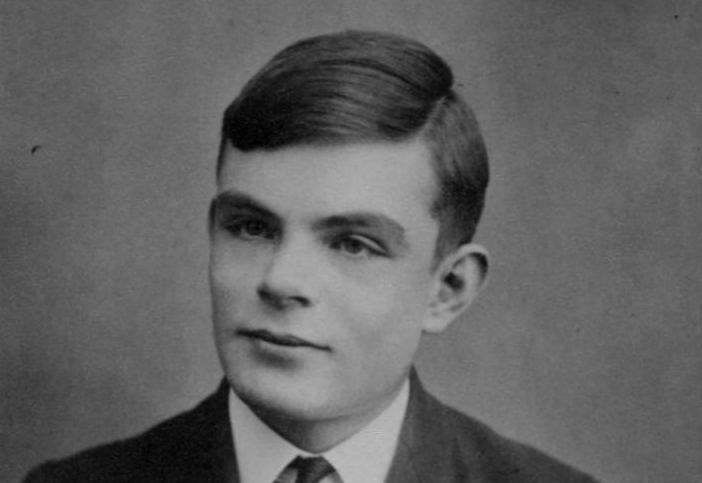
We now regard Alan Turing, the troubled and ultimately persecuted cryptanalyst (and, intellectually, much more besides)—who cracked the code of the German Enigma machine in World War II—as one of the great minds of history. His life and work have drawn a good deal of serious examination since his early death in 1954, and recently his legacy has even given rise to popular portrayals such as that by Benedict Cumberbatch in the film The Imitation Game. So what, more and more of us have started to wonder, forms a mind like Turing’s in the first place?
A few years ago, mathematics writer Alex Bellos received, from “an old friend who teaches at Sherborne, the school Turing attended between 1928 and 1930,” some “new information about the computer pioneer and codebreaker’s school years” in the form of “the list of books Turing took out from the school library while he was a pupil.” Bellos lists them as follows:
Illusions
Journal of the Chemical Society, vols. 95, 96, 97
“As you can see, and as you might expect,” writes Bellos, “heavy on the sciences. The AJ Evans, a memoir about the author’s escape from imprisonment in the First World War, is the only non-scientific book.” He also notes that “the physics books he took out all look very serious, but the maths ones are lighthearted: the Lewis Carroll and the Rouse Ball, which for decades was the classic text in recreational maths problems.” Sherborne archivist Rachel Hassall, who provided Bellos with the list, also told him that “the book chosen by Turing for his school prize was a copy of the Rouse Ball. Even teenage geniuses like to have fun.”
If you, too, would like to do a bit of the reading of a genius — or, depending on how quantitatively your own mind works, just have some fun — you can download for free most of these books the young Turing checked out of the school library. Programmer and writer John Graham-Cumming originally found and organized all the links to the texts on his blog; you can follow them there or from the list in this post. And if you know any youngsters in whom you see the potential to achieve history’s next Turing-level accomplishment, send a few e‑books their way. Why read Harry Potter, after all, when you can read A Selection of Photographs of Stars, Star-Clusters & Nebulae, together with information concerning the instruments & the methods employed in the pursuit of celestial photography?
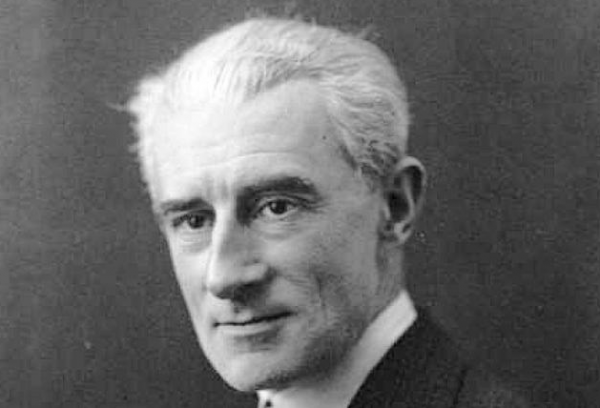
On May 1st, 2016, Maurice Ravel’s masterful orchestral composition Bolero entered the public domain, which means we may be hearing a lot more of the piece, first written and performed in 1928 as a ballet commissioned by Russian dancer Ida Rubenstein. Then again, it’s not like Boléro hasn’t fully permeated the public’s domain for decades, regardless of its copyright status.
Audiences swooned as British ice dancers Torvill and Dean won the gold at the 1984 Winter Olympics in Sarajevo with a perfect score-performance to Bolero; both Jeff Beck and Frank Zappa have covered it; Bolero famously scored a sex scene in 1979’s sleazy comedy 10; it popped up in 2014’s Spider-Man 2; and it even provided the title of a film, 1934’s Bolero, which culminated in the leads dancing to Ravel’s composition….
If you happened to have missed all of these cultural moments, you’ve still heard Bolero, with its unmistakable flute and piccolo melody and persistently rapping snare drum. (Maybe you, and your tot, saw seven chickens dance to Bolero on Sesame Street.)
Bolero is not only Ravel’s most famous composition, but perhaps one of the most well-known pieces of classical music ever written. “Famous to historians and record-books for ostensibly containing the longest-sustained single crescendo anywhere in orchestral repertory,” writes Allmusic, and “famous to musicians and music lovers for being both the most repetitive 15 minutes of music they are likely to play/hear and also one of the most absolutely well-composed.” So repetitive is Bolero that it has been cited as evidence that Maurice Ravel suffered from Alzheimer’s when he wrote it.
I find this explanation of Bolero unconvincing, primarily because of its aforementioned “well-composed” quality. This is no musical perseveration, the symptom of a decaying mind, but an intentional exercise—as is so much modern music since Ravel—in finding beauty and variation in sameness. We hear it in the minimalism of composers like Steve Reich, or the droning beats of Kraftwerk and Can. In fact, classical review magazine Gramophone invokes Krautrock-style repetition in its description of Bolero’s drive “toward motorik self-oblivion.” The piece “is about developing a single moment in time, obsessively rethought/re-shaded/redrawn/revisited, revealed through shifting perspectives on itself.”
Gramophone’s thorough documentation of Bolero’s recording history details the ways in which a succession of conductors and orchestras have approached the piece’s complex interplay of sameness and difference, beginning with one of the very first recordings, conducted by Ravel himself, in 1930. Leading the Orchestre des Concerts Lamoureux in a session for Polydor, Ravel was in poor health, and perhaps indeed suffering from some form of dementia. (Two years later, an auto accident worsened his condition; Ravel died in 1937 after an unsuccessful brain surgery.) His “conducting technique” in the 1930 recording “falls far short” in comparison to other recorded versions, writes Gramophone in their tepid review.
Nonetheless, this version represents a “historical curio” and an opportunity to hear the composer preside over his own interpretation of this enthralling piece of music. You can hear Ravel’s recording above.
One outcome of the upcoming “Brexit” vote, we’re told, might free the UK to pursue its own unfettered destiny, or might plunge it into isolationist decline. The economic issues are beyond my ken, but as a reader and student of English literature, I’ve always been struck by the fact that the oldest poem in English, Beowulf, shows us an already internationalized Britain absorbing all sorts of European influences. From the Germanic roots of the poem’s Anglo-Saxon language to the Scandinavian roots of its narrative, the ancient epic reflects a Britain tied to the continent. With pagan, native traditions mingled with later Christian echoes, and local legends with those of the Danes and Swedes, Beowulf preserves many of the island nation’s polyglot, multi-national origins.
Irish poet Seamus Heaney—whose work engaged with the ironies and complications of tribalism and nationalism—had a deep respect for Beowulf; in the introduction to his translation of the poem, Heaney describes it as a tale “as elaborate as the beautiful contrivances of its language. Its narrative elements may belong to a previous age but as a work of art it lives in its own continuous present, equal to our knowledge of reality in the present time.” Though we’ve come to think of it as an essential work of English literature, Beowulf might have disappeared into the mists of history had not the only manuscript of the poem survived “more or less by chance.” The “unique copy,” writes Heaney, “(now in the British Library) barely survived a fire in the eighteenth century and was then transcribed and titled, retranscribed and edited, translated and adapted, interpreted and taught, until it has become an acknowledged classic.”
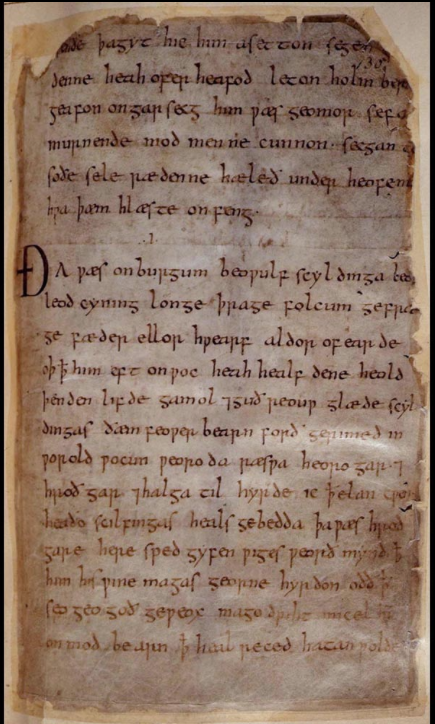
Now, the British Library’s digitization of that sole manuscript allows us to peel back the layers of canonization and see how the poem first entered a literary tradition. Originally “passed down orally over many generations, and modified by each successive bard,” writes the British Library, Beowulf took this fixed form when “the existing copy was made at an unknown location in Anglo-Saxon England.” Not only is the location unknown, but the date as well: “its age has to be calculated by analyzing the scribes’ handwriting. Some scholars have suggested that the manuscript was made at the end of the 10th century, others in the early decades of the 11th, perhaps as late as the reign of King Cnut, who ruled England from 1016 until 1035.”
These scholarly debates may not interest the average reader much. The poem survived long enough to be written down, then became known as great literature these many centuries later, because the rich poetic language and the compelling story it tells captivate us still. Nonetheless, though we may all know the general outlines of its hero’s contest with the monster Grendel and his mother, many of the cultural concepts from the world of Beowulf strike modern readers as totally alien. Likewise the poem’s language, Old English, resembles no form of English we’ve encountered before. Scholars like J.R.R. Tolkien and poets like Heaney have done much to shape our appreciation for the ancient work, and we might say that without their interventions, it would not live, as Heaney writes, “in its own continuous present” but in a distant, unrecognizable past.
In 1969, Laurence J. Peters, a professor at the University of Southern California, published the bestselling book, The Peter Principle: Why Things Always Go Wrong, where he advanced this theory: “In a hierarchy every employee tends to rise to his level of incompetence … in time every post tends to be occupied by an employee who is incompetent to carry out its duties.” Meanwhile, the real work gets “accomplished by those employees who have not yet reached their level of incompetence.”
Above, Adam Westbrook offers a short introduction to “The Peter Principle” and its corollary, the concept of “creative incompetence.” If you take “The Peter Principle” seriously, you’ll know that not all promotions are good ones. As you move upward, you might find that you’re dealing with more headaches .… and less work that you truly enjoy. To preempt the bad promotion, Peters suggested (somewhat light-heartedly) engaging in some “creative incompetence”–that is, creating “the impression that you have already reached your level of incompetence. Creative incompetence will achieve the best results if you choose an area of incompetence which does not directly hinder you in carrying out the main duties of your present position.” In short, find the job you really like, do it well, but give your boss the occasional oddball reason not to mess with a good thing.
Got examples of your own creative incompetence to recommend? Feel free to add them in the comments below.
If you would like to sign up for Open Culture’s free email newsletter, please find it here. It’s a great way to see our new posts, all bundled in one email, each day.
If you would like to support the mission of Open Culture, consider making a donation to our site. It’s hard to rely 100% on ads, and your contributions will help us continue providing the best free cultural and educational materials to learners everywhere. You can contribute through PayPal, Patreon, and Venmo (@openculture). Thanks!
How to understand a country as enormous, as culturally and economically productive, and as contradictory and frustrating as the United States of America? As an American myself, I’m here to tell you that there’s no shortcut. I live abroad, and distance has provided me a helpful new perspective, but my curiosity about how my homeland turned out like it did remains strong. That same curiosity possesses many an American and non-American alike, and they all can satiate at least some of it by watching episodes of the PBS documentary series American Experience available free online. Note: We have a list of streamable episodes down below.
Since premiering at The American Experience on October 4, 1988 with an episode on the great San Francisco earthquake of 1906, the article may have fallen away, but the in-depth exploration of U.S. history has continued apace. While hardly formulaic, the episodes do tend start with a particular event, place, or individual that time has rendered iconic. And so, at the top of the post, we have the American Experience portrait of Thomas Edison, the “holder of more patents than any other inventor in history” who grew rich and famous “as the genius behind such revolutionary inventions as sound recording, motion pictures, and electric light.”
Edison has indeed come to represent the American archetype of the self-made millionaire whose sheer ingenuity would improve lives across the country, and ultimately the world. But the coin has, as always, another side: how much of Edison’s success owes to his own hard work, and how much owes to his combination and marketing of the work of others? (Similar questions have continued to swirl around more recent larger-than-life figures in American business, not least Steve Jobs.) Another fascinatingly complicated legacy, as well as quite possibly America’s most scrutinized life and death, comes in for the American Experience treatment in the series’ four-hour episode on John F. Kennedy.
In addition to these stories of American personalities, the online archive also has stories of American places like Mount Rushmore, American achievements like space travel, American eras like the year 1964, and even pieces of American infrastructure like Penn Station. And of course, given the insatiable American appetite for presidential biographies, such commanders-in-chief as Jimmy Carter, Ronald Reagan, and Bill Clinton also have their own episodes. But viewers outside America should note that, because of geographical rights restrictions, not all these videos may stream for them. Since I live outside America myself, I’ve got the same problem, but then again, I’ll also have some binge-watching (and cultural reintroduction) material on my next trip back.
“For average prospective house owners the choice between the hysterics who hope to solve housing problems by magic alone and those who attempt to ride into the future piggy back on the status quo, the situation is confusing and discouraging.” Those words, as much as they could describe the situation today, actually came printed in Arts & Architecture magazine’s issue of June 1945.
“Therefore it occurs to us that the only way in which any of us can find out anything will be to pose specific problems in a specific program on a put-up-or-shut-up basis.” What the magazine, at the behest of its publisher John Entenza, put up was the Case Study Houses, which defined the ideal of the midcentury modern American home.
More specifically, they defined the ideal of the midcentury modern southern Californian home. Los Angeles provided a promising environment for many of the formidable European minds who came to America around the Second World War, including writers like Aldous Huxley, composers like Arnold Schoenberg, and philosophers like Theodor Adorno. Architects, such as the earlier arrival Richard Neutra, especially thrived in the young city’s vast space and under its bright sun, giving shape to a new kind of twentieth-century house, one influenced by the rigorously clean aesthetics of the German Bauhaus movement but adapted to a much friendlier climate, both in terms of the weather and the freedom from strict tradition.
Even if you don’t know architecture, you know the Case Study houses from their countless appearances in movies, television, and print over the past seventy years. Sooner or later, everyone sees an image of Neutra’s Stuart Bailey House, Charles and Ray Eames’ Eames House, or Pierre Koenig’s Stahl House. The decades have turned these and other houses from the peak of midcentury modernism into priceless architectural treasures — or at least extremely high-priced architectural treasures. Some open themselves to tours now and again, but very few of us will ever have a chance to experience these houses as not quasi-museums but actual livable spaces.
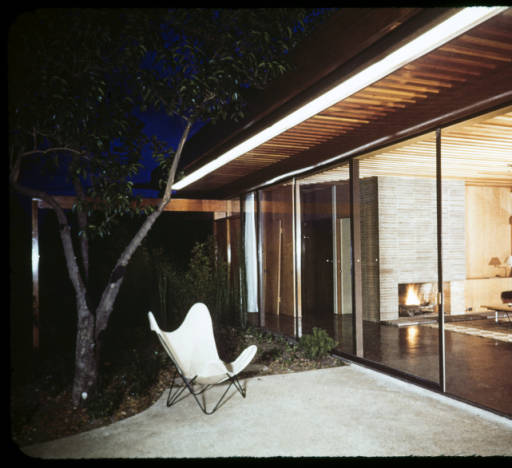
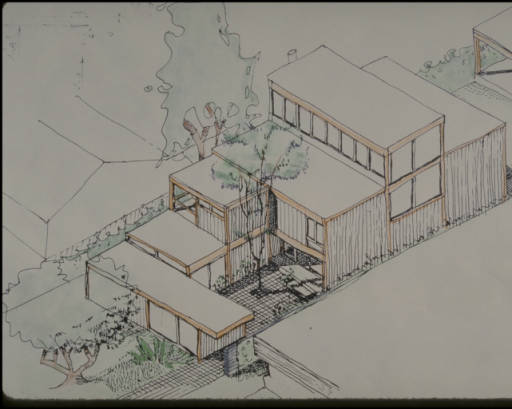
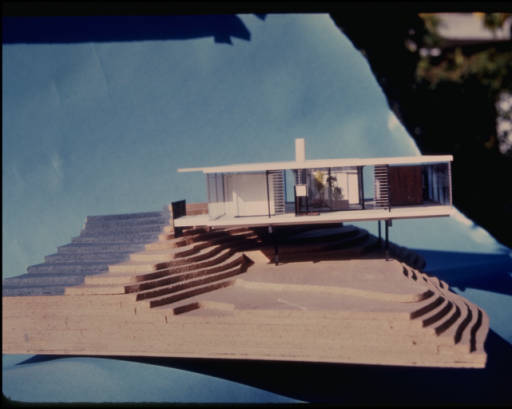
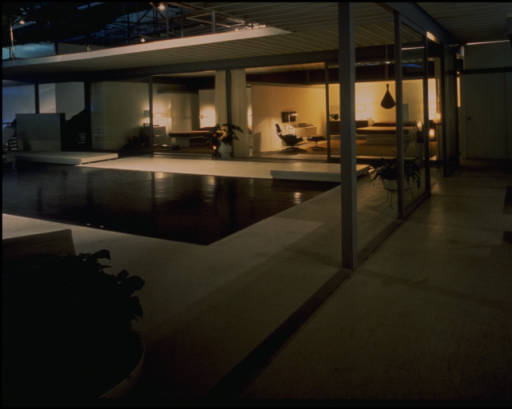
Now we have the next best thing in the form of the University of Southern California’s Architectural Teaching Slide Collection, which collects about 1300 rarely seen photographs of midcentury modern houses shot all over the western United States from the 1940s to the 1960s by Koenig himself, along with his colleague Fritz Block, who also happened to own a color slide company. “Instead of the polished tableaus you might find in the pages of Architectural Digest,” writes Hyperallergic’s Carey Dunne, “these spontaneous snapshots capture quirky and more intimate views.” Koenig and Block captured these houses “with an architect’s geometrically minded and detail-oriented eye, never presenting them as mere real estate.” The archive also offers images of models, blueprints, and other such technical materials.
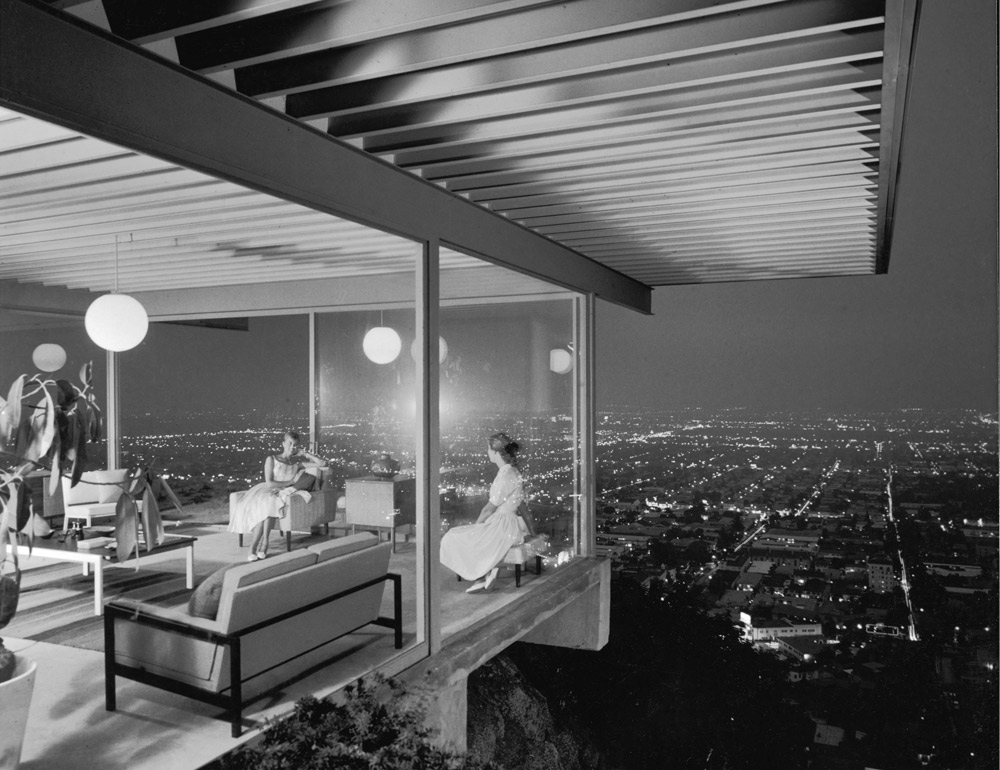
Arts & Architecture meant to commission ideas for the everyman’s house of the future, “subject to the usual (and sometimes regrettable) building restrictions,” “capable of duplication,” and “in no sense… an individual ‘performance.’ ” Yet American midcentury modern houses, from the Case Study Program or elsewhere, all came out as individual performances, but also the first works of architecture many of us get to know as works of art. And the work of architectural photographers like Julius Shulman, especially his iconic shot of the Stahl House high above the illuminated grid of Los Angeles, has done much to instill in viewers a reverence suited to art. A collection of non-standard views like these, though, reminds us that even the most visionary house is a real place. Enter the USC archive here.
We're hoping to rely on loyal readers, rather than erratic ads. Please click the Donate button and support Open Culture. You can use Paypal, Venmo, Patreon, even Crypto! We thank you!
Open Culture scours the web for the best educational media. We find the free courses and audio books you need, the language lessons & educational videos you want, and plenty of enlightenment in between.