You’ve seen buildings magically transformed into artistic canvases before — the Astronomical Clock Tower in Prague; the iconic buildings at Cambridge University; and then this facade in Ukraine. But have you seen the audience take control of the architectural painting? That’s what happened in Lyon, France during the “Fête des lumières,” held last December. Throw an audio analysis algorithm and a microphone into the mix, and the audience now drives the surreal architectural show…
In 1945 Alfred Hitchcock had to explain one of Hollywood’s unwritten rules to Salvador Dali: No, you can’t pour live ants all over Ingrid Bergman! Hitchcock had approached Dali for help with a dream sequence in his upcoming thriller, Spellbound, starring Bergman and Gregory Peck. He was unhappy with the fuzziness of Hollywood dream sequences. “I wanted to convey the dream with great visual sharpness and clarity–sharper than film itself,” Hitchcock recalled in his 1962 interview with François Truffaut. “I wanted Dali because of the architectural sharpness of his work. Chirico has the same quality, you know, the long shadows, the infinity of distance and the converging lines of perspective. But Dali had some strange ideas. He wanted a statue to crack like a shell falling apart, with ants crawling all over it. And underneath, there would be Ingrid Bergman, covered by ants! It just wasn’t possible.”
This clip permanently resides in our collection of Cultural Icons, which lets you see/hear great cultural figures in video & audio. And don’t miss our collection of Free Hitchcock movies.
If you would like to support the mission of Open Culture, consider making a donation to our site. It’s hard to rely 100% on ads, and your contributions will help us continue providing the best free cultural and educational materials to learners everywhere. You can contribute through PayPal, Patreon, and Venmo (@openculture). Thanks!
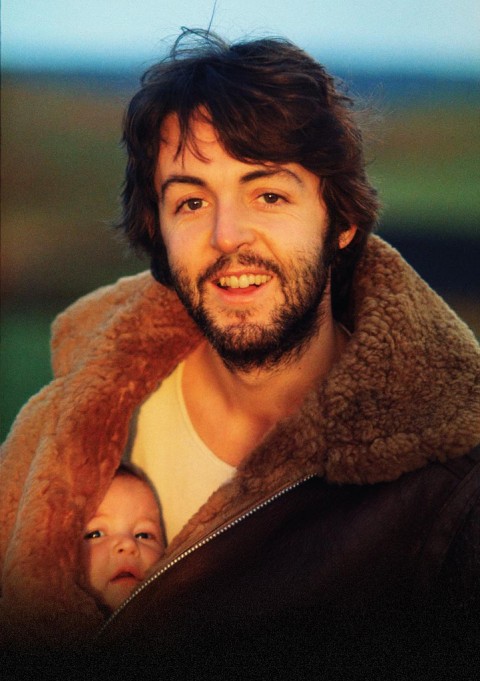
In 1967, a young Linda Eastman went to London to photograph the “Swinging Sixties” and snagged exclusive photos of The Rolling Stones, Eric Clapton and Jimi Hendrix. In the midst of it all, she met Paul McCartney, and when the two married in 1969, she had a fixed place within rock ‘n roll’s inner circle.
During the coming decades, she took over 200,000 images. Yes, that means many more photographs of rock stars and artists. But the emphasis also shifted inward, to a new domestic life with Paul and their children — Heather, Mary, Stella, and James. Years later, as Paul prepares to marry again, the photographic work of Linda McCartney (1941–1998) has been published in a 288-page retrospective volume called Linda McCartney: Life in Photographs. It features a forward by Paul and some commentary by Annie Leibovitz. An impressive sampling of Linda McCartney’s work can be previewed on this web site.
Earlier this year, Google rolled out “Art Project,” a tool that lets you access 1,000 works of art appearing in 17 great museums across the world, from the Met in New York City to the Uffizi Gallery in Florence. (More on that here.) Now, as part of a broader effort to put art in your hands, the company has produced a new smartphone app (available in Android and iPhone) that enriches the museum-going experience, and it’s being demoed at the Getty Museum in Los Angeles.
The concept is pretty simple. You’re wandering through the Getty. You spot a painting that deeply touches you. To find out more about it, you open the Google Goggles app on your phone, snap a photo, and instantly download commentary from artists, curators, and conservators, or even a small image of the work itself. Sample this, and you’ll see what we mean. And, for more on the story, turn to Jori Finkel, the ace arts reporter for the LA Times.
In 1982, Danish filmmaker Jørgen Leth directed 66 Scenes from America, a film that stitched together a series of lengthy shots, each a visual postcard from a journey across America. And, taken together, you have a tableau of the American experience.
Along the way, the pop artist Andy Warhol makes his appearance. The man who coined the expression “15 Minutes of Fame” takes four minutes to eat a hamburger, mostly without saying a word. And simply because of his fame, we watch … and watch. About this scene Leth gives a few details:
[Warhol] is told that he has to say his name and that he should do so when he has finished performing his action, but what happens is that the action takes a very long time to perform; it’s simply agonizing. I have to admit that I personally adore that, because its a pure homage to Warhol. It couldn’t be more Warholesque. That’s of course why he agreed to do it.
This was presumably not a paid placement by Burger King.
If you would like to support the mission of Open Culture, consider making a donation to our site. It’s hard to rely 100% on ads, and your contributions will help us continue providing the best free cultural and educational materials to learners everywhere. You can contribute through PayPal, Patreon, and Venmo (@openculture). Thanks!
The Elements of Creativity. They come down to this: Copy. Transform. Combine. Nothing is truly original. Everything is a remix, more or less.
Director Kirby Ferguson first traced this idea through literature and music, then through filmmaking. Next up? Technology, computers and user interface. Above we have the third and penultimate installment in the “Everything is a Remix” series. (You can watch it in large format here.) Look for the final segment to appear this fall, and consider supporting the project here.
It was another time, another place, a moment when criminals were invited to pose for the camera. The mugshot as an art form.
Above we have one of 2500 “special photographs” taken by photographers from the New South Wales Police Department between 1910 and 1930. The four men (Hampton Hirscham, Cornellius Joseph Keevil, William Thomas O’Brien and James O’Brien) were arrested on charges of burglarizing the home of a bookie — one Reginald Catton — in April 1921. O’Brien was let off the hook, but the other three dapper ones weren’t so lucky.
Arkansas-born artist Shea Hembrey kicks off his TED talk by confessing to a hick childhood in which he and his sister “would compete to see who could eat the most squirrel brains.” That modest joke sets the stage for his introduction of Seek, a project Hembrey conceived in response to his disappointment with several exhibits of contemporary art in Europe, including the Venice Biennale. Finding much of the work he encountered too obtuse and inaccessible, Hembrey decided to create an international biennial of his own, featuring the 100 most inspiring artists he could find.
The twist, of course, is that all 100 artists (and artworks) were created by Hembrey himself, in strict accordance with two personal criteria: First, the work must be something he could explain to his grandma in less than five minutes; next, its process must engage the three “H’s” of head, heart, and hand.
All 100 pieces feature distinct materials, character and craft, and taken together they provide an impressive showcase for Hembrey’s humor and virtuosity. But that grandma of his had better be hiding a degree in semiotics, or at least an old copy of the The Postmodern Condition, because the success of Seek’s joke is largely dependent on our knowledge of the world it lampoons. And for all the determined folksiness of his manifesto, the position Hembrey stakes out — somewhere between parody and homage — would not be unfamiliar to the curators of the Venice Biennale.
Sheerly Avni is a San Francisco-based arts and culture writer. Her work has appeared in Salon, LA Weekly, Mother Jones, and many other publications. You can follow her on twitter at @sheerly.
We're hoping to rely on loyal readers, rather than erratic ads. Please click the Donate button and support Open Culture. You can use Paypal, Venmo, Patreon, even Crypto! We thank you!
Open Culture scours the web for the best educational media. We find the free courses and audio books you need, the language lessons & educational videos you want, and plenty of enlightenment in between.