From last night’s White House Correspondents’ Dinner. (Also get Wanda Sykes’ standup appearance here. Rather funny.)
These clips come from CSPAN’s YouTube Channel, which is included in our Intelligent YouTube Video Collection
From last night’s White House Correspondents’ Dinner. (Also get Wanda Sykes’ standup appearance here. Rather funny.)
These clips come from CSPAN’s YouTube Channel, which is included in our Intelligent YouTube Video Collection
The most popular article in yesterday’s New York Times was an Op-Ed calling for a thoroughgoing overhaul of the traditional university. For Mark Taylor (chairman of the religion department at Columbia University), it’s time to get rid of the mass-production university model — the university that builds walls between disciplines, encourages academics to work on often irrelevant topics, and produces an ongoing glut of graduate students, who work as cheap laborers, then have difficulty finding full-time teaching jobs. So what’s the solution? Taylor proposes six ideas: 1) Getting rid of free-standing academic departments and making academic work cross-disciplinary, 2) developing multi-disciplinary programs that focus on “real” problems, 3) increasing collaboration among institutions, partly with the help of the internet, so that universities don’t have to develop redundant strengths, 4) moving away from traditional, citation-packed dissertations and instead having grad students communicate their research in more contemporary digital formats, 5) helping grad students plan for a life beyond scholarship itself, and 6) imposing mandatory retirement and abolishing tenure, essentially in order to keep faculty responsive and productive.
What Taylor is suggesting is not entirely new. These ideas have been floating around for some time. But they’re packaged well, and they drive home the point that universities, like so many other traditional institutions (newspapers, book publishers, fossil fuel-based energy systems, General Motors, etc), are increasingly feeling outdated. Or, put differently, they’re not responding to rapid changes in technology and the global economy. There’s an older generation that likes these institutions pretty much as they are. And that generation now runs them. Then, there’s a younger generation learning to do things in different ways. And we’re left to wonder: How long will it take for these institutions to catch up? Or will they simply get outflanked by something new? As always, love to hear your thoughts.
| The Daily Show With Jon Stewart | M — Th 11p / 10c | |||
| We Don’t Torture | ||||
|
||||
Here’s Jon Stewart talking Monday night about the revelation that America’s “extreme interrogation” techniques actually amount to torture. Somehow he manages to work The New York Review of Books, The Paris Review, McSweeney’s and The Utne Reader into the discussion. You’ll find it about 4 minutes in. Pretty funny stuff, although the commentary is sad when you get right down to it.
On a more serious note, Rahm Emanuel (highlighted in the video above) was almost certainly referencing excellent Mark Danner’s work in the NYRB, which you can find here.
The direct link to the Stewart video can be found here.
A quick heads up: The three-day Aspen Environment Forum is now underway, and it has gathered an impressive number of speakers (energy experts, government & business leaders, writers, photographers, and other thinkers) to take a serious look at our environmental challenges and the possible solutions. You can find video highlights from each day here, and you can also find live coverage on this National Geographic Blog.
It’s not often than a song gets written for an economics professor. It’s so bad that it’s actually good. Add that to the soundtrack for the Collapse.
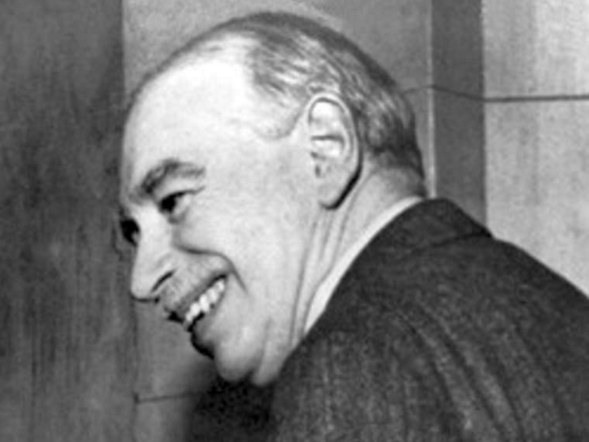
Image via Wikimedia Commons
Once the Fed’s toolbox proved unable to stop the cascading global financial meltdown, the US government turned to the one strategy that it had left. It dusted off the old economic playbook of John Maynard Keynes and began introducing massive stimulus plans and other forms of government intervention. Since our collective fate now depends on Keynesian theory holding water, it seems worth bringing you a primer on Keynes and his style of economic thinking. And that’s what you get with this segment from This American Life. The segment (get the full episode here and then move to the 38th minute) tells you a little about his complex personality. (As they put it, you could make two movies about him — one that features “Keynes the statesman, advising presidents and prime ministers, furiously writing up papers that changed the direction of modern intellectual thought. Another movie would pretty much be a gay porno …” He was sexually too “out there” for even the envelope-pushing Bloomsbury Group.) Through interviews with various economists, the program then overviews the central tenets of Keynesian economics, and discusses Keynes’ influence over later generations of economists. During the 1940s, 50s and 60s, Keynesianism was all the rage, then it declined and almost disappeared during the 70s. Now it’s back, perhaps stronger than ever. My completely intuitive guess is that Keynesianism will alleviate some of the financial strains — it will keep more people working, which is good — but it will also lengthen the recession, bring about new problems (inflation and new bubbles), and prevent us from seriously addressing the problems that got us into this mess. Keynesianism may be the humane and necessary way to go, but don’t expect perfection, or anything close. In the meantime, if you want more blogs and podcasts that track the financial crisis, then please see our handy list.
It’s time to put a human face on the disheartening economic statistics that we’re hearing almost daily. This video features students from a Southern California high school talking candidly (and without scripts) about how the economic collapse has affected their day-to-day lives. Unemployment, parents leaving the family, homelessness, scarce food — it’s all part of the reality they’re now living. Fittingly, this video project grew out of an AP lit class (more on the backstory here) that happened to be reading F. Scott Fitzgerald’s The Great Gatsby. There’s nothing like a good tale of materialism and decadent morality to get struggling kids talking.
There’s something of a happy ending to this story. This video made its way to Washington, and it resulted in President Obama visiting the school last week during his trip to California. So, yes, someone is listening. But how much will it really change the lot of these kids?
Lastly, you may want to check out this photo gallery called Scenes from Recession. It offers “some glimpses of the places and lives affected by what some are calling the Great Recession.” Stunning and depressing stuff, to be sure. But that’s our world.
Stay with me conservatives on this one. It’s not as bad as you think…
NPR’s Intelligence Squared (iTunes — Feed — Web Site) has a rather unique format. It brings Oxford-style debates to America, and it features leading thinkers taking different positions on hot-button issues of our day. (Get more precise details on the debate format here.) Recent debates have centered on the following questions: Is Washington or Wall Street ultimately to blame for the financial crisis? Should we legalize the market for human organs? Is the US finally winning the war in Iraq? And then, is George W. Bush the worst president of the last 50 years?
The GWB debate brings together a pretty solid panel. Arguing against the Bush legacy: Jacob Weisberg (Editor in Chief of Slate) and Simon Jenkins (columnist for the Guardian and the Sunday Times). Then, for the Bush legacy: Karl Rove (the all important Bush strategist) and Bill Kristol (editor of The Weekly Standard and former columnist for The New York Times). As you’ll see, it’s a pretty spirited conversation. Have a listen and let us know where you come down: iTunes — Feed — Stream.
As a quick note, the Intelligence Squared podcast can be permanently found in our Ideas & Culture Podcast Collection.


Open Culture scours the web for the best educational media. We find the free courses and audio books you need, the language lessons & educational videos you want, and plenty of enlightenment in between.

©2006-2026 Open Culture, LLC.
All rights reserved.

