If you would like to support the mission of Open Culture, consider making a donation to our site. It’s hard to rely 100% on ads, and your contributions will help us continue providing the best free cultural and educational materials to learners everywhere. You can contribute through PayPal, Patreon, and Venmo (@openculture). Thanks!
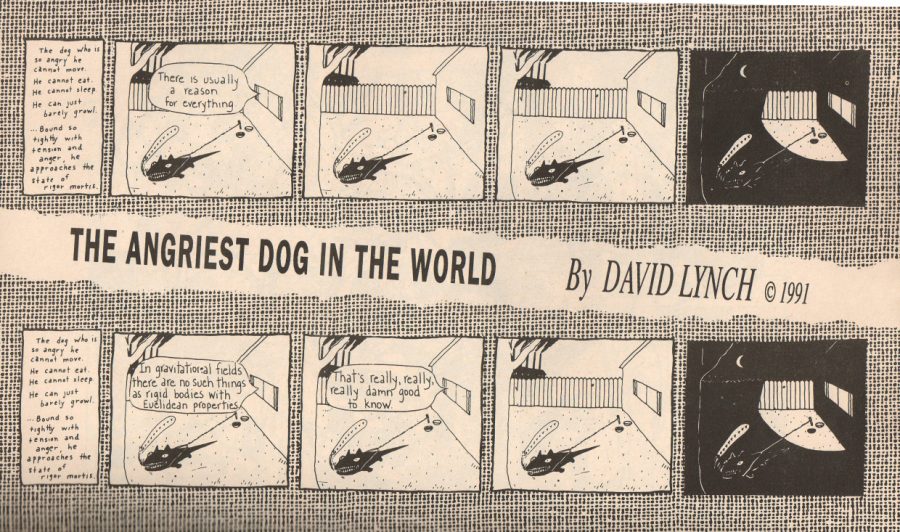
Most David Lynch fans discover him through his films. But those of us who read alternative weekly newspapers in their 1980s and 90s heyday may well have first encountered his work in another medium entirely: the comic strip. Like many of the best-known examples of the form, Lynch’s comic strip stars an animal, specifically a dog, but a dog “so angry he cannot move. He cannot eat. He cannot sleep. He can just barely growl. Bound so tightly with tension and anger, he approaches the state of rigor mortis.” That text, which prepared readers for a reading experience some way from Marmaduke, introduced each and every edition of The Angriest Dog in the World, which ran between 1983 and 1992.
During that entire time, the strip’s artwork never changed either: four panels in which the titular dog strains against a rope staked down in a suburban backyard, in the last of which night has fallen. The sole variation came in the word bubbles that occasionally emerged from the window of the house, presumably representing the voice of the dog’s owners.
You can see a few examples at Lynchnet and also on this blog. “If everything is real… then nothing is real as well,” it says one week. On another: “It must be clear to even the non-mathematician that the things in this world just don’t add up to beans.” Or, in a nod to the region of The Angriest Dog in the World’s home paper the LA Reader: “Bill… who is this San Andreas? I can’t believe it’s all his fault.”
“At some point David Lynch called up the editor at the time, James Vowell, and said, ‘Hi, I’d like to do a comic strip for you,’” says former Reader editor Richard Gehr as quoted by John F. Kelly at Spooky Comics. Every week thereafter, Lynch would phone the Reader to dictate the text of the latest strip. “We would give it to somebody in the production department and they would White Out the panels from the week before and write in a new, quote/unquote… gag.” The clip from The Incredibly Strange Film Show’s 1990 episode on Lynch above shows the evolution of the process: someone, one of Lynch’s assistants or perhaps Lynch himself, would regularly slip under the Reader’s office door an envelope containing word balloons written and ready to paste into the strip. (Dangerous Minds finds aninterview where Vowell describes another production method altogether, involving wax paper.)
Lynch came up with the words, but what about the images? “I assume he drew the first iteration,” says Gehr as quoted by Kelly. “I don’t even know if the second and third [panels] were hand drawn. Those could have been mimeographed too or something.” The style does bear a resemblance to that of the town map Lynch drew to pitch Twin Peaks to ABC. The attentive fan can also find a host of other connections between The Angriest Dog in the World and Lynch’s other work. That factory in the background, for instance, looks like a place he’d photograph, or even a setting of Eraserhead, during whose frustrating years-long shoot he came up with the strip’s concept in the first place. “I had tremendous anger,” says Lynch in David Breskin’s book Inner Views. “And I think when I began meditating, one of the first things that left was a great chunk of that.” If only the Angriest Dog in the World could have found it in himself to do the same.
Based in Seoul, Colin Marshall writes and broadcasts on cities and culture. His projects include the book The Stateless City: a Walk through 21st-Century Los Angeles and the video series The City in Cinema. Follow him on Twitter at @colinmarshall or on Facebook.
Have you ever worked as an “extra” on a film or television shoot, one of the anonymous many somewhere in the background while the main characters advance the story up front? If so, you know that to be seen but not heard onscreen requires doing exactly that. Even though a crowded party scene, for instance, really does sound like a crowded party scene in the final product, the shoot happens in something close to silence. Only the stars speak, and indeed make any sound at all; everyone else just mimes their lively conversations. Sound designers add the crowd noise later, after the shoot, just like they add music, footsteps, doors opening and closing, crackling of fires and the whipping of winds, and pretty much every other sound you hear besides speech.
“The Magic of Making Sound,” the Great Big Story video above, reveals the work of Foley artists, some of the most little-known craftsmen in the entertainment industry. We usually think of realism as a primarily visual quality, praising something that “looks real” almost as often as we complain about what “looks fake,” but much of what makes dramatic action onscreen feel real happens on a completely unseen level.
Foley artists (named for early sound-effects designer Jack Foley) create all the incidental sounds you’d expect to hear in real life, so if and only if they do their work well, nobody in the audience will notice it. (Minimal Foley work, combined with dialogue dubbed in a studio instead of recorded during the shoot, contributes greatly to the “dreamlike” quality of some older films, especially from Europe and Asia.)
The Great Big Story video, along with the short profile of veteran Hollywood Foley artist Gary Hecker just above, show masters of the trade employing a variety of its tools: bags of corn starch for snow, gloves with paperclips taped to the fingertips for dog paws, and for that inevitable (if implausible) schwing of a sword being unsheathed, a kitchen spatula. Just like visuals, sound requires a certain degree of not just imagination but exaggeration to achieve that “larger than life” feeling. Still, the Foley craft has its origins in nothing more grand than the sounds made by hand to accompany radio dramas in the 1920s. The profession may have moved on from the coconut-shell horse hooves of nearly a century ago — these videos show the current industry standard, a jerry-rigged looking device made of plunger cups — but most of its equipment has remained reliably unchanged. How many other kinds of film-and-television technicians can say the same?
Based in Seoul, Colin Marshall writes and broadcasts on cities and culture. His projects include the book The Stateless City: a Walk through 21st-Century Los Angeles and the video series The City in Cinema. Follow him on Twitter at @colinmarshall or on Facebook.
“Talk of a movie about [Freddie Mercury], who died in 1991, has gone on for years: Dexter Fletcher came up as a potential director, and for the role of Mercury both Ben Wishaw and Sacha Baron Cohen have at different times been attached. But now the film has entered production, having found a director in Bryan Singer, he of the X‑Men franchise, and a star in Rami Malek, best known as the lead in the television series Mr. Robot.”
That’s how our Colin Marshall introduced a post last fall which, among other things, gave us a first unofficial glimpse of Rami Malek as Freddie Mercury. Now comes the first official glimpse of Malek as Mercury. Above, watch the newly-released trailer for Bohemian Rhapsody, the long-awaited biopic that explores 15 years in the history of Queen–from the formation of the band, to their captivating, career-defining 1985 performance at Live Aid, previously featured on our site here.
Enjoy the trailer, and look for Bohemian Rhapsody to hit theaters on November 2.
In brief surveys of film history, the eye-popping process known as Technicolor seems to emerge fully-formed in the 1930s and 40s with classics like Gone with the Wind and The Wizard of Oz, movies so vivid they almost exemplify the phrase “eye candy” with a “richer, color-flooded version of the real world,” writes Adrienne LaFrance at The Atlantic. This golden age of Technicolor, with its “supersaturated aesthetic… created films punctuated by colors so electric they were surreal.”
But like any new technology, color film, and the Technicolor process in particular, followed a long trajectory of trial and error involving many an ambitious failure and many early attempts now lost to history. One such film, 1917’s The Gulf Between, considered the first Technicolor film, employed one of the earliest, two-color versions of the process. Surviving now only in very short fragments, the 58-minute production was “expensive and hard on the eyes,” notes Richard Trenholm at Cnet, “a critical and artistic flop” and “a commercial one, too.”
Technicolor scientists and filmmakers refused to give up on the process, laboring mightily throughout the 1920s to figure out the exact elements needed to connect with moviegoers. Most problematically, the two-color process could not reproduce believable blues, purples, or yellows. As James Layton, co-author of The Dawn of Technicolor, tells The Atlantic, “skies would never reproduce accurately, and water wouldn’t…. There are some great examples. A beach scene… where the sky is this very vivid green, it’s very unnatural.”
One herculean effort to make Technicolor a hit came from Douglas Fairbanks, whose painstaking 1926 film The Black Piratemade artistic use of the process’s limitations, taking inspiration from the Dutch masters to achieve a sense of depth. In 1970, the British National Film Archive began a restoration (see some clips above, with a 70s-sounding soundtrack overlaid).
Fairbanks’ film remains one of only a handful of Technicolor films from the period that has survived in full into the present, likely because it represents one of the few commercial successes. But just last month, Jane Fernandes, a British Film Institute (BFI) conservationist, discovered several snippets of many more 1920s Technicolor films taped to the beginnings and ends of reels from a copy of The Black Pirate donated to BFI in 1959.
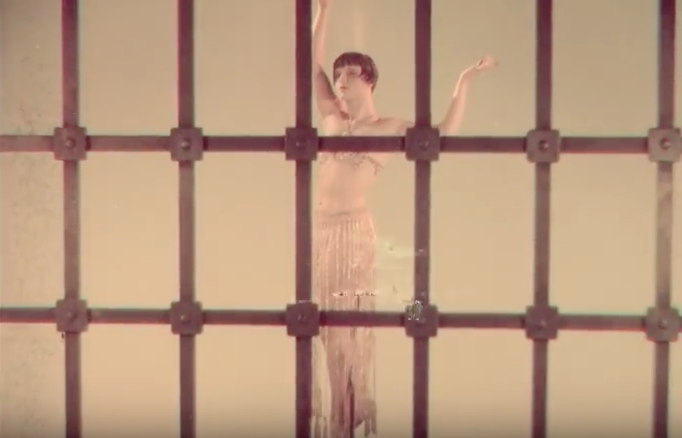
These fragments include a very brief shot of silent icon Louise Brooks in color (at the 1:11 mark), from the lost 1926 film The American Venus, her first feature. Also included in the find are short clips from other Technicolor films made that same year, The Far Cry, The Fire Brigade, and Dance Madness, as well as a test shot from the historical drama Mona Lisa, starring L.A. Times gossip columnist Hedda Hopper as Leonardo da Vinci’s enigmatic model.
You can see these prized snippets in the video at the top of the post, with narration from BFI curator Bryony Dixon. “Another batch of extracts,” reports Smithsonian.com, “was found taped to ads for a North London television shop that ran before and between movies in the 1950s. They include scenes from early Technicolor musicals that came out in 1929 including Sally, Gold Diggers of Broadway, Show of Shows and On with the Show!”
In BFI’s April 30 press release announcing these rare finds, Dixon compares them to “an Egyptian vase shattered into pieces and the shards scattered across museums all over the world…. For now we have the shards but we can dream of seeing Louise Brooks’s first film or a lost Hedda Hopper in colour.” Future discoveries, as well as the latest restoration techniques, may soon return an expanded history of 1920s two-color Technicolor to scholars and film fans of the 21st century.
“Dada thrives on contradictions. It is creative and destructive. Dada denounces the world and wishes to save it.” So says one narrator of journalist-filmmaker Mick Gold’s Europe After the Rain, a 1978 Arts Council of Great Britain documentary on not just the international avant-garde movement called Dada but the associated currents of surrealism churning around that continent during the first half of the twentieth century. “Dada wanted to replace the nonsense of man with the illogically senseless. Dada is senseless, like nature. Dada is for nature, and against art. Philosophers have less value for Dada than an old toothbrush, and Dada abandons them to the great leaders of the world.”
Of the many bold and often contradictory claims made about Dada, none describe it as easily understood. But Dada has less to do with intellectual, aesthetic, or political coherence than with a certain energy. That energy could fire up the likes of André Breton, Salvador Dalí, René Magritte, Giorgio de Chirico, and many other artists besides, channeling frustrations with the state of post-World War I Europe into a sensibility that demanded ripping everything up and building it all again, beginning with the very foundations of sense.
Gold and his collaborators on Europe After the Rain understand this, audiovisually interpreting the legacy of Dada, which despite its short lifespan left behind a host of still-striking works in text, image, and sculpture, in a variety of ways.
“The movie is full of treasures,” writes Dangerous Minds’ Oliver Hall, including “BBC interviews with Max Ernst and Marcel Duchamp from the Sixties, a reading of Artaud’s ‘Address to the Dalai Lama,’ an account of Freud’s meeting with Dalí.” He adds that its “re-enactment of Breton’s dialogue with an official of the Parti communiste français is illuminating, and complements the other valuable material on the ‘Pope of Surrealism’: his work with shell-shocked soldiers in World War I, trials and expulsions of other Surrealists, collaboration with Leon Trotsky in Mexico, less-than-heroic contributions to the French Resistance, and study of the occult.” But then, the kind of mind that could launch a movement like Dada — which fifty years after its end remained fascinating enough to inspire a documentary that itself holds its fascination forty years on — is capable, one suspects, of anything.
Based in Seoul, Colin Marshall writes and broadcasts on cities and culture. His projects include the book The Stateless City: a Walk through 21st-Century Los Angeles and the video series The City in Cinema. Follow him on Twitter at @colinmarshall or on Facebook.
To casual viewers, most Japanese animation (at least apart from the elegant work of Hayao Miyazaki and his collaborators at Studio Ghibli) can look like a pretty unsophisticated and even disreputable affair, characterized by crude flashiness, convoluted storylines, and bizarre, sophomoric humor. All those things do, of course, exist in the realm of anime, but only because everything does: if Japan’s version of animation often rises above those of other cultures, it does so as a result of that culture regarding animation as simply cinema by other means. And any cinematic form will inevitably produce diverse virtuosity: to see how a master Japanese animator can have a sensibility completely different from that of Miyazaki, look no further than Satoshi Kon.
“Even if you don’t know his work, you have certainly seen some of these images,” says Every Frame a Painting’s Tony Zhou in the series’ video essay on Kon’s work, which includes the internationally acclaimed films Perfect Blue, Tokyo Godfathers, andPaprika.
“He is an acknowledged influence on both Darren Aronofsky and Christopher Nolan, and he has a fan base that includes just about everyone who loves animation.” The essay shows us how those two Western live-action auteurs, among Kon’s other fans, have borrowed his images for their own stories, just as Kon, in turn, drew a great deal of inspiration from a similarly unlikely source: George Roy Hill’s 1972 cinematic adaptation of Kurt Vonnegut’s novel Slaughterhouse-Five.
More specifically, Kon drew inspiration from the film’s inventive and surprising cuts from one scene to another, a formal reflection of its chronology-and-geography-jumping protagonist’s state of being “unstuck in time.” Throughout his decade-long feature filmmaking career, Kon “was constantly showing one image and then revealing that it wasn’t what you thought it was.” Kon died in 2010, having “pushed animation in ways that aren’t really possible in live action, not just elastic images but elastic editing, a unique way of moving from image to image, scene to scene.” His accomplishments live on not just in his own work, but in all the ways the creators who admire it continue to adapt his innovations for their own, even in the traditionally “respectable” forms of cinema.
Based in Seoul, Colin Marshall writes and broadcasts on cities and culture. His projects include the book The Stateless City: a Walk through 21st-Century Los Angeles and the video series The City in Cinema. Follow him on Twitter at @colinmarshall or on Facebook.
When you watch an animated film, you visit a world. That holds true, to an extent, for live-action movies as well, but much more so for those cinematic experiences whose audiovisual details all come, of necessity, crafted from scratch. Walt Disney understood that better than anyone else in the motion-picture industry, and none could argue that he didn’t capitalize on it. When they founded Studio Ghibli, Hayao Miyazaki and the late Isao Takahata — in the fine 20th-century Japanese tradition of borrowing Western ideas and then refining them nearly beyond recognition — took Disney’s deliberate world-building a step further, painstakingly crafting a look and feel for their productions that amounts to a separate reality: rich, coherent, and, for the millions of die-hard Ghibli fans all around the world, immensely appealing.
In a few years, those fans will get the chance to enter Ghibli’s world in a much more concrete sense. Disney’s insight that his audience would beat a path to an amusement park based on his studio’s movies led to Disneyland, Disney World, and their global successors, two of which, Tokyo Disneyland and Tokyo Disney Sea, now rank among the five most visited theme parks in the world.
The area of the Japanese capital already offers an acclaimed Ghibli experience in the form of the Ghibli Museum, but in just a few years the city of Nagakute, a suburb of Nagoya, will see the opening of Ghibli’s own version of Disneyland, a theme park filled with attractions based on the studios beloved films.
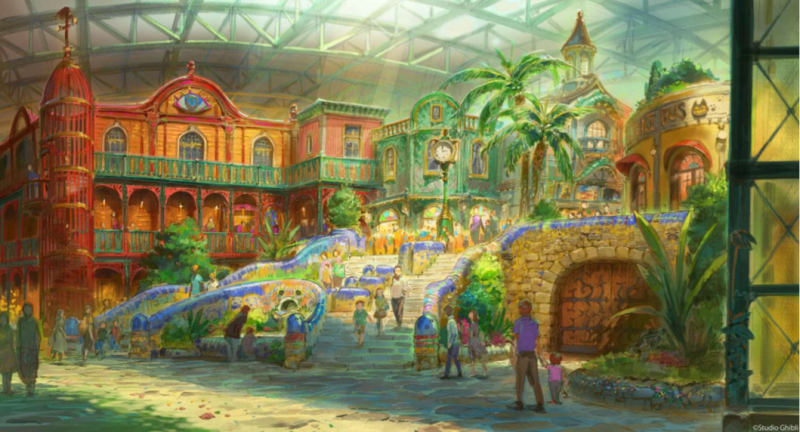
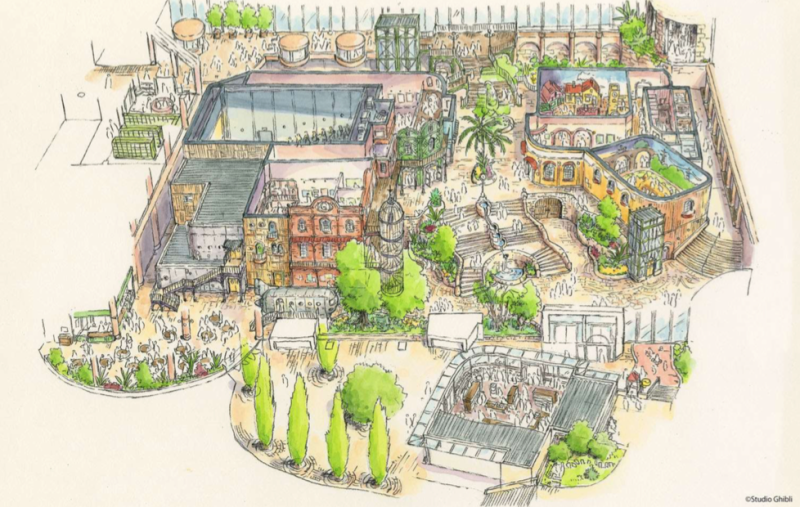
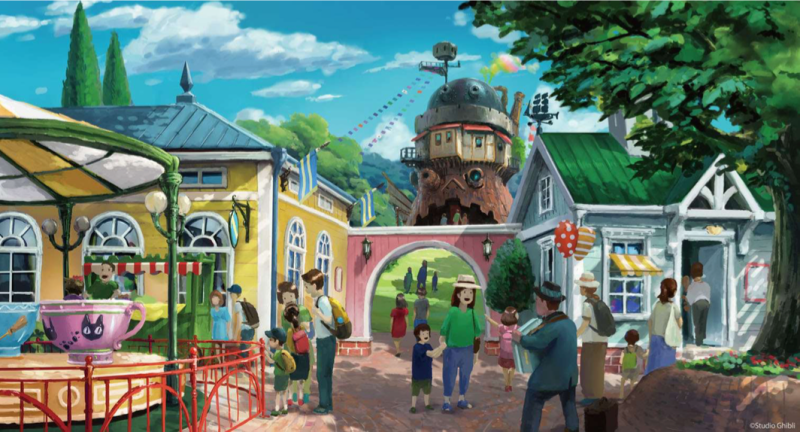
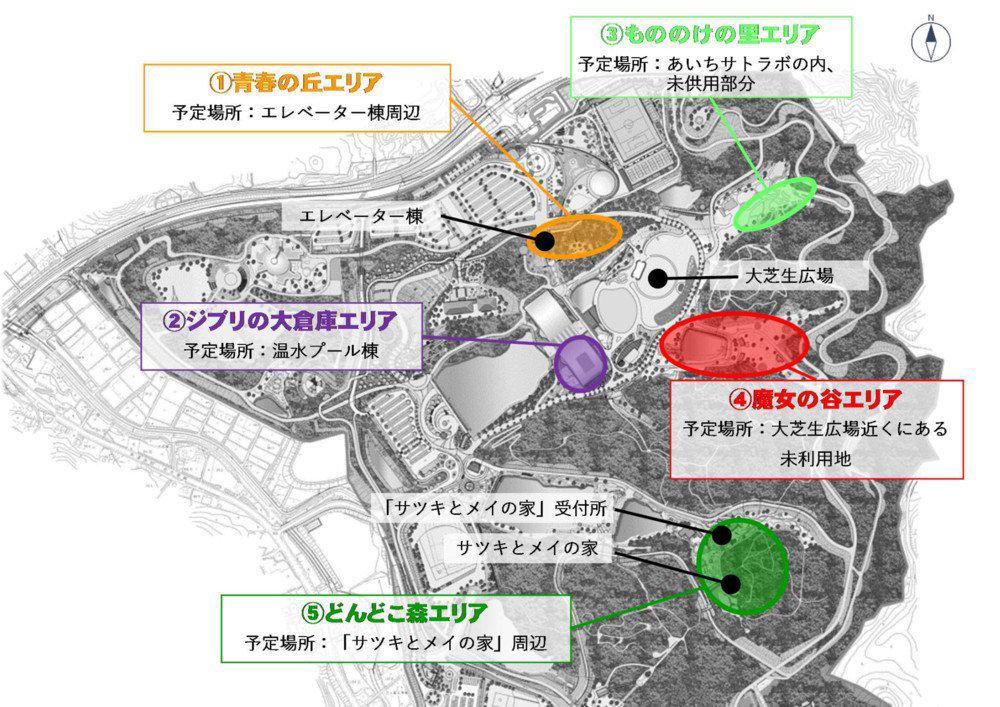
Scheduled to open in 2022 on the same plot of land used for the 2005 World’s Fair (where the house from My Neighbor Totoro was then built and still stands today), Ghibli’s theme park will greet visitors with a main gate reminiscent, writes Kotaku’s Brian Ashcraft, of “19th-century structures out of Howl’s Moving Castle as well as a recreation of Whisper of the Heart’s antique shop.”
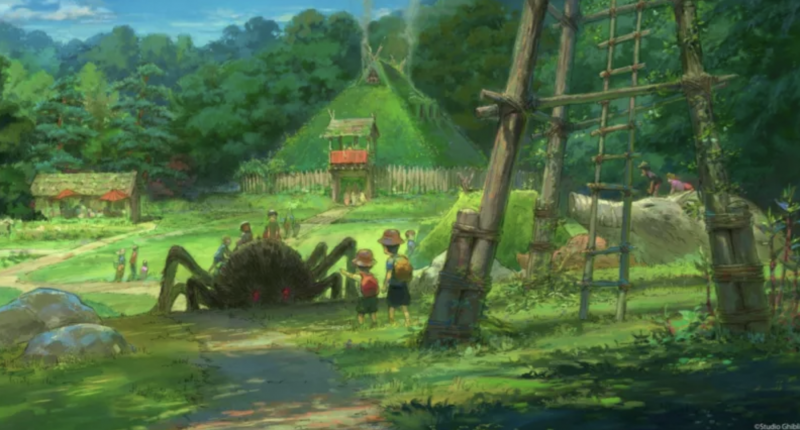
It also includes “the Big Ghibli Warehouse, which is filled with all sorts of Ghibli themed play areas as well as exhibition areas and small cinemas,” a Princess Mononoke village, a combined area for Howl’s Moving Castle and Kiki’s Delivery Service called Witch Valley, and the Totoro-themed Dondoko Forest. Will Studio Ghibli’s theme park rise into the ranks of the world’s most visited? Nobody who has yet visited their world, in any of its manifestations thus far, would put it past them.
Studio Ghibli has released some basic concept for the new theme park. You can get a few glimpses of what they have in mind on this page.
Based in Seoul, Colin Marshall writes and broadcasts on cities and culture. His projects include the book The Stateless City: a Walk through 21st-Century Los Angeles and the video series The City in Cinema. Follow him on Twitter at @colinmarshall or on Facebook.
We're hoping to rely on loyal readers, rather than erratic ads. Please click the Donate button and support Open Culture. You can use Paypal, Venmo, Patreon, even Crypto! We thank you!
Open Culture scours the web for the best educational media. We find the free courses and audio books you need, the language lessons & educational videos you want, and plenty of enlightenment in between.